
The Los Angeles Chargers’ offense seemingly has a lot of problems right now, but what’s the main issue?
Los Angeles controlled the ground game, won the time of possession battle, and still lost 26-14. The turnovers and route distribution issues tell a deeper story.

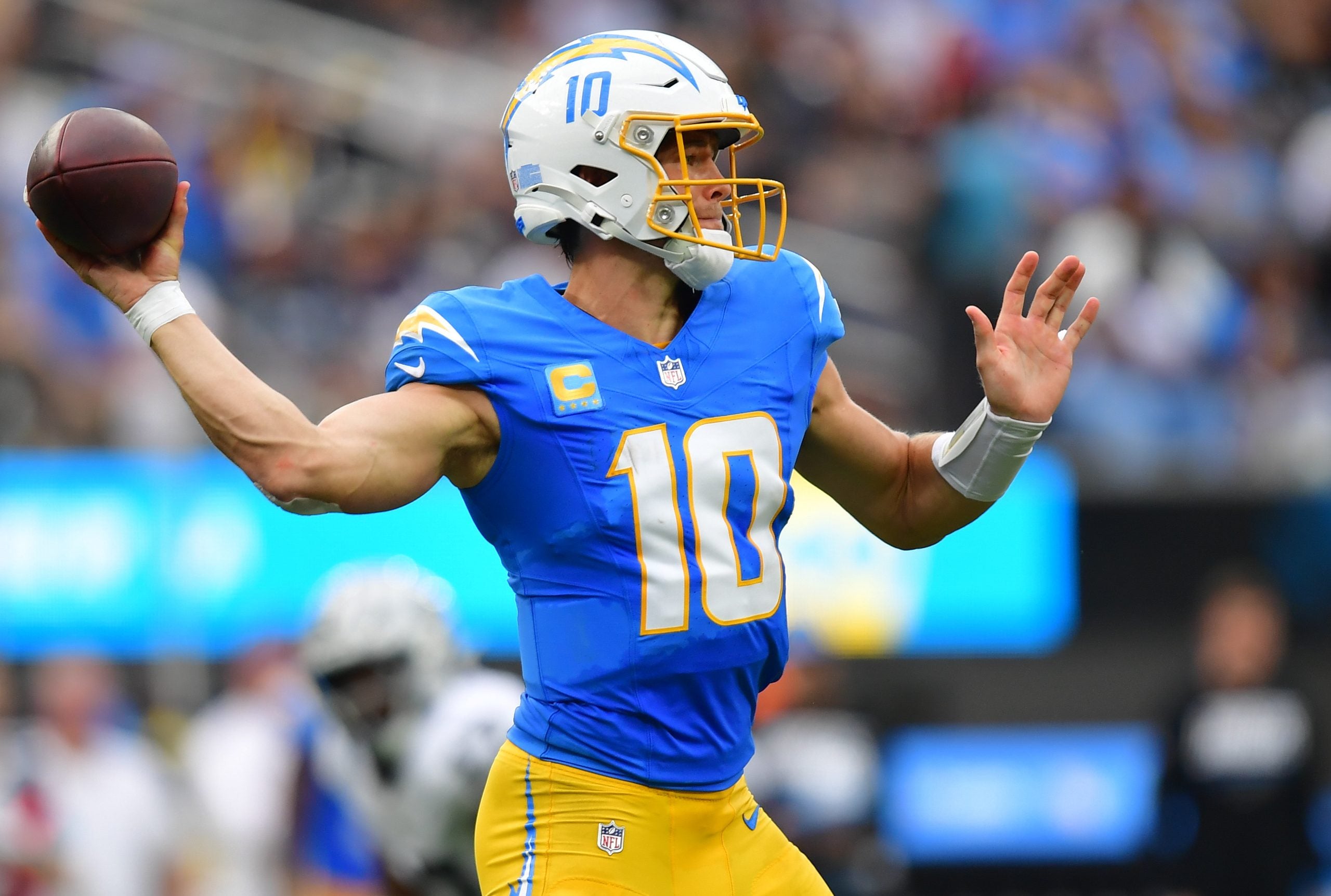
The Los Angeles Chargers’ 26-14 loss to the Las Vegas Raiders on Sunday was the kind of defeat that forces a team to take a hard look in the mirror.
On paper, Los Angeles dominated much of the game. The Chargers finished with more first downs, more total yards, better third-down efficiency and a significant advantage in time of possession. They also produced two and a half times as many rushing yards as the Raiders.
None of it mattered.
The Chargers turned the ball over twice, repeatedly failed in critical situations and made some of the most baffling offensive mistakes you will see from an NFL team. The result was a loss to a Raiders team that entered the season with considerably lower expectations but is now 2-0.
And while the defense has plenty of problems of its own, the biggest concern in Los Angeles might still be the offense.
The offense was supposed to carry this team
That is what makes the Chargers’ struggles so alarming.
The expectations surrounding this offense were enormous entering the season. Justin Herbert is one of the most physically talented quarterbacks in football, while offensive coordinator Mike McDaniel was expected to unlock another level from an offense built around Herbert’s arm talent and mobility.
Instead, the offense has looked more like a liability than the engine that was supposed to drive Los Angeles into the postseason. Sunday was the perfect example.
Herbert threw two interceptions, but the context surrounding the first one made the turnover particularly frustrating. Herbert did a nice job stepping up through pressure and found an open receiver coming back toward him along the right side of the field. One of his own receivers jumped in front of the pass, seemingly believing the football was intended for him.
The result was an interception.
That sequence was less about Herbert simply making a bad throw and more about an offense that appeared completely out of sync. The route distribution was a mess, and it directly contributed to a turnover that helped swing the game.
Those are the types of mistakes a team with playoff aspirations simply cannot afford.
The Ladd McConkey problem is real
There was already concern about what this offense looks like without Ladd McConkey. Sunday only reinforced it.
When McConkey is unavailable, the Chargers appear to lose a significant portion of their offensive identity. That is an uncomfortable reality for a team relying so heavily on one of its most talented receivers.
McConkey is an extremely important piece of the offense, but building an entire offensive structure around the availability of one receiver is dangerous. The Chargers cannot afford to have an offense that effectively stops functioning when McConkey is not on the field.
No amount of schematic creativity can completely compensate for a lack of reliable playmakers forever.
Herbert has to be better when the game is on the line
There is still plenty of evidence that Herbert is an excellent quarterback.
His arm talent is obvious. His ability to make difficult throws from inside the pocket is obvious. His ability to create plays under pressure is obvious. But the Chargers need more from him in the moments that decide games.
The frustrating part is that Herbert can make spectacular plays throughout a game and still fail to deliver when Los Angeles needs a drive to change the outcome. The Raiders game was another example of that disconnect.
The Chargers do not need Herbert to be perfect. They need him to be the player who makes the defining play when the game is hanging in the balance. So far, that has been inconsistent.
The offensive line remains a problem
The offensive line was supposed to be an area where the Chargers could stabilize this season.
The expectation was that getting their elite tackles (Joe Alt and Rashawn Slater) back would solve many of the problems that plagued the unit previously. In theory, two elite tackles should go a long way toward fixing an offensive line.
For Los Angeles, it has not been that simple.
Herbert continues to face pressure, and the offense has struggled to consistently establish the type of rhythm expected from this personnel. That creates an especially frustrating situation because the ingredients for a high-level offense are clearly present.
Herbert can play at an elite level. McDaniel can design an elite offense. The Chargers have talented skill players. They have the ability to run the football.
And yet the offense continues to produce too many possessions that end without points or with self-inflicted mistakes. At some point, talent and scheme have to turn into execution.
The defense has problems of its own
None of this means the Chargers’ defense should escape criticism. It shouldn’t.
The defense has looked significantly different without Jesse Minter, who spent the previous two seasons getting remarkable production out of a group that did not necessarily possess a roster full of elite individual talent.
Minter consistently found ways to make the most out of what he had. Now he’s gone, and the drop-off has been noticeable. It is almost a Samson situation: the Chargers did not necessarily realize how important the hair was until it was gone.
The new defensive leadership has exposed some of the limitations that were already present on the roster. A group that was previously able to compensate for its lack of star power through coaching and structure has not consistently been able to do that anymore.
The results have been ugly.
The Chargers have surrendered significant production to quarterbacks who could reasonably be viewed as backups by the end of this season or next season. That is a major problem for a team with postseason aspirations.
The defense was always going to have limitations. The question was whether the coaching could continue to maximize the personnel. So far, that has not happened.
Why the offense is still the bigger concern
There is a legitimate argument that the defense has been the worse unit. But that does not necessarily make it the bigger problem.
The expectations were different.
Nobody expected the Chargers’ defense to be the dominant unit on this roster. The defense was supposed to survive, create enough negative plays and keep games manageable while the offense carried the team.
The offense was supposed to be the difference-maker. That is why the Herbert-McDaniel combination is so important. If Los Angeles is going to be a legitimate playoff team, it needs its most talented players and its most talented side of the football to perform at a high level.
A flawed defense playing poorly is a problem.
An offense built around an elite quarterback and an innovative offensive coordinator playing like a liability is a much more significant warning sign. Right now, the Chargers have both problems at once.
The Chargers still have a path forward
For all of the concerns surrounding Los Angeles, this season is not suddenly devoid of hope.
There is still institutional faith in head coach Jim Harbaugh, Herbert and McDaniel. There is still plenty of talent on the roster.
The Chargers ran the football effectively against Las Vegas, outside of Omarion Hampton’s costly fumble. The running game needs to continue developing. Herbert needs to settle into the offense. The offensive line needs to become more consistent. And the defense needs to find a way to compensate for the loss of Minter’s influence.
The infrastructure is there. The talent is there. What is missing is execution.
That is ultimately what made Sunday’s loss so frustrating. The Chargers did enough statistically to win the football game. They moved the ball. They converted third downs. They controlled possession. They ran the football.
But when the moments arrived that actually decided the game, Los Angeles repeatedly failed to capitalize. That is the difference between a team that looks good on paper and a team that actually wins.
The Chargers have plenty of time to fix it. But if Herbert, McDaniel and the offense cannot turn all of that talent and production into points, the defense may not matter anyway.
Right now, Los Angeles isn’t simply trying to determine which side of the ball is worse. It is trying to figure out how either side is going to give this team a reliable path to the postseason.
