
There’s a misconception about a recent Packers contract decision, and it could matter much more in 2027
Guard’s contract restructure is widely misinterpreted, and the future cap math shows what actually matters for Green Bay.


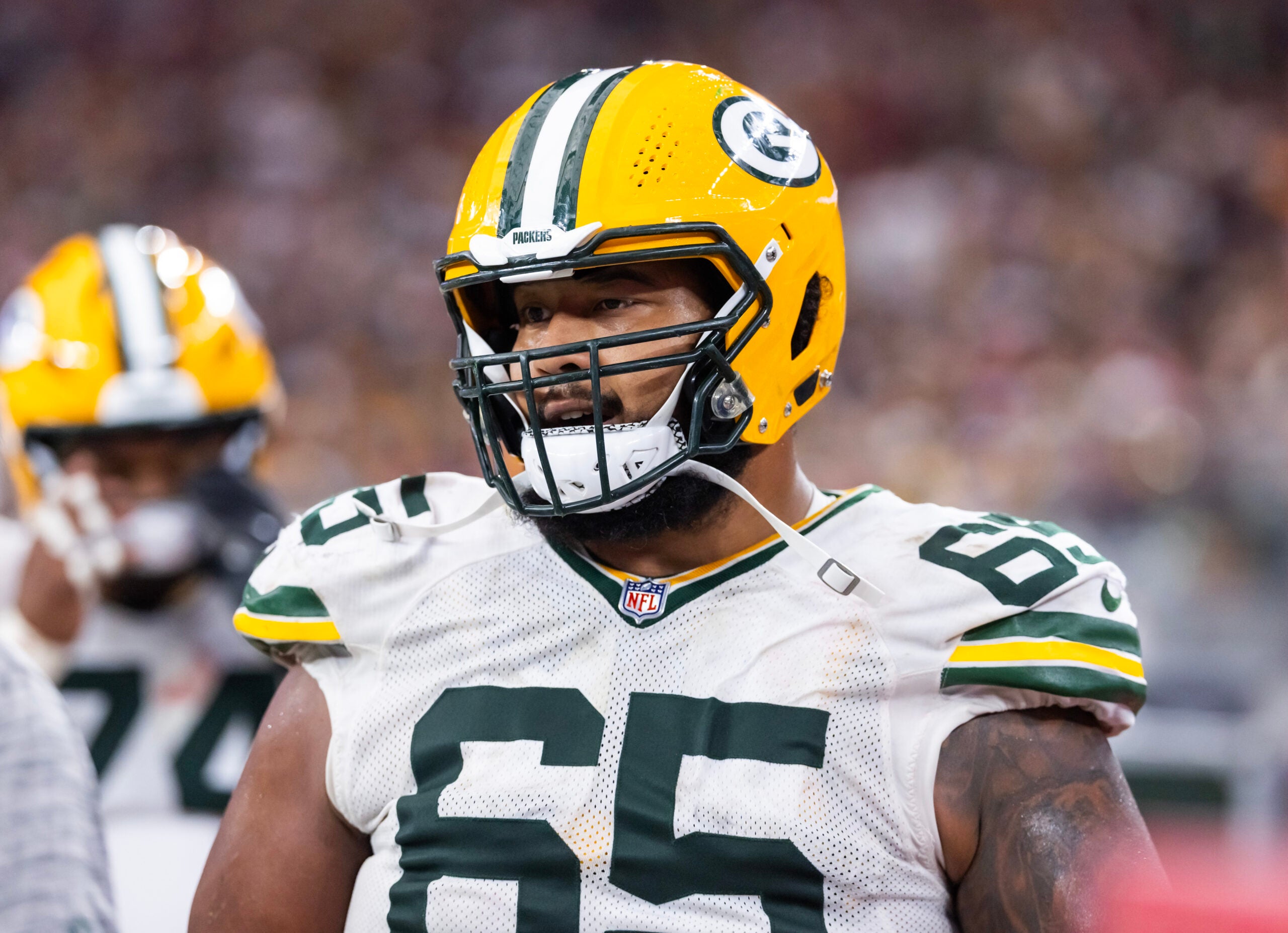
The Green Bay Packers made a contract decision back in March that will only truly manifest itself in 2027. Instead of releasing left guard Aaron Banks, general manager Brian Gutekunst kept him on the roster and restructured his contract.
The bad decision came earlier. Banks signed a four-year, $77 million contract in 2025 free agency, and the deal hasn’t worked out for Green Bay. To make it possible to keep him in 2026, the Packers converted $7.7 million of his base salary and $9.5 million of his roster bonus into a restructure bonus. That move pushed $12.8 million from the 2026 salary cap into future years.
Accounting, not money
Banks’ salary in 2026 stayed exactly the same at $18.1 million. The only thing that changed was his cap hit, which dropped by $12.8 million. That money is now prorated over the rest of the contract, including two void years in 2029 and 2030.
Many Packers fans see the restructure as something that will make it harder to get rid of Banks next offseason because the dead money will be higher. However, that’s a misconception, and it’s not how teams operate.
NFL front offices tend to work with a three-year salary cap window. The dead money in a potential release would indeed be bigger. Nevertheless, Green Bay saved $12.8 million in cap space this season. If that space goes unused, it rolls over to 2027, and the same amount would help mitigate the impact of a Banks’ release.
The restructure is not about money. Banks didn’t receive more or less because of it. What matters for the Packers is actual cash: what they will or won’t pay if they release him, and the financial ramifications of that choice.
What a 2027 release would look like
If Green Bay cuts Banks next offseason, it will probably happen with a post-June 1 designation. In that scenario, a release in March would keep his roster spot and cap hit on the books through June 1. Once the Packers are out of the deal on June 2, the future proration of his dead money doesn’t accelerate into 2027. Only the 2027 portion of his signing bonus and restructure bonus hits that year’s cap, and the rest accelerates into 2028.
With a post-June 1 cut, the Banks deal would end up as a two-year, $47.441 million contract. The remaining amount, close to $30 million, is unguaranteed money that would never be paid.
Aaron Banks’ cap numbers
If the Packers decide to release him in 2027 with a post-June 1 designation:
- 2027: $9.947 million in dead money, $15.5 million in cap savings
- 2028: $16.341 million in dead money, $7.606 million in cap savings
- 2029: $3.197 million in cap savings
- 2030: $3.197 million in cap savings
Releasing Banks without the post-June 1 designation would be a different story. His estimated 2027 cap hit is $25.447 million, and the dead cap would be $26.288 million, so the Packers would actually lose cap space next year. In exchange, no dead money would carry into 2028 and beyond.
Why the cash is the real story
Green Bay already paid Banks $29.341 million in 2025 and $18.1 million in 2026. Those are the cash numbers, and the restructure didn’t change them. It was an unusual contract for the Packers because it was heavily front-loaded, and that’s why it weighed so much on the team over the first two years.
Banks is estimated to make $15.5 million in 2027 and $14 million in 2028, so the contract gets cheaper year after year. When the Packers signed him, the idea was that those final two seasons would be the team-friendly part of the deal.
The signing simply hasn’t worked. His performance has been average, but the bigger problem is his injury history. The games he’s missed and the time he’s spent on the injury report. Even though his 2027 salary isn’t necessarily prohibitive, it’s hard to imagine a scenario where Green Bay keeps him around next year.
So the restructure won’t affect a potential decision to move on from Banks at all. It doesn’t make that decision harder. The money is already paid, and the dead money would hit the cap anyway because of the large signing bonus the Packers gave him in the first place. It’s just a matter of when. If Gutekunst wants to move on from Banks next offseason, the cap ramifications make it easy to do.
