
Arizona Cardinals finally find their franchise QB while remaking both sides of the ball in latest 7-round 2027 NFL mock draft
The latest 7-round 2027 NFL mock draft provides the Arizona Cardinals with a franchise quarterback, amongst other important pieces.

The Arizona Cardinals take a major swing at quarterback in this 2027 NFL Mock Draft, selecting Oklahoma State’s Drew Mestemaker with the fourth overall pick. From there, the Cardinals address several other important areas, including wide receiver, edge rusher, offensive tackle, and linebacker.
I created this mock draft using the A to Z Sports Mock Draft Simulator, with the draft order based on the simulator’s projected selections. Arizona comes away with eight players, including a potential franchise quarterback, a big-bodied receiver, and multiple additions to the offensive and defensive lines.
Here’s a breakdown of every selection and how each prospect could fit in Arizona.
Round 1, Pick No. 4: Drew Mestemaker, QB, Oklahoma State
The Cardinals start their draft by addressing the most important position on the field. Drew Mestemaker has emerged as one of the most intriguing quarterback prospects in the 2027 class after a remarkable rise from North Texas to Oklahoma State.
Mestemaker put together an outstanding 2025 season at North Texas, throwing for 4,379 yards and 34 touchdowns with just eight interceptions while completing nearly 69% of his passes. His production and efficiency helped establish him as a legitimate NFL prospect.
The appeal is his combination of accuracy, downfield aggression, and ability to operate an offense. Mestemaker has demonstrated that he can produce explosive passing plays without consistently putting the ball in harm’s way. However, his decision-making under pressure and ability to maintain that efficiency against higher-level defenses will be important areas to monitor.
Taking a quarterback fourth overall would represent a major commitment to finding Arizona’s long-term answer at the position. If the Cardinals believe Mestemaker can become a franchise quarterback, this is the kind of selection that could reshape the direction of the organization.
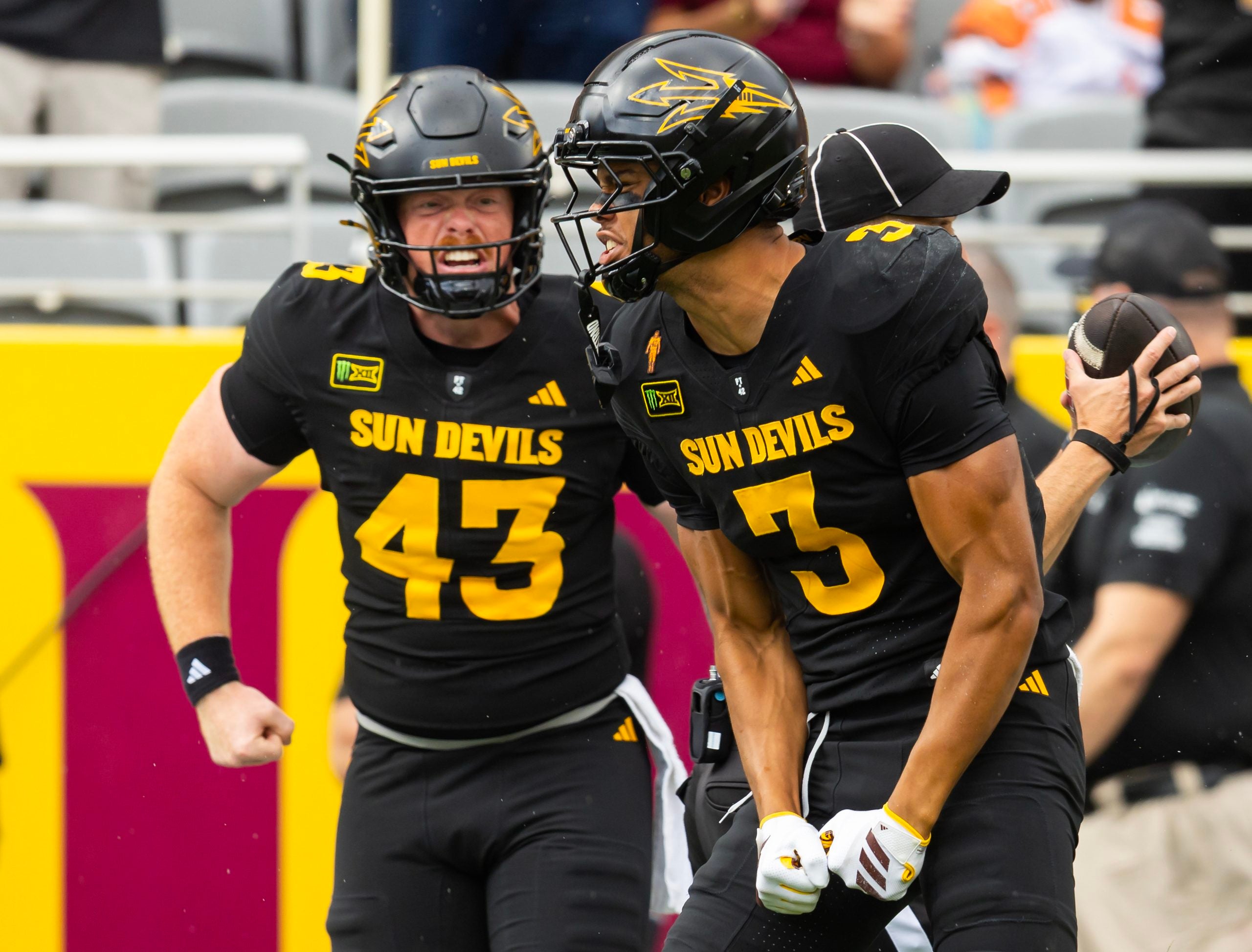
Round 2, Pick No. 36: Reed Harris, WR, Arizona State
The Cardinals follow up their quarterback selection by giving him another potential weapon in the passing game. Reed Harris brings an intriguing combination of size, athleticism, and big-play potential to Arizona’s receiving corps.
Listed at 6-foot-5 and 217 pounds, Harris has the frame to challenge defensive backs on contested catches and provide a substantial target in the red zone. His ability to stretch the field makes him an appealing complement to receivers who win with route precision and separation underneath.
Harris transferred to Arizona State after beginning his college career at Boston College. His early production with the Sun Devils has helped raise his profile, although improving his route running and consistently creating separation against physical coverage will be important as he prepares for the next level.
Pairing Harris with a potential franchise quarterback would allow the Cardinals to build chemistry between two young players. Arizona would be investing in a receiver who offers a different physical profile and the potential to become a downfield threat.
Round 2, Pick No. 51: Clev Lubin, EDGE, Louisville
Arizona addresses its pass rush with its second second-round selection, adding Louisville edge defender Clev Lubin to the defensive front.
Lubin has put together an impressive college career, with production at multiple stops before establishing himself at Louisville. In 2025, he recorded 8.5 sacks and three forced fumbles, demonstrating an ability to disrupt opposing offenses. His first-step explosiveness, active hands, and variety of pass-rush moves make him an intriguing prospect.
The Cardinals would be betting on Lubin’s ability to turn that disruption into consistent NFL production. He has shown that he can threaten offensive tackles around the edge, but his length and ability to disengage against bigger blockers are areas that could affect his effectiveness against the run.
At pick No. 51, Lubin would give Arizona another young defender capable of contributing to its pass rush. Adding an edge defender with his production and energy would help the Cardinals build a deeper defensive front.
Round 3, Pick No. 68: Elijah Paige, OT, USC
The Cardinals turn their attention to the offensive line in the third round, selecting USC tackle Elijah Paige.
Paige offers an intriguing physical profile at 6-foot-7 and approximately 315 pounds. His experience at left tackle gives Arizona a developmental option at one of the most important positions on the offensive line, particularly if the team wants to improve its ability to protect a young quarterback.
The selection makes sense after taking Mestemaker in the first round. A young quarterback needs time to work through progressions, and improving the offensive line can make a significant difference in his development.
Paige would need to continue refining his technique, particularly against NFL-caliber edge rushers who can challenge his balance and footwork. Still, his size and experience provide a foundation for further development. The Cardinals would have an opportunity to work him into the lineup while evaluating his long-term potential at tackle.
Round 4, Pick No. 106: Cade Uluave, LB, BYU
Arizona adds another defensive prospect in the fourth round with BYU linebacker Cade Uluave.
Uluave is an aggressive, physical linebacker whose game is built around diagnosing plays and attacking downhill. He has demonstrated the ability to make plays against the run while also showing some pass-rush ability. His 2025 season included three sacks and 19 quarterback pressures, giving him an interesting profile beyond traditional linebacker responsibilities.
The biggest appeal is his energy and willingness to attack the football. Uluave could give Arizona another option in its linebacker rotation, particularly in situations where the defense needs a physical presence against the run.
His size could present challenges when taking on NFL offensive linemen, so developing his ability to avoid blocks and maintain positioning will be important. Nevertheless, Uluave would add a competitive defender who could contribute on special teams while working toward a larger defensive role.
Round 5, Pick No. 141: Ryan Baer, OT, Pittsburgh
The Cardinals return to the offensive line in the fifth round, selecting Pittsburgh tackle Ryan Baer.
After using a third-round pick on Paige, Arizona continues to invest in protecting its quarterback and building depth at tackle. Baer would give the Cardinals another developmental option who could compete for a reserve role while learning the demands of the professional game.
The benefit of selecting multiple offensive linemen is that the Cardinals would have more than one opportunity to find a long-term contributor. Injuries can quickly expose a team’s weaknesses up front, and having capable reserves can be the difference between maintaining an offense’s rhythm and struggling to protect the quarterback.
Baer would need to prove that his technique, strength, and movement skills can translate against NFL defenders. At this point in the draft, however, Arizona would be looking for a player who can develop into a reliable piece of its offensive line rotation.
Round 7, Pick No. 225: Matthew Bailey, S, Illinois
Arizona adds a defensive back with its first seventh-round selection, taking Illinois safety Matthew Bailey.
The Cardinals could use this selection to increase competition in the secondary and add another young player who can develop within the defensive system. Safety depth can be particularly important in an NFL defense, where players are asked to cover receivers, support the run, and communicate adjustments before the snap.
Bailey would have an opportunity to earn his place through training camp and preseason performance. His ability to process plays quickly, tackle reliably and contribute on special teams would be important factors in his path to the roster.
Seventh-round selections are often developmental investments, and Bailey would have time to establish his role. If he can become a dependable special-teams contributor while improving his coverage skills, he could provide value beyond his draft position.
Round 7, Pick No. 242: Jordan Dwyer, WR, TCU
The Cardinals close out their draft by returning to the wide receiver position, selecting TCU’s Jordan Dwyer.
Arizona already added Harris in the second round, but taking another receiver gives the team another chance to find a productive contributor. A deeper receiving group would give the offense more flexibility with its personnel packages and provide additional competition throughout training camp.
Dwyer would have to demonstrate that he can consistently separate from defenders, handle his assignments, and make the most of his opportunities. His route running, hands, and ability to contribute after the catch would all be important areas to evaluate as he makes the transition to the NFL.
The seventh round is an appropriate place to take a chance on a developmental receiver. If Dwyer can establish himself on special teams and earn opportunities in the passing game, he could become a useful depth piece for the Cardinals.
Final thoughts on the Cardinals’ 2027 NFL Mock Draft
This mock draft centers on a straightforward plan: find a potential franchise quarterback, give him another receiving weapon, and continue building the offensive and defensive lines.
Mestemaker is the defining selection. Taking him fourth overall would signal that Arizona believes his accuracy, production, and developmental trajectory give him the potential to lead the franchise. Harris would provide a promising downfield target, while Lubin gives the defense an edge rusher with a track record of creating disruption.
Paige and Baer also reinforce the offensive line, which could be particularly important if the Cardinals are developing a young quarterback. Uluave and Bailey add defensive depth, while Dwyer provides another opportunity to find a contributor at wide receiver.
Of course, the 2027 NFL Draft is still months away, and the prospects’ draft positions will change as the college season continues. But this class gives Arizona a potential new centerpiece at quarterback while addressing several positions that could help the team build for the future.
This mock draft was created using the A to Z Sports Mock Draft Simulator, available at atozsports.com/draft-simulator.
