
Vikings QB Kyler Murray’s issues raise an important question that Kevin O’Connell needs to answer correctly
It’s a difficult question for Kevin O’Connell to answer, mainly because this is path he chose ahead of the season.


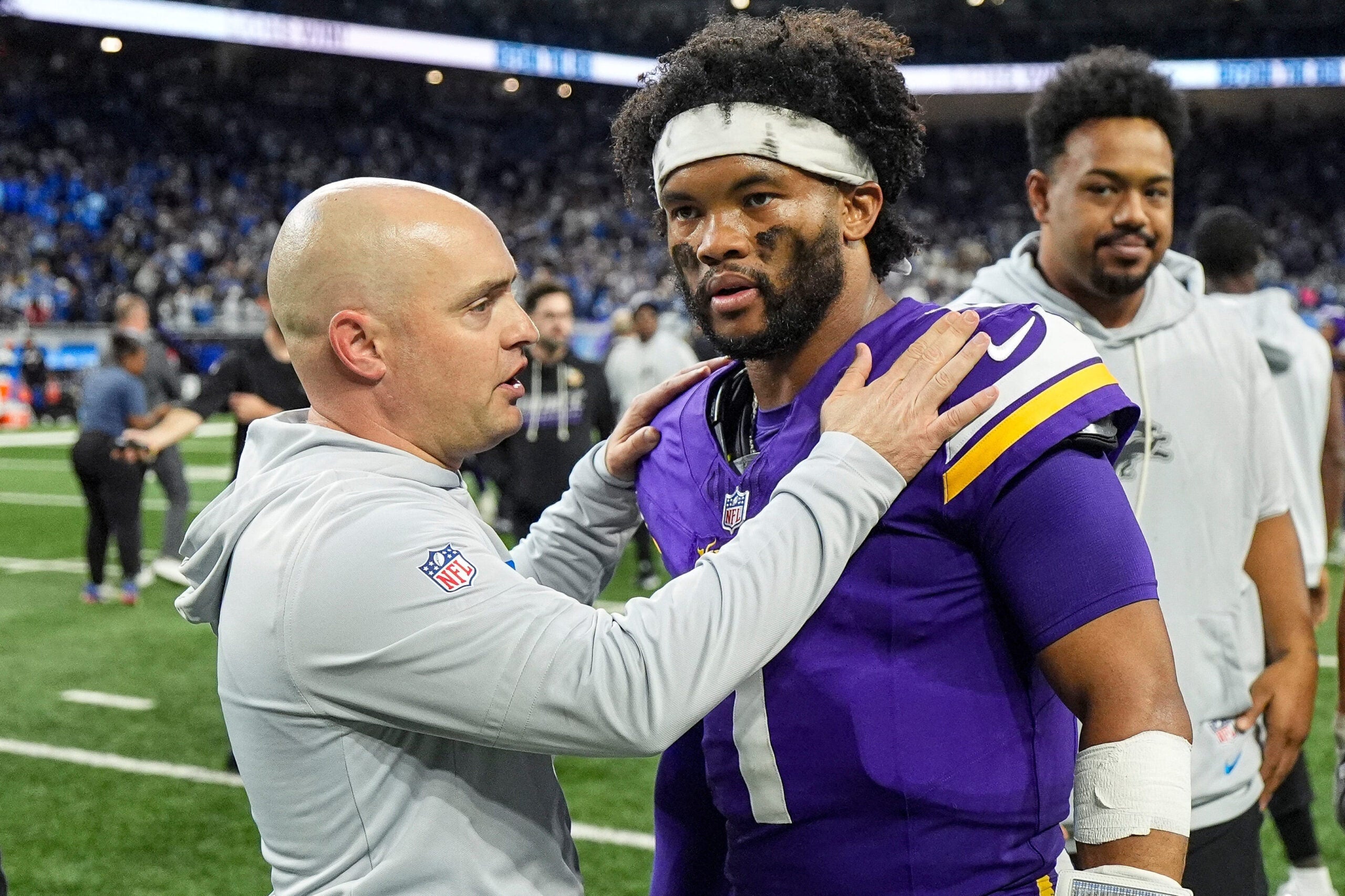
Is Kyler Murray fixable? That question has followed the Minnesota Vikings after a rough 19-15 loss to the Detroit Lions. The answer takes nuance. It isn’t as simple as blaming Murray or head coach Kevin O’Connell. The tape still shows plenty of good, and that is the most frustrating part of the entire discussion.
Minnesota signed Murray to a veteran minimum deal because the Cardinals are covering much of the money left on his contract. In practice, it’s a one-year prove-it deal. The idea was to bring in a quarterback with plus arm talent and help him adjust to an offense he had never played in. O’Connell and the organization thought they could elevate him to a different level. The Vikings believed he could process and throw with anticipation. So far, that hasn’t proven to be the case.
Kyler Murray’s accuracy and progressions took a step back
Murray was very accurate against the Miami Dolphins (73.0%) and the New Orleans Saints (80.0%). Against Detroit, the ball sprayed everywhere, and his accuracy dropped to 58.6%. The misses weren’t in a different area code, but they were in the wrong spot. For a player who has placed the ball well throughout the year, that is a frustrating regression.
Even so, Murray is still pushing the ball downfield. Over the last two games, Murray is averaging 10.5 air yards per attempt, which ranks second among quarterbacks during that span. He is attacking vertically the way O’Connell wants, but the bigger issue is what he is seeing.
One drift concept stood out on film. The play isolates an in-breaking route of about 10 to 12 yards, built for an easy chunk gain thrown with anticipation. Justin Jefferson was wide open. Murray only needed to fit the ball between two linebackers playing close to the line of scrimmage, a window that is bigger than it looks. Sam Darnold makes that throw. Kirk Cousins makes that throw. In a Kevin O’Connell offense, you cannot pass up an easy completion to the best receiver in football.
Some people have started to question Jefferson because of how little he’s getting the football. The film doesn’t support that. He hasn’t lost a step, and he is still creating opportunities against double coverage. He just isn’t getting the ball, and part of that comes down to Murray’s progressions.
The good is still there
When Murray locks in on something, he can grip it and rip it. His deep post to wide receiver Jordan Addison for more than 50 yards was a perfect example of the max protect shot plays O’Connell has leaned on. It’s a version of Yankee, which pairs Jefferson running a deep crosser while Addison runs the deep post. The deep safety went flat-footed, saw Jefferson coming, and jumped him. Against single high, that left a cornerback in trail position. Murray threw it out front and let Addison run under it.
The issue is a willingness to hit tight windows. Not everyone will be wide open with five yards of separation. With receivers like Jefferson and Addison, you have to throw before they come out of their breaks and trust them to win. Murray hasn’t figured out what open looks like for these two yet. His running ability is also a real separator. It’s the biggest difference between him and Carson Wentz, and Murray is significantly more accurate than Wentz this year and across their careers.
Even though the eye test is ugly, the numbers paint him as average. Over the last two weeks, Murray has posted 0.089 EPA per play, 17th among 30 qualifying quarterbacks, along with a 49.3% success rate that ranks 16th. The eye test feels worse than that.
Kevin O’Connell might need to park his offense
I believe Murray is fixable. Whether he will be fixed is another question. What O’Connell is doing feels like a head coach who is a little too smart for his own good.
His receivers are getting open and the offensive line was solid on Sunday. However, if your quarterback isn’t hitting these throws, you can’t keep calling them. Before the bye, O’Connell leaned on ball control against the Saints, using short concepts mixed with a few shots, and it worked. Over the last two weeks, the shot plays have returned in a big way.
This is the second straight year in which the receivers are open, and the quarterback can’t run the offense. J.J. McCarthy couldn’t, Carson Wentz can’t, and Max Brosmer hasn’t. Now Murray is in the same spot. It reminds me of my AP Physics teacher in high school, a brilliant guy who belonged teaching a master’s program and struggled to relate the material to his students. Murray is playing tight, and thinking is the most dangerous thing on a football field.
Simplifying the offense might be the answer and let Murray play free. Sean McVay with Puka Nacua, Seattle with Jaxon Smith-Njigba, and Zac Taylor with Ja’Marr Chase all find simple ways to feed their stars. O’Connell should be able to do the same for Jefferson.
No singular person is to blame. The blocking has been inconsistent, the run game has been far from reliable, and quarterback and play caller aren’t in sync. Change probably isn’t coming, either. O’Connell confirmed at his Monday press conference that Murray remains his starter as long as he is healthy. This is the horse O’Connell picked, and the rest of the season will show whether he can get the most out of it.

