
Titans’ JC Latham reveals the hard truth about growing up that’s turned him into one of the NFL’s best young tackles
I sat down with JC Latham, Brian Daboll, and Carmen Bricillo to find out what changed for the Titans’ third-year right tackle in his break-out season. The answer started a long way from the football field.


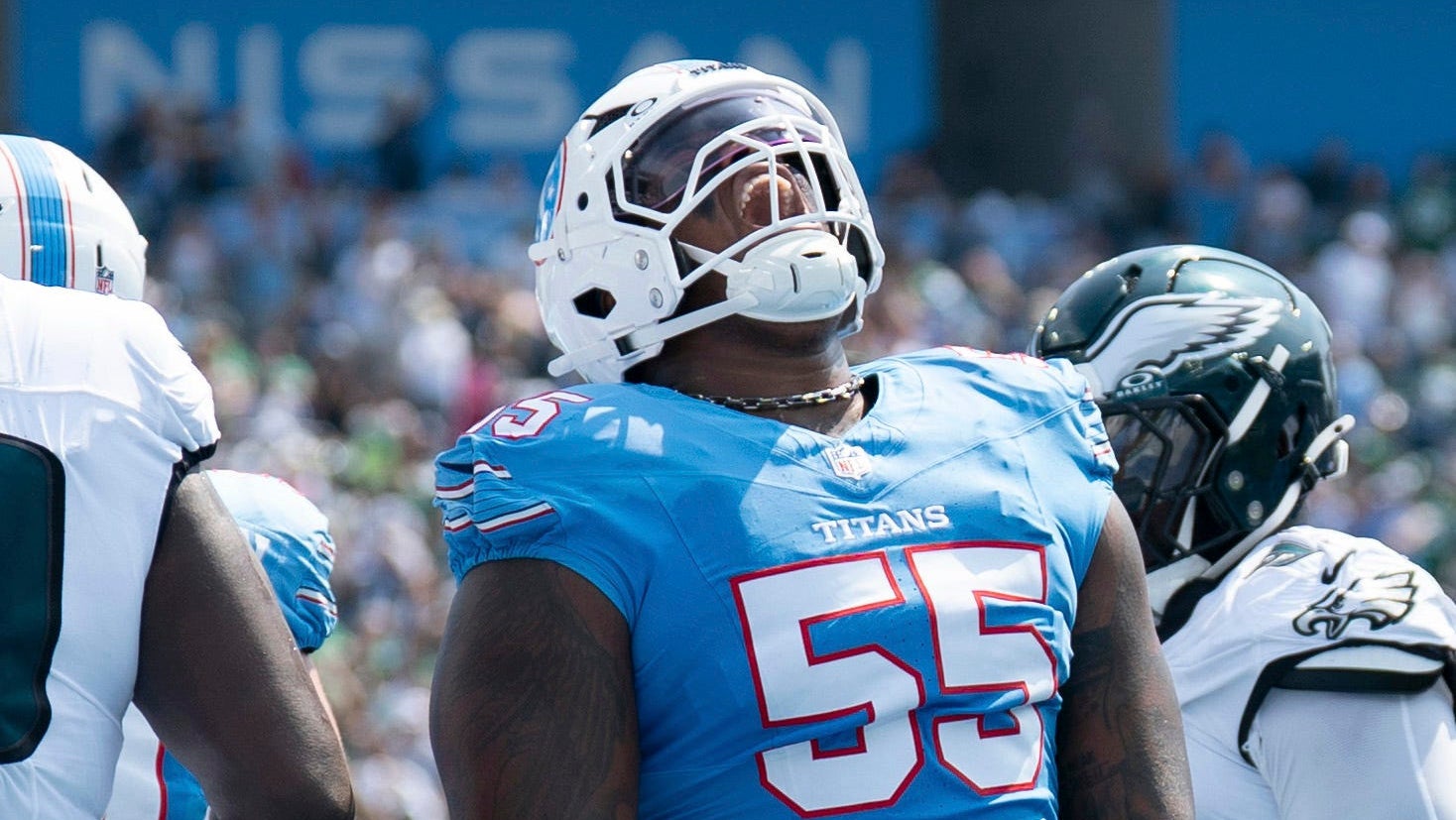
“You wait, you’re going to love JC.”
That’s what Alabama offensive line coach Eric Wolford told Tennessee Titans offensive line coach Carmen Bricillo when he joined Robert Saleh’s new staff in Tennessee. His old buddy Wolford was giving him a heads up on the starting right tackle he was about to inherit.
Now, halfway through the season, JC Latham’s play has lived up to that billing and then some.
He has been the Titans’ best offensive lineman this year, with only one shaky game to speak of, in Cincinnati, in which he was dealing with an injury. Saleh announced before the bye that he wouldn’t give injury updates on anybody until Wednesday of the following game week. But my understanding is that the hand injury that cost Latham in the Titans’ Week 9 game isn’t expected to keep him off the field for long.
With his breakout season hopefully continuing as Tennessee returns from its bye, I spoke with Latham, offensive coordinator Brian Daboll, and Bricillo. I wanted to learn why the Titans’ third-year, top-10 draft pick has come online over his past 15 games or so; because he looks like somebody well on his way to a massive contract extension as one of the faces of this offense. In speaking with all three of them, the central theme that emerged is one that each of us can relate to it in our own way.
Grow up!
Maybe it was graduating college and getting your first job. Maybe it was your first big promotion, the one that put a lot of new responsibility on your plate. Maybe it was your first serious relationship, getting engaged, or getting married. Or maybe it was moving out of your parents’ house and suddenly paying real rent, real utility bills, your own car insurance, and your own phone bill.
Whatever it was, all of us can relate to the growing pains of going from adolescence to real adulthood in our early 20s. You turn 18 and you’re legally an adult. Still, everybody goes at their own pace. Often it takes real responsibility landing on your plate in those first couple years of adulthood to force a sink-or-swim moment that turns you into a different person.
For me, I can identify the moment easily. My wife and I welcomed our first child when we were 24 years old. I thought I had my life together before then, but in hindsight I can’t help but laugh.
For Latham, that moment was becoming the starting tackle of an NFL team at age 21. Now at the ripe old age of 23, the heart of nearly our entire conversation revolved around his jump from winning times at Alabama to… leaner times in Tennessee. That step up into the NFL came with realizations and hard truths he had to accept. Some habits had to change, and new ones had to be established, before his mindset and off-field process could set him up for success on the field.
He talked about how much winning was going on during the Nick Saban era at Alabama. When you’re a stud starting tackle on a team like that, it’s easy to believe you have it all figured out. So when people told him he had trouble focusing and locking in, he didn’t buy it. In his mind, he was dominating. You have to be focused to be that successful, right?
“Then as I’ve gotten older and I realized,” Latham explained, “looking at how I live my life, I’m just like man, you’re late, you’re late on this, with your friends, you’re going out to eat, and you’re late over here, or you’re late with your laundry or your chores or whatever it might be. Just noticing certain tendencies. And I was like, I wonder if this is carrying over to the field. Like, how is this carrying over? And then I just sat back and looking at it, I was like, well, you led the league in penalties last year. So that’s obviously a focus aspect to it. And I was thinking about how it got there, and I was like, well, I think that while you are focused and putting in effort at times, maybe you’re not focused in the right areas. And that became a theme of mine all offseason.”
He tried to dial in on the parts of the offense that mattered most to him. That meant less time on every route and the 10,000-foot picture of certain plays and formations. Instead, he focused on the specifics of his job, plus the jobs along the line he might be asked to handle in a pinch. Those micro details are the things that separate the good from the great. He put the blinders on to begin mastering them.
However, it was a pair of conversations this past winter that truly stopped him in his tracks. He said:
“It struck me from one of my O-line trainers and one of my agents. You know, they don’t talk with each other. And it’s one of the biggest things, you know, if multiple people are saying the same thing. There’s some truth to it, especially if they don’t talk about it with each other.”
Latham began with the trainer. “So my trainer pointed out one day, we were doing a competition day and I think I lost one of my reps. This is back in February. I lost one of my reps and he was basically just telling me like, oh yeah, JC, he was traveling over the weekend, so he’s not locked in today.“
“I didn’t lose for the rest of that day.”
“And his biggest thing afterwards, his biggest thing was telling me, hey, we shouldn’t have to get on you for you to focus, right? That focus should be there from the jump.”
Then his agent, at a later date. “The deeper part came when my agent was talking to me later about something. And she was like, we think your biggest issue is your focus. And we think that you need to pay attention to that.”
“And that’s when I started noticing just the tendencies of like, dang, I definitely forgot to do this. I definitely forgot to do that, whatever it might be, to where it’s like, yeah, you’re not focusing in on a lot of the parts of your life. And if you clean all this up, if you live to where you’re pushing the needle, even if it’s just holding myself accountable to be like, hey, I want to take my dog on a walk at 4 o’clock. Like, let’s be focused to handle everything that we have to do before that. And set up everything we have to do after that to where we’re focused, deliberate. So you’re building those habits to where when the season comes and you say, okay, on Mondays and Tuesdays, I want to watch all the second and third down reps of the team that we’re playing following up to it. You’ve already built this tendency of saying you’re going to do something, knowing the routine, and then just executing it at that point.”
Hearing all of this in our interview, it sounded like a young man who had been flying by the seat of his pants in life. Again, I think a lot of us can relate to that at some point in our transition to adulthood. Latham connected the lack of attention to detail in his day-to-day life with tendencies that were bleeding into his workplace performance. Then he set out to change them.
Brian Daboll, father of 6, told me “everyone grows up at different times. Again, I have a number of my own kids that are similar age, and they’re all a little bit different. I do think that the support staff in the building here, not just the coaching staff, but the support staff plays a big role in the development of young players. But, you know, ultimately it comes down to the person and to the young man. ‘Are these the goals I’d like to achieve? Is this the player I want to be? What are steps A, B, C, and D to help me do that?’ And then it’s ultimately your choice. And if you don’t do it, then you usually don’t get the results in this league. And if you do it, you have a much better chance.”
I asked Latham whether the honesty to accept that truth and work to change it came naturally to him.
“It was pretty natural,” he said with confidence. “It was pretty natural because I’m a self-aware guy. And being at Bama and at IMG before that, like, we’re always focused on the process. And then looking at the results. And if your process is not aligning with the results that you want to get, you have to look inward. One of the lessons for me this year is like winning makes it hard for you to be humble, to find areas of improvement, and losing is what really helps you see where you need to improve. Coming from programs of excellence before, you just tell yourself, keep working hard. But you don’t know exactly what areas you’re struggling in because you’re winning, you know, and winning masks a lot of things. So being in the NFL is really humbling.”
What happens when you pair elite ability with elite habits
“Okay, this is the real world. You need to figure it out before you’re one of those next guys that turns into a could-have-been.”
That’s the message Latham told me would run through his head after that realization this past winter. He worked hard to change the habits of his life, and in turn, the way he performs on and off the field as an NFL tackle.
Nobody is questioning the raw ability. Latham was the 7th overall pick, and he’s one of the most impressive combinations of size, strength, and athleticism to enter the NFL in recent memory at tackle.
“He’s got all the talent in the world,” Daboll volunteered. “He’s a big physical guy that has athleticism. And the big thing for me when I got here was, hey, let’s get to know each other. Let’s kind of set the standard and the expectations of ‘What I think you can become, what we think you can become, and then let’s try to be as good a football player as we can.’ And I think (Bricillo) has done a great job. I tell you what, I’ve been very pleased with him as a young man and pleased with him as a player.“
Latham has already publicly discussed some of the specific changes he made over the past calendar year. One of the biggest was working with a mental coach, which he said he started last season after the Browns game. Once those meetings began, he noticed an immediate uptick in how he played. The process was there, and the results followed.
A big part of that work for him is finding his spark before it’s too late. He recalled a game late last season when he got run over on a bull rush. If you’ve watched Latham play at all, you know he doesn’t get run over. His anchor against speed to power is nuclear grade. It is his superpower.
So after the game, he called his brother and marveled at what happened. “I’ve never been ran over before,” he said over the phone. A teammate had stepped on his foot a little bit, he got run over, and it made him furious.
“For the rest of the game, nobody got nothing on me,” Latham recalled. “And I was just thinking, I did have that same thought that my trainer kind of vocalized later. Why does it take you messing up for you to lock in, for you to go? Why can’t you show up with that mindset? So figuring out, that’s one thing we talked to my mental coach about, which is what helped towards the end of the year last year, figuring out whatever mental zone that is. That is your process, and that’s the process you need to apply every single day.
That process has yielded impressive results. Before the Week 9 hand injury, Latham was on a streak of very high-level tackle play. He has made big strides in just about every metric. If you know offensive line play, you can turn on almost any game and say, “Now that is a high-level starting tackle.” It’s borderline All-Pro tape he’s put out there this season.
The most impressive number, as I see it, is his pass block win rate on an island. Among active tackles, only 49ers tackle Trent Williams, a future Hall of Famer, is higher at 96.4%. Latham sits right behind him at 96.1%. That’s not a small sample size either. In terms of how often he’s left with no help on the right side, Latham has been top 5 in many weeks and No. 1 in the league at times.
Daboll isn’t one to publicly discuss the finer points of his scheme, and he didn’t take the bait when I asked. But the reality is that this team is clearly very comfortable leaving Latham alone on the right side.
That’s even more of a credit to him because he has dealt with backup and now third-string play at right guard beside him. As inconsistency has increased at that spot, the Titans have still trusted Latham to beat his man one-on-one. For most of the season, he has been crushing that assignment.
He hasn’t been shabby in the run game either. ESPN’s run block win rate has him at 81% through nine weeks, tied for 9th best in the NFL.
“He looks like he was built in a lab to play offensive line, and that’s the kind of players you like to work with,” Daboll chuckled. “But then you have to have the intangibles, and the toughness, and the intelligence, and the wherewithal to do the right things when you’re supposed to do them on a consistent basis in the league, because you’re going against some really good players as well. So your talent will only take you so far.“
As Latham has matured, though, Bricillo emphasized that he hasn’t lost his youthful charm. “e’s excitable, he’s talented, he cares, he’s fun,” the OL coach detailed. “You know, his youth, his youthful exuberance, you can feel it. It’s palpable in the room. He brings that energy. You see it on the sidelines, you see it in the meetings, you see it at practice. He’s fun to coach, and the sky’s the limit.“
Defining success for what’s next
“Let’s not celebrate doing what’s expected.”
That’s what Bricillo told me in the third of my three interviews for this profile. It stuck out because it boiled down the mindset of this player and both coaches I spoke to. When I tried to get them to brag on Latham’s success, they weren’t being humble for the sake of humility. You could feel that they view his job at tackle as a cold, simple pass-fail exercise.
That’s part of why offensive linemen don’t get the love that skill players do. Those guys razzle-dazzle you with explosive plays, yards after the catch, and defenders left grasping at air. With linemen, we joke that the best ones are the ones you never notice. Going a whole game without thinking about a specific lineman means he didn’t screw up the offense! Nice! The best do their jobs quietly.
Latham seems to have adopted that mindset wholesale. Doing his job for a game, a month, or half a season isn’t enough. Going back to when he started playing his most consistent football in the back half of 2025, he’s close to a full season’s worth of games now. That still isn’t enough. He has to do it consistently for a long time.
“I think he’s done a good job of doing his job,” Bricillo told me. “I think that my cookie-cutter statement would be that I’m pleased but not satisfied. But all the same, there’s something we say: let’s not celebrate doing what’s expected. Sure, JC is really talented and is really dedicated, and he’s out there doing his job, but the reality is he’s a starting tackle in the league. We expect a lot of him, and fortunately for us, he’s embraced that in how he’s approached the game since I’ve been hired. He’s a pro’s pro, does extra to buy in. You know, he’s always studying it. I get text messages from him at 9:30, 10 o’clock at night sometimes where he’s watching some tape and he’s got a question. And it just demonstrates that obviously it’s important to him and he’s working his butt off to maximize his traits.”
So Latham and his coaches are focused on finishing the season strong before turning to the future. Latham is in the third year of his four-year rookie deal, and as a first-rounder, he carries a fifth-year option. Tennessee will face that decision this offseason. The way he’s playing right now has big fat extension written all over it.
But what does it take to be truly awesome, to earn that extension and the ones after it, and to become a face of the franchise?
“Awesome, I think, is longevity,” Bricillo told me. “When you really compare those guys and you look at the guys that like do it at the highest level for a long time, that’s the challenge. There’s still another level and certain blocks that he can achieve. And look, it’s not like we got Carmen Bricillo ability out there,” he said of himself, joking.
“JC is as physically gifted as anyone I’ve had the pleasure of coaching. And therefore, then you have a vision as a coach and as a player of where you want to go and where you want to play to.”
“I think there’s another level that he can achieve. That’s what I think. That’s what JC sees.”
