
Packers’ overlooked trade acquisition makes strong case for bigger role as surprising numbers alter running back pecking order
The 23-year-old running back got a new chance against the Patriots after injuries thinned the backfield, and his full-season sample adds weight to that performance.


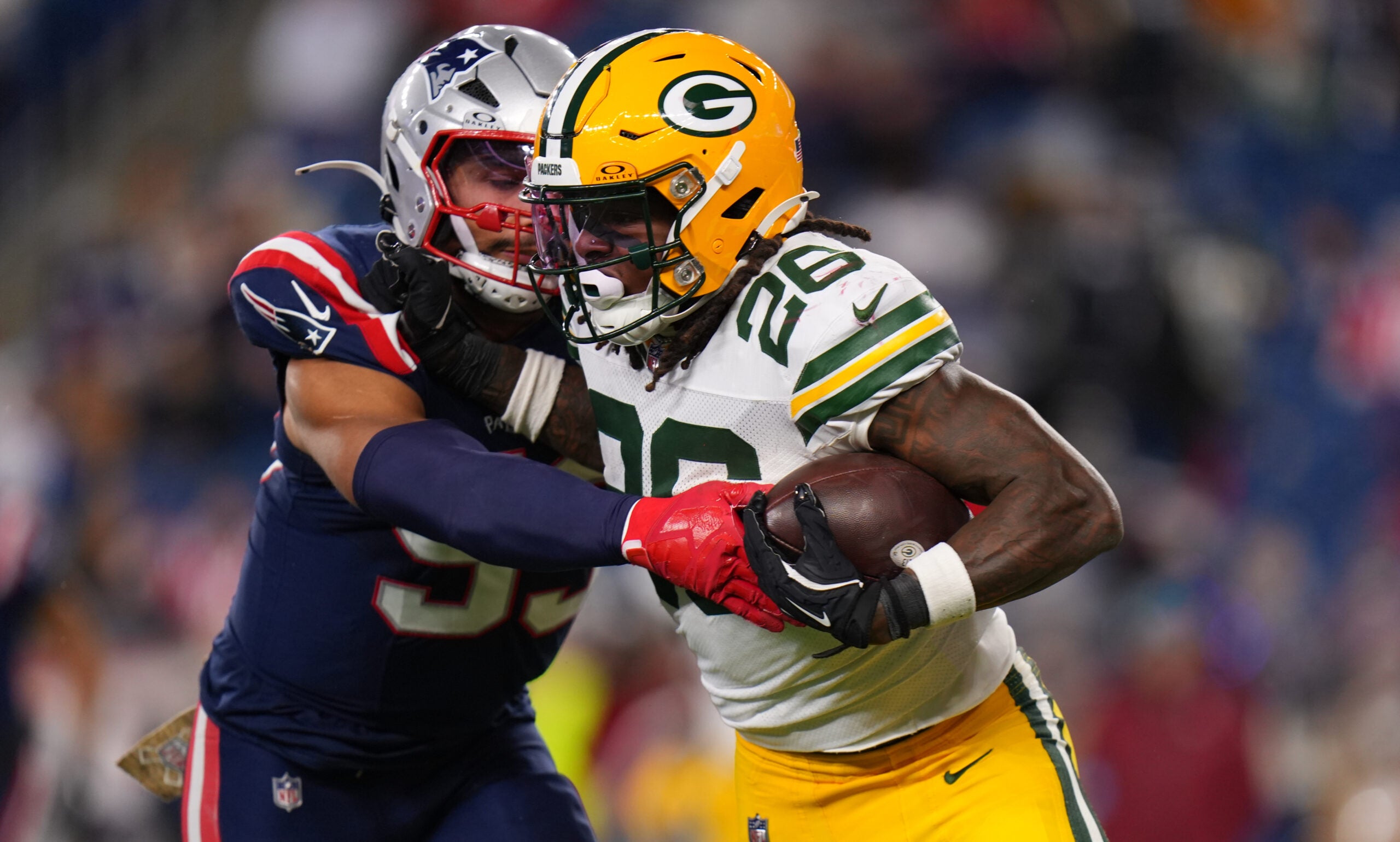
Just a few days ago, the conversation around the Green Bay Packers running back situation pointed in one direction. Josh Jacobs had disappointed, the depth looked thin, and the team seemed likely to look for reinforcements before the trade deadline. Then Kaleb Johnson delivered a promising performance in the Packers’ 45-27 win over the New England Patriots on Sunday, and the picture looks different.
Green Bay acquired Johnson from the Pittsburgh Steelers before the regular season for a 2028 sixth-round pick. That one game isn’t the only reason for optimism, either. Over his entire sample this season, Johnson has been better than every other running back on the roster, including Jacobs.
Now with Josh Jacobs slated to miss at least two games with his finger injury, Johnson’s role will inevitably become even more important.
From healthy scratch to featured back
Johnson started the season as essentially the third running back in the rotation, behind MarShawn Lloyd and Chris Brooks. When Brooks got hurt, the Packers promoted Pierre Strong from the practice squad, and Johnson stayed third on the depth chart. After Jacobs returned from the Commissioner’s Exempt List, Johnson became a healthy scratch for a few games.
Against New England, a sequence of events opened the door again. Lloyd missed the game with a knee injury, and Jacobs left early with a broken finger. That pushed Johnson into a significant role.
The Packers had doubts about him early on. Head coach Matt LaFleur acknowledged that Johnson had a fumbling issue and needed to improve in pass protection. Against the Patriots, though, Johnson didn’t fumble and showed why he’s a talented runner.
The numbers aren’t close
The advanced metrics make a compelling case for Johnson. In yards after contact per attempt, Johnson sits at 3.6, and no other Packers running back is above 2.33.
Yards after contact per attempt
Packers RBs through nine games in 2026:
- Kaleb Johnson: 3.6
- Chris Brooks: 2.33
- Pierre Strong: 2.24
- Josh Jacobs: 2.08
- MarShawn Lloyd: 1.93
PFF’s Elusive Rating, which measures a runner’s impact with the ball independent of blocking, shows an even wider gap. Johnson leads the room with an 83.6 rating. Lloyd is second at 33.1, followed by Jacobs at 26.6, Brooks at 25.9, and Strong at 12.8.
Johnson averages 4.1 yards per attempt, second only to Brooks. But Brooks has just 15 carries, and as more of a pass-protection back, he tends to pick up yards in situations where defenses expect a pass. Johnson has 42 carries.
Even with fewer attempts than Lloyd, Johnson is Green Bay’s leading rusher with 172 yards, and he added a touchdown against the Patriots. Lloyd has 149 yards on 57 carries, while Jacobs has 80 yards on 36 carries.
Johnson hasn’t contributed much as a receiver. As a runner, however, he has outplayed Jacobs and clearly outplayed Lloyd, who received many more opportunities.
Fumbles don’t explain the gap
Ball security remains the area Johnson has to clean up. The Packers’ running backs have fumbled five times this season: Johnson twice, Lloyd twice, and Jacobs once.
That means fumbles can’t justify playing Lloyd over Johnson, though. Both have the same issue, and only one of them has produced at a high level when given the ball. With a clean game against the Patriots, Johnson could put himself in position for more snaps down the stretch.
Long-term value is a big consideration
The Packers acquired Johnson because they saw him as a potential long-term option at the position, and the contract situation supports that perception. Jacobs is under contract through 2027, but he has no guaranteed money left on his deal, and there’s a reasonable chance Green Bay releases him next offseason. Moving on from Jacobs would clear $13.5 million in cap space.
Brooks and Lloyd are also under contract for 2027, while Strong will be a free agent. Johnson is signed through 2028, and at 23 years old, he’s the youngest player in the room by far.
You can argue a sixth-round pick was too much based on Johnson’s limited role for most of the season. But consider the type of players teams usually land in the sixth round, the three more cost-controlled years, and how much better he’s been than the other running backs on the roster. The trade now looks justified. Even if Johnson never becomes the long-term starter, he has a realistic path to being part of the Packers’ rotation for years to come.
