
Sources: Brian Kelly is the heavy favorite to land a Power Four HC opening; other early coaching notes for a potentially chaotic offseason
Could former Notre Dame and LSU head coach Brian Kelly make his return to the sideline next season? Other coaching notes to consider.

The college football coaching carousel is starting to gain momentum, and one of the most accomplished names in the sport could be preparing for a return to the sidelines.
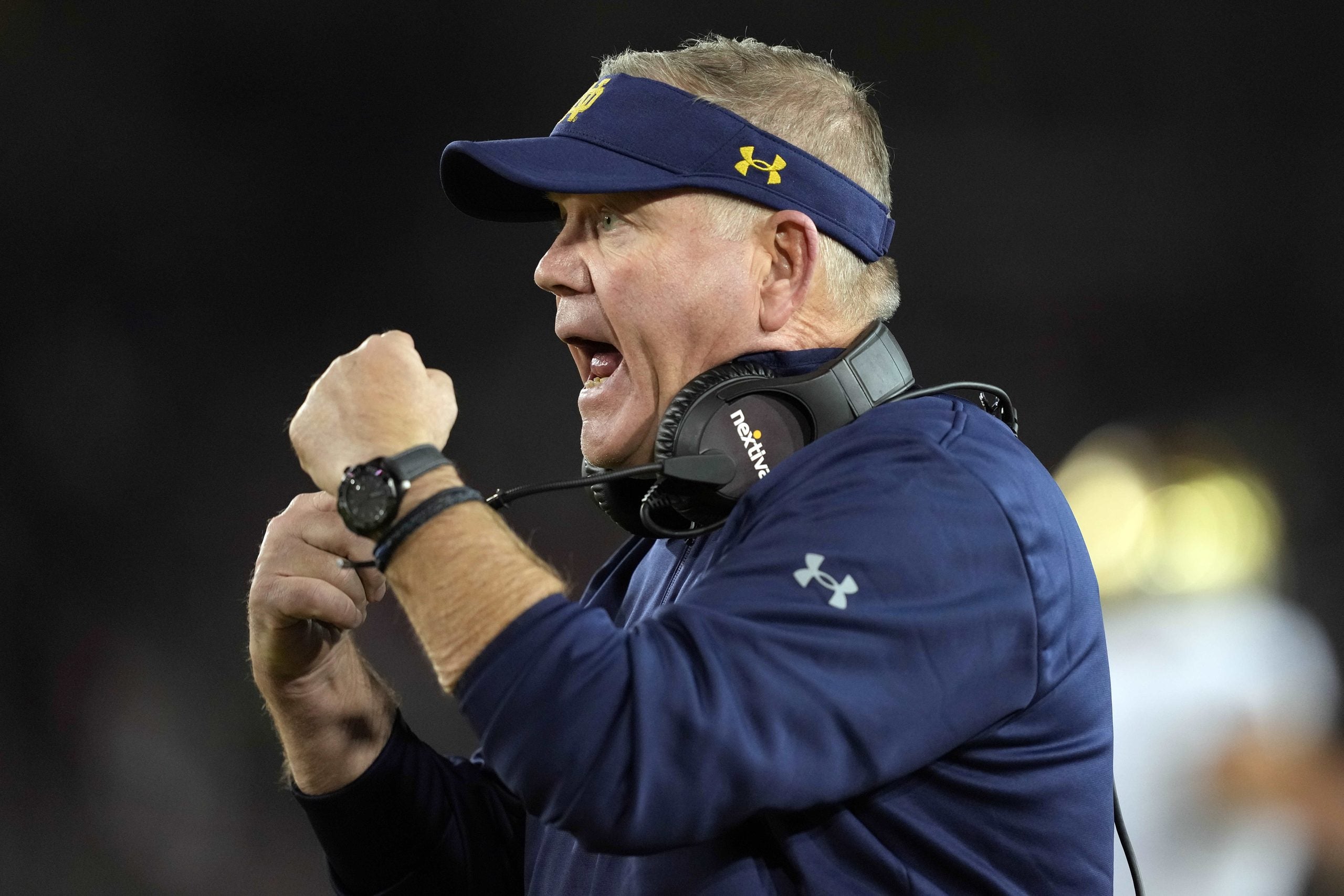
Former Notre Dame and LSU head coach Brian Kelly has quickly emerged as a serious contender for the Maryland head coaching vacancy. Kelly has already interviewed with Maryland officials, and multiple sources familiar with the situation believe he has separated himself from the competition quickly.
The feedback surrounding Kelly has been particularly strong.
“I think he’s getting it,” a former college personnel staffer told me.
“He’s the favorite, and it’s no secret. I’d be shocked if he doesn’t get it,” a current agent added.
Those are significant endorsements, particularly this early in a coaching search. While nothing is official, the momentum surrounding Kelly and Maryland is difficult to ignore. If the two sides can agree on the financial and organizational details, this could be one of the first major moves of the offseason.
At this time, based on conversations I have had, I would be surprised if Kelly doesn’t end up with that job. That is assuming that a more attractive job doesn’t open, at least one that he would have more interest in.
Brian Kelly and the road back to coaching
Kelly brings an extensive resume to the table, with experience building programs at virtually every level of major college football.
His head coaching career began at Grand Valley State, where he spent 13 seasons and established himself as one of the best coaches in Division II. His teams won national championships in 2002 and 2003, helping put Kelly on the radar for opportunities at the FBS level.
He moved to Central Michigan in 2004, leading the Chippewas to a 19-16 record over three seasons before taking over at Cincinnati. That move proved to be a significant turning point.
Kelly went 34-6 with the Bearcats, including an undefeated 2009 regular season and a trip to the Sugar Bowl. Cincinnati became one of the biggest success stories in college football, and Kelly quickly became a highly sought-after coaching candidate.
Notre Dame ultimately landed him in December 2009.
Kelly spent 12 seasons in South Bend, compiling a 113-40 record and becoming the winningest head coach in program history. He guided the Irish to the 2012 BCS National Championship Game and College Football Playoff appearances in 2018 and 2020.
His departure from Notre Dame after the 2021 regular season was controversial, particularly given the timing and the way he handled his exit. However, there is no questioning the consistency he brought to the program. Notre Dame became a regular 10-win contender under Kelly, and he helped establish a foundation that continued after his departure, even if he also put a self-created ceiling on the program.
LSU was his next stop, and the Tigers initially looked like a natural fit (outside of the weird fake Southern accent). Kelly went 10-4 in his first season, won the SEC West and defeated Alabama in Baton Rouge. He followed that with a 10-win season in 2023.
Things eventually went sideways. LSU finished 9-4 in 2024 before Kelly was dismissed during the 2025 season. He left Baton Rouge with a 34-14 record, including a 19-10 mark in SEC play.
Kelly has since spent time working in broadcasting, but the Maryland opportunity appears to have given him a legitimate path back into the profession.
Why Maryland makes sense for Kelly
At first glance, Maryland might not seem like the obvious destination for a coach with Kelly’s resume. However, there are several reasons this opportunity could make sense for both sides.
The biggest selling point is recruiting geography. Maryland sits in the middle of one of the richest recruiting regions in the country, which could make things easier while Kelly regularly visits the area’s top golf courses. The DMV area produces significant Power Four talent, and the Terps have the opportunity to compete for players in Maryland, Washington D.C., Virginia, Pennsylvania, and New Jersey without having to build their recruiting operation from scratch.
Kelly has spent decades recruiting, so he has a lot of connections all around the area, if he chooses to use them. His experience at Notre Dame and LSU gives him an understanding of how to build relationships, evaluate talent, and compete for players against the biggest programs in the country.
There is also the Big Ten factor. Maryland has struggled to establish itself as a consistent contender since joining the conference, but the resources and recruiting territory are there. Kelly has already demonstrated that he can build a program capable of competing nationally, including at a school with Notre Dame’s academic and institutional restrictions.
Maryland also needs an established name. After parting ways with Mike Locksley, the program has an opportunity to make a statement with its next hire. Kelly would immediately bring credibility, experience, and national attention to College Park.
The university has publicly emphasized its desire to build a program capable of competing at the highest level, and it hired TurnkeyZRG, led by Chad Chatlos, to assist with the search.
Why the Kelly hire could fail
There are legitimate reasons to question whether Kelly would be the right person to lead Maryland into its next chapter.
The first concern is where his career stands. Kelly is 65 and coming off a disappointing ending at LSU. He was fired in October 2025 after the Tigers went 34-14 during his tenure. His final season was particularly damaging to his reputation, and there will be questions about whether he still has the energy and motivation to take on another major rebuilding project.
There is also the question of program culture. Kelly’s departure from Notre Dame was controversial, and his tenure at LSU included criticism of his communication style and the way he connected with players and the surrounding community. Maryland cannot afford to bring in a high-profile coach who struggles to establish the relationships necessary to keep a roster together in the NIL and transfer portal era.
The Big Ten is another challenge. Kelly knows the conference landscape from his time at Notre Dame, but Maryland is not LSU or Notre Dame when it comes to resources, expectations, and roster-building advantages. He would have to close a considerable talent gap against Ohio State, Oregon, Penn State, Michigan, and the conference’s other established powers.
Ultimately, Kelly’s resume makes him an attractive candidate. But Maryland would be betting that the coach who built successful programs at multiple stops is still capable of doing it again. His name alone won’t solve the problems that have prevented the Terps from becoming a consistent Big Ten contender.
Other coaching search nuggets to monitor
The Maryland situation is only one piece of what could become a fascinating coaching carousel. Several other jobs and potential candidates are worth monitoring, particularly as the season reaches its conclusion.
Lincoln Riley’s future at USC is becoming increasingly uncertain
There is more chatter than ever that this could be Lincoln Riley’s final season at USC.
Riley arrived in Los Angeles with enormous expectations after building Oklahoma into a national contender. His offensive background, quarterback development, and ability to produce explosive offenses made him one of the most coveted coaches in the country.
However, the results at USC have not matched the expectations. Through five seasons, the Trojans have not reached the College Football Playoff or won a conference championship. The pressure has continued to build, particularly with the resources and recruiting investment USC has put into the program.
Riley has publicly maintained that he wants to remain at USC, but the temperature surrounding his position is worth watching.
If USC does make a change, three names to monitor are Marcus Freeman (not going to happen), Kalen DeBoer, and Bob Chesney.
- Marcus Freeman: The Notre Dame head coach would make sense on paper given his recruiting ability, defensive background, and experience leading a major program. However, I would put this in the category of not going to happen. Freeman has built something at Notre Dame, and there is little reason to believe he would walk away from it for USC.
- Kalen DeBoer: This is a name worth monitoring, although I would consider it unlikely. DeBoer has already demonstrated that he can build an explosive offense and win at the highest level. His offensive philosophy would make him an interesting fit in Los Angeles, but leaving Alabama for USC would be a significant decision.
- Bob Chesney: This is the name I would be particularly interested in watching. Chesney is currently UCLA’s head coach after taking James Madison to the College Football Playoff in 2025. He has built successful programs at multiple levels, winning eight conference championships over his head coaching career. A move across town would be fascinating, especially given his ability to build a program and develop talent.
There is also another coaching storyline worth separating from the USC search: Riley himself could become a candidate for another job if the Trojans move on. His offensive resume would make him an intriguing option for programs looking to make an immediate offensive splash. There is one particular job that Riley would have high interest in if it does come open, I’m told.
Glenn Schumann is an early name to watch at Florida State
One name to keep on the radar for the Florida State opening is Georgia defensive coordinator Glenn Schumann.
Schumann has spent nearly his entire coaching career around two of the most successful programs in college football. He worked under Nick Saban at Alabama before following Kirby Smart to Georgia in 2016.
He eventually worked his way up to defensive coordinator, taking over Georgia’s defense in 2022. He has been part of Georgia’s championship-winning operation and has developed a reputation as an excellent recruiter and defensive mind.
There are also some Florida State connections. Schumann was born in Valdosta, Georgia, and his grandfather, Jack Haskin, coached at Florida State and is a member of the school’s athletics Hall of Fame.
The biggest question is whether Schumann is ready to make the jump from coordinator to head coach. He has never run his own program, but his experience working under Saban and Smart gives him an impressive foundation.
Florida State would be an intriguing opportunity for a young coach looking to establish himself as a head coach.
Jeff Monken could finally be ready to make a move
Jeff Monken is another name worth monitoring as the offseason approaches.
The Army head coach has been mentioned for other openings in previous coaching cycles, but there seems to be more smoke than ever that he could leave West Point after this season.
Monken has been at Army since 2014 and has built one of the more recognizable programs in the country. His triple-option offense has made the Black Knights difficult to prepare for, and he has helped restore Army as a legitimate competitor on the national stage.
Before Army, Monken had successful stops at Georgia Southern and Southern, establishing himself as one of the more accomplished coaches in the option-football world.
His career head coaching record entering 2026 was 118-73, and his ability to build a winning culture with a different roster-building model is a major selling point.
The obvious question is whether a Power Four program would be willing to embrace his offensive system. Monken isn’t going to completely change his identity to fit the latest offensive trends.
Still, there is a reason his name continues to surface. If he is genuinely interested in leaving Army, this could be the offseason when he finally gets a serious opportunity.
Michigan could create the biggest coaching domino of the offseason
If and when the Michigan job comes open, and there certainly is a lot of smoke about this potentially being Kyle Whittingham’s lone season, expect Kalen DeBoer speculation to return in a major way.
This is the one job that always deserves extra attention when discussing DeBoer’s future. He has already been connected to Michigan in previous coaching-cycle conversations, and the possibility of that opening becoming available would create a significant storyline.
DeBoer has an impressive resume. He went 25-3 at Washington, reached the national championship game following the 2023 season, and eventually took over for Nick Saban at Alabama.
He has proven that he can build explosive offenses and win at the highest level. However, Alabama is a different environment from the ones he inherited at Washington and Fresno State, and the expectations in Tuscaloosa are obviously enormous.
DeBoer’s contract was extended through January 2033, so Alabama has made a significant commitment to him. That doesn’t eliminate the possibility of him listening, particularly if Michigan becomes available.
Nobody knows whether DeBoer would be more receptive to leaving Alabama this time around. His decision could ultimately depend on how the Crimson Tide finish the season and what he believes the future looks like in Tuscaloosa.
Michigan is one of the few jobs that could realistically force a major conversation.
And if that opening happens, expect a significant amount of speculation and interest from some of the biggest names in the sport.
Alabama could have two interesting names on its radar
If DeBoer does decide to leave Tuscaloosa, Alabama would immediately become the biggest opening in college football.
Two names worth monitoring in that scenario are Houston Texans head coach DeMeco Ryans and Atlanta Falcons offensive coordinator Tommy Rees.
Ryans would be a fascinating possibility, although I would consider this a long shot.
The current Houston Texans head coach is an Alabama alumnus who played linebacker for the Crimson Tide from 2002-05. He was a unanimous All-American, SEC Defensive Player of the Year, and a first-team All-SEC selection during his final season.
After a successful NFL playing career, Ryans moved into coaching with the San Francisco 49ers. He eventually became their defensive coordinator before landing the Texans head coaching job in 2023.
Ryans has established himself as a respected NFL head coach, making the possibility of a return to college football difficult to envision.
However, the Alabama connection is real. He knows the program, understands the expectations, and would carry tremendous credibility with the fan base.
The question is whether he would even entertain leaving the NFL.
Rees is another name that makes sense to monitor.
The former Notre Dame quarterback and offensive coordinator has a history with Alabama. He served as the Crimson Tide’s offensive coordinator and quarterbacks coach in 2023 under Nick Saban, helping the program win the SEC championship and reach the College Football Playoff.
Rees subsequently moved to the NFL, working with the Cleveland Browns before being named offensive coordinator of the Atlanta Falcons in January 2026.
His offensive background, familiarity with Alabama, and previous relationship with the program make him an interesting name if the position becomes available.
He would represent a very different type of hire than Ryans. Rees has never been a college head coach, so Alabama would be making a significant bet on his leadership and ability to run an entire program.
Still, his familiarity with the university and experience working with Saban would make him a name worth keeping an eye on.
The bigger picture
The coaching carousel could become extremely interesting this offseason.
Maryland appears to have a legitimate opportunity to land a former national championship contender in Brian Kelly. USC’s situation could create another major opening, while Michigan potentially has the ability to completely change the direction of the coaching market.
Then there are the situations at Florida State and Alabama (if the DeBoer smoke becomes real), where the names being discussed could have significant ripple effects throughout college football.
The most important thing to remember is that these situations are connected. One major opening could create movement at several other programs, particularly if established coaches begin considering opportunities they previously weren’t willing to entertain.
This is one of those offseasons where the first domino could determine how the entire coaching carousel unfolds.
