
Dante Moore claims Jets had nothing to do with his return to Oregon, but are we really supposed to believe that?
The Ducks’ star quarterback addressed the speculation this week.


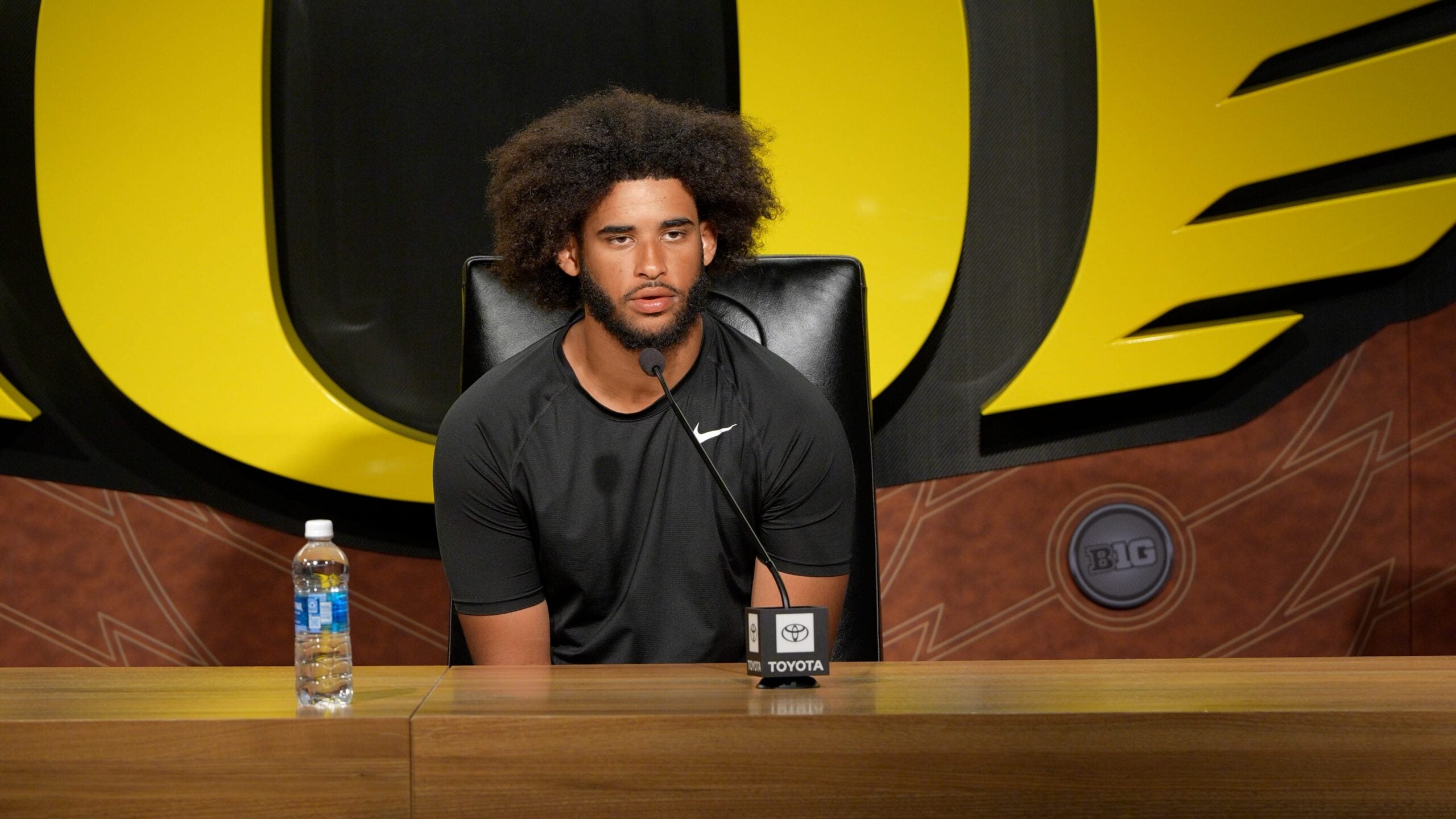
Oregon Ducks quarterback Dante Moore had an incredibly difficult decision to make after last year. Between rejoining a championship-caliber roster and becoming a New York Jet, Moore opted for Eugene over the Big Apple.
Despite massive speculation, Moore says the Jets played no role in his decision to return to Oregon for the 2026 season, but that claim deserves serious scrutiny. The Oregon quarterback was widely expected to be the second overall pick in the 2026 NFL Draft, a selection that would have likely landed him with the Jets. Moore threw for 3,565 yards and 30 touchdowns while completing 72% of his passes during a strong 2025 campaign. Even with those numbers, inconsistencies in his game remained, and he chose to head back to Eugene instead of securing a rookie contract worth roughly $50 million.
Everyone has been wondering: did the Jets scare him away?
New York has a brutal history with quarterbacks. Zach Wilson was a bust. Sam Darnold struggled mightily before finding success in Seattle. Mark Sanchez never had a stable situation to build upon his early success. The pattern is glaring, and any quarterback prospect paying attention would have reason for pause.
When The Athletic’s Chris Vannini asked Moore whether the Jets’ history influenced his decision, Moore pushed back firmly.
“Not at all. Of course, there was $50 million on the line, a lot to help support my family, but at the end of the day, I don’t play the game for money,” Moore said. “I play the game to tell myself I’ve got a lot to improve. I had a chance to come back and learn more, so when I take that next step next year, I’ll be more prepared for those moments in my life.”
This is the perfect PR answer, and there’s probably plenty of truth behind it. Moore gets to return to Oregon with a loaded roster, compete for a national championship, chase a Heisman Trophy, and enter the 2027 NFL Draft as a more polished quarterback. Those are legitimate reasons to go back to school. From a football development standpoint, the decision makes sense on its surface.
But are we really supposed to believe that his potential landing spot had nothing to do with it?
Quarterbacks understand better than anyone that where they land can completely determine the trajectory of their career. The right coaching staff, the right offensive infrastructure, the right culture around a young passer can be the difference between a franchise cornerstone and a cautionary tale. The Jets have produced far more cautionary tales than cornerstone quarterbacks over the last 15 years.
I find it hard to believe that Moore and his camp didn’t weigh the Jets’ organizational dysfunction as part of this calculus. Passing on a contract worth roughly $50 million is not a decision anyone makes lightly, and it signals that something beyond simple self-improvement motivated the return. Whether Moore admits it publicly or not, an organization that has repeatedly failed to develop quarterbacks is not exactly a dream destination for a prospect who wants to maximize his potential.
The most important aspect of this situation is what it says about the Jets. When a consensus top-2 pick would rather forfeit generational money and return to college than risk landing with your franchise, the problem isn’t the prospect. Passing on the Jets might have been the smartest business decision Moore could have made.
