
Comments from Chaz Coleman’s high school coach make his Tennessee breakup more puzzling while helping show if Jim Knowles deserves any blame
Penn State transfer EDGE Chaz Coleman won’t be suiting up for the Tennessee Vols this fall after being medically disqualified from the UT football roster late last month.


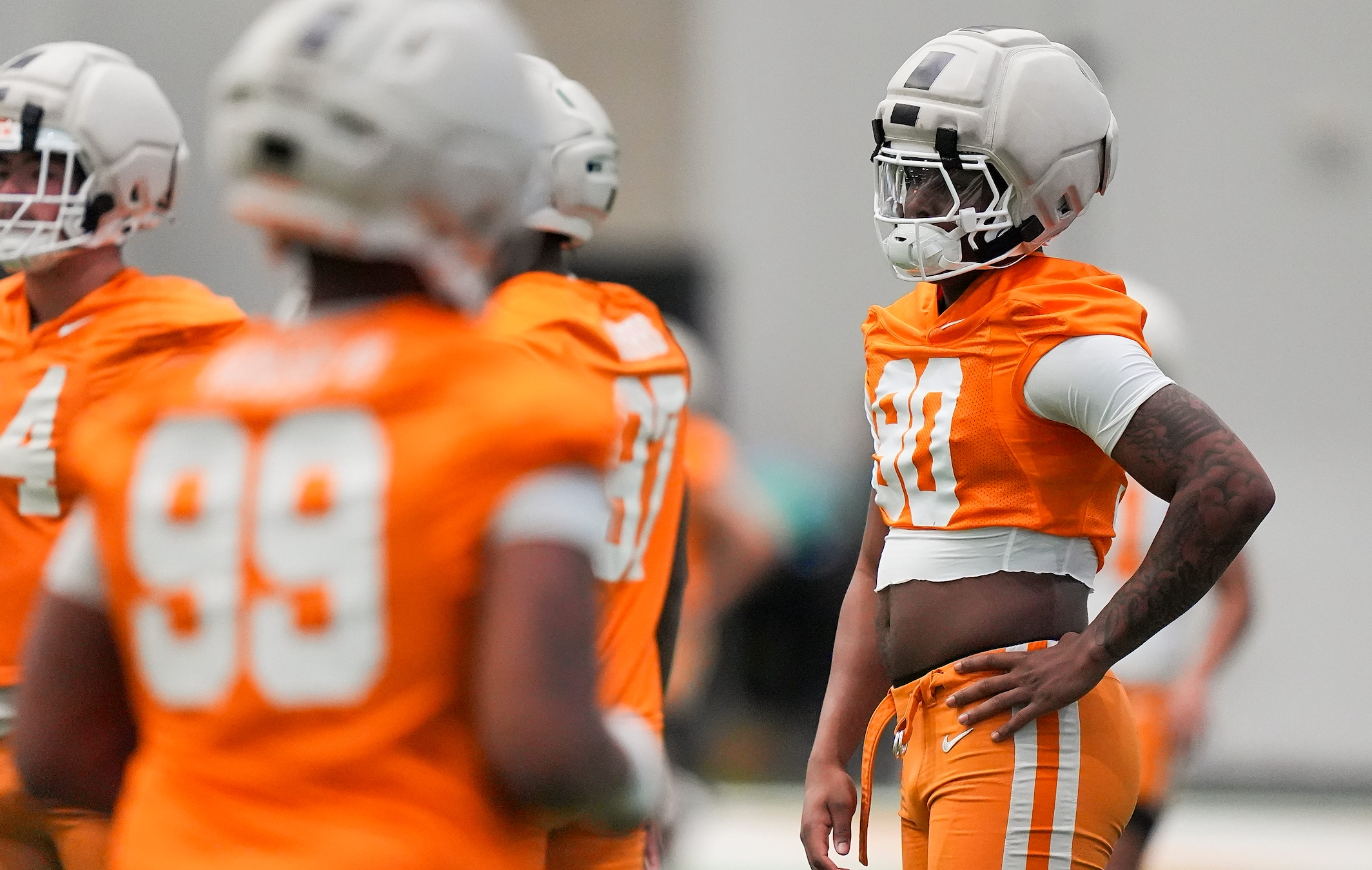
EDGE Chaz Coleman was officially medically disqualified from the Tennessee Vols’ roster late last month after a chaotic offseason that included missing most of spring practice and not participating in offseason workouts.
Coleman, who transferred from Penn State to Tennessee in January, reportedly dealt with personal issues after arriving in Knoxville.
The Ohio native was arguably the Volunteers’ biggest transfer addition of the offseason — Coleman is viewed as a player with NFL talent — but he won’t be a factor for Tennessee in 2026 after being removed from the roster (UT has a lack of premier pass rushers on the roster as a result).
One of the big reasons why the Vols were so aggressive in their pursuit of Coleman was because he played for new Tennessee defensive coordinator Jim Knowles last season at Penn State.
And unsurprisingly, Knowles has taken some heat this offseason because of the way the situation with Coleman played out, with many fans and media analysts wondering if he should’ve seen all of this coming.
The general feeling, though, is that because Coleman didn’t have any issues at Penn State last season, there’s no reason Knowles should have anticipated the transfer EDGE having any issues at Tennessee.
“I think that’s been the natural reaction,” said VolQuest’s Austin Price in June when asked if Knowles deserved any blame. “[Because] you have so many coaches that came from Penn State [and fans ask], ‘How could you not know this?’ That’s what everybody says. In talking to people, the kid was not like this at Penn State.
“Now, the only thing I can compartmentalize here is that he did not get to Penn State until the summer last year and went straight into football stuff. There was no offseason. And then, of course, he had the concussion last year late in the year. I don’t know where things went amiss for him. You wish him all the best, but you’ve gotta move on and figure out what Tennessee is going to be along the edge.”
Old comments from Chaz Coleman’s high school coach paint a different picture than what Vols fans saw this offseason
Some comments from Coleman’s high school coach from two years ago paint a much different picture of the Penn State transfer than what Vols fans saw this offseason.
And those comments help show why Knowles shouldn’t carry the blame for the way things played out for Coleman at Tennessee.
Matt Richardson, who coached Coleman at Harding High School, spoke to On3 in 2024 and praised Coleman’s work ethic, leadership, elite athleticism, and accountability.
“If you just watch his basketball highlight film for two minutes, you’ll see he’s a walking double-double,” said Richardson. “He’s dunking all over the place and showing his explosiveness and all that good stuff. But once basketball was over, he did everything I asked him to do. He came to lifting and did everything we asked of him.“
“He’s grown into a leadership position,” added Richardson. “He’s never been asked to do that until this year. He embraced it and did a great job leading the guys. He’s a talker once you get to know him… After the game, he’s the last one in there cleaning everything up, making sure it looked like it did when we got there. That’s Chaz. He does all that without being told.”
I believe that the best way to get the best view of a player’s true self is by talking to high school coaches and teammates. I just think that’s the best way to get the best overall picture of a player’s character, work ethic, etc.
So when you hear those comments from Coleman’s high school coach, combined with the fact that he didn’t have any issues as a true freshman at Penn State, it’s easy to understand why Knowles was on board with going all-in on landing the talented pass rusher.
What happened at Tennessee this offseason is clearly something that no one saw coming. And it seems there are a couple of reasons for it that combined to create the perfect storm of dysfunction.
For starters, there’s the fact that Coleman went from being three hours away from home at Penn State to 7.5 hours away from home at Tennessee.
The distance from home is actually something Richardson mentioned in his comments to On3 two years ago after Coleman committed to Penn State.
“[Penn State] is far enough away from home that he has that space, but not too far if he has to get back to his family,” said Richardson. “He has a lot of brothers and sisters, so that was important to him and I know the staff made him feel very comfortable.”
Another factor is that Coleman was a late bloomer in high school. He was mostly used as a quarterback before transitioning to a pass rusher under Richardson during his senior season (Richardson’s first year as Harding’s head coach was Coleman’s senior season). Coleman went from being a relatively unknown recruit to being one of the top paid transfers in the nation in about two years’ time. That can be a lot of pressure for a young player to live up to. It’s important to remember the human element here — Coleman is still just 19 years old. Everyone handles that kind of stuff differently. We see established MLB players, for example, struggle for months after signing a lucrative contract with a new team. Athletes aren’t robots and production isn’t automatic. The mental part of the game is just as important as the physical part.
The other factor is the head injury that Coleman suffered at Penn State last season. That injury has reportedly had some lingering effects (such as vertigo). It’s unclear how much that injury impacted Coleman’s offseason, but it certainly sounds like it was a factor.
The Chaz Coleman saga was a disaster for the Vols, but it wasn’t anyone at Tennessee’s fault
Tennessee’s been criticized for some of their roster issues over the last two years (Nico Iamaleava last spring and Boo Carter last fall), so it’s reasonable to question if the Vols need to change their process to avoid these kinds of situations in the future.
Ultimately, though, the Coleman situation is unique, and I don’t think, at least based on what we know, that anyone at Tennessee is to blame for this. I don’t think there’s any way the Vols could’ve seen this coming (that’s the downside to the short transfer portal window in January, which leads to rushed decisions).
This won’t be the last situation like this that we see in college football in the NIL era, which is why the portal window should be pushed back to late April/early May. That’s what would be best for student-athletes, but I’m not sure anyone in a leadership position in college football’s major conferences is thinking about what’s best for student-athletes.
