
2027 NFL Draft Interior Offensive Line Rankings: Top 25 list features the next Tyler Linderbaum and a ton of future starters
The 2027 NFL Draft class boasts a ton of interior offensive line talent. Who are the headliners to know for the class early on?

The 2027 NFL Draft interior offensive line class might not grab headlines the way the quarterback or edge rusher groups do, but after grading 25 guards and centers this summer, the group has more depth than most realize.
That depth grows even further when you factor in college offensive tackles who will inevitably move inside at the NFL level. On the latest edition of Best Spot Available, co-host Joe DeLeone and I worked through the entire interior offensive line class as summer scouting wraps up.
Here are my notes on all 25 players, including where I have them ranked leaving the summer.
THE TOP TIER
No. 1: Kade Pieper (Iowa)
At a hair over 6-4 and now 298 pounds, Pieper continues to grow into his frame, which is really the only major question about him. From a movement perspective and raw power at the point of attack, he displaces gaps and works well in either an outside zone or inside zone running scheme. After starting at right guard last season, Pieper moves over to center, where he looks like the next Tyler Linderbaum.
No. 2: Greg Johnson (Minnesota)
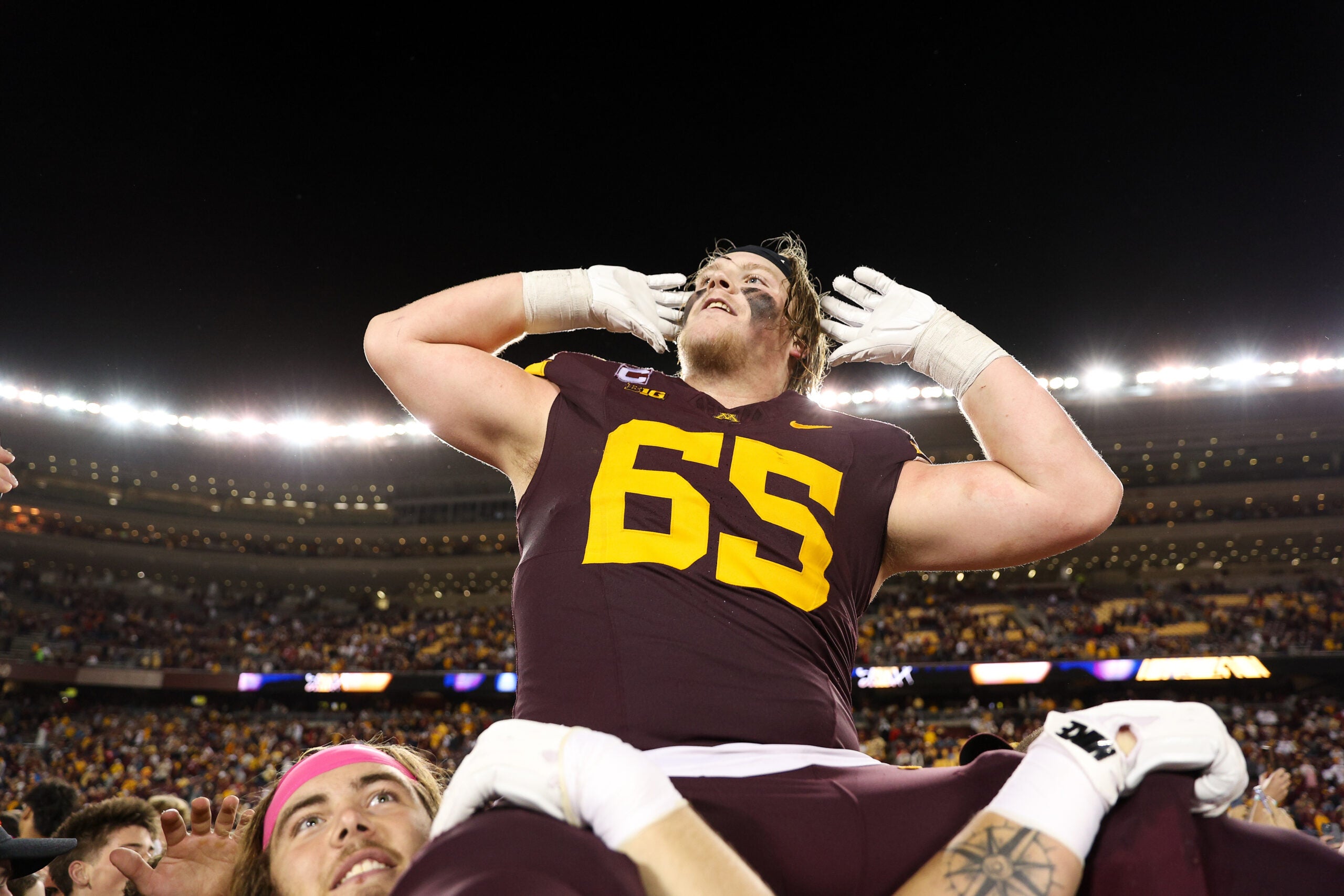
At 6-6.5 and nearly 330 pounds, Johnson has spent the last couple of years starting at center and right guard. I actually liked his center tape a lot in 2024 and was a little confused why they moved him to guard last season. You quickly realize this is a talented offensive lineman who could play either spot. His ability to play with consistent leverage despite being a taller player is something special, and there just really isn’t a glaring weakness in his game.
No. 3: Carter Smith (Indiana)
This is the first college offensive tackle on my list. When you watch him at left tackle for the Hoosiers, it is clear that his ability in pass protection is not going to translate well. He lacks the length and overall range, which makes his outside shoulder a little weak at times. But he has impressive movement skills and a body type that should work well inside, especially at center. For a heavy zone team, Smith’s movement skills can be a huge asset at the next level.
No. 4: Anthonie Knapp (Notre Dame)
Another college left tackle, Knapp is actually moving into left guard for Notre Dame this offseason. He is pound for pound one of the strongest overall players on the Notre Dame roster. His range at tackle is solid, but he is not always comfortable in one-on-one pass protection situations. Inside, his raw power and movement skills should shine. This feels like a future starter at the NFL level at either guard or center, with a lot of flexibility.
No. 5: Evan Tengesdahl (Cincinnati)
His game is predicated on being the bouncer at the club, and he plays with a nasty demeanor that you love as an offensive line enthusiast. He doesn’t have the greatest lateral mobility in the world, but he’s explosive out of his stance and incredibly powerful. He has multiple years of eligibility remaining, so I do not necessarily know if he will be in the 2027 NFL Draft. If he does declare, he feels like a top-100 pick to me.
THE MIDDLE OF THE PACK
No. 6: Austin Siereveld (Ohio State)
Like Knapp, Siereveld started at left tackle for Ohio State this past year but is moving inside to guard for the Buckeyes. At tackle, he gets by with solid movement skills and good technique overall, but there are limitations to him as a rangy offensive tackle. Inside, his movement skills should shine, and his consistent technique is a big anchor in both the run and passing game.
No. 7: Brandon Baker (Texas)
After starting at right tackle as a sophomore, Baker will be moving inside to right guard as a junior, where he should feel a lot more comfortable. He’s a gifted enough athlete to play off the tackle, but there was clearly some discomfort in pass protection, playing on his heels too much. Inside, you’re playing with less space, which should allow him to showcase his explosiveness. As his body continues to fill out developmentally, there should be even more power that comes along.
No. 8: Ashton Beers (Minnesota)
I asked myself why Greg Johnson had to move from center to guard for Minnesota. Then my co-host Joe DeLeone said I need to go watch Ashton Beers. That’s why. Another massive interior offensive lineman, Beers is not as physically gifted as Johnson from a flexibility and explosiveness perspective, but he moves well for his size, plays with good leverage, good hand strength, and the ability to latch at the point of attack. There’s nothing flashy about his game, but he’s an incredibly efficient football player.
No. 9: Cayden Green (Missouri)
I’m honestly not in love with Cayden Green. He’s a guy who has played both guard and tackle between his time at Oklahoma and Missouri. Inside, his athletic gifts are sufficient to good, but there are physical limitations, and his body is overly sloppy right now. His technique and frame need to be a lot more consistent if he wants to make a clean transition to the next level.
No. 10: Wendell Moe (Tennessee)
The former Arizona transfer was a player I didn’t love in 2024, but in 2025 for Tennessee, he looked like a much more consistent player from a technical perspective. His conditioning also took a step forward, although there was still a lot of bad weight on his frame. For a bigger guy, he moves well enough to play at the NFL level and potentially start at some point. His raw power was showcased a lot more in his one year with the Volunteers.
No. 11: Braelin Moore (LSU)
The former Virginia Tech transfer is not big and lacks length, but he moves well, and he is a battler. I’m not sure if he will ever be a starting center at the NFL level, but he plays with the type of tenacity and communication skills that I’m just not going to bet against.
No. 12: Shadre Hurst (Houston)
The former Tulane transfer is an awesome football player. But at a hair over 6-1 and 293 pounds, he is extremely undersized. I wish Houston would play him at center to see what that could look like. For now, he’s a guard only, which brings major questions from a pure size and mass perspective.
DEVELOPMENTAL PROSPECTS AND DAY 3 TYPES
No. 13: Iapani Laloulo (Oregon)
Another center with absolutely no length, built like a bowling ball. He’s a tenacious blocker who works to the second level well and has solid enough lateral mobility to make it matter, but he has limited range and no length to sustain leverage at the point of attack, which creates some bad losses in the run game.
No. 14: Luke Montgomery (Ohio State)
I was really disappointed with Montgomery’s film. On the hoof, he looks the part. He’s a good athlete, and he’s flashed, but his overall power profile at the point of attack was hit or miss, and he was on the ground way too much. His hand technique also needs major improvement. There’s talent there, but he left me underwhelmed.
No. 15: Justin Evans (Nebraska)
He’s basically the complete opposite of Montgomery. Not a great athlete, but he’s a physical, tough interior offensive lineman who gets the most out of his ability.
No. 16: Patrick Kutas (Ole Miss)
Kutas has a good frame and is an incredibly well-coached offensive lineman who also plays with requisite tenacity. You admire the way he plays, even if there are some clear limitations to his game.
No. 17: Drew Bobo (Georgia)
Bobo is incredibly smart, consistent, and technical. However, he lacks athletic traits, which does seriously limit his ceiling.
No. 18: Jacob Maikkula (Oklahoma)
I was really digging Maikkula’s film. I thought he had a ton of consistency, good communication skills, and he was a better athlete than I initially gave him credit for. Then I watched the Ole Miss game, and that soured me on him. I know he faced a couple of talented interior rushers in that game, especially Will Echoles. But his inability to halt power at the point of attack was really troubling.
No. 19: Alani Noa (USC)
He’s a bull in the china shop who is just way too out of control for my tastes. I think his explosiveness is fine and his power is good, but when he misses his landmarks, he misses really badly.
No. 20: Ashton Craig (Notre Dame)
Craig would be a lot higher if not for injury, and unfortunately his durability issues are well documented, causing him to miss a lot of games the last couple of years. He’s a good athlete for the center position and has good overall technique. But until he’s able to stay on the field consistently, he’s just a body at this point.
No. 21: Carson Hinzman (Ohio State)
Another tenacious interior offensive lineman who’s been through the wringer at Ohio State, replaced and then came back. I like a lot of the qualities he brings to the table, but I just don’t think he has the tools to stick at the NFL level for a long time.
No. 22: Drew Evans (Indiana)
Similar to what I just said about Hinzman. He’s played guard and could play some center. He plays with a reckless abandon. I like the communication skills and the experience factor, but he does not have any one trait that wows you enough.
No. 23: Cash Cleveland (Texas Tech)
The former Colorado freshman All-American mixed in last year for Texas Tech and is hoping for a bigger role this season. There are some things to like, but the sample size is just way too small to trust right now.
No. 24: Braydon Nelson (Oklahoma State)
The North Texas transfer really underwhelmed me. When I first saw his body type, I thought I was going to like him as a college offensive tackle who’s probably more of a guard at the NFL level. But he was sloppy, didn’t move well, and was a disappointing watch overall.
No. 25: Aidan Banfield (North Carolina)
I do not understand this player whatsoever. He has some draftable feedback at the NFL level, and I don’t get it. He doesn’t have a great frame; he’s got sloppy weight on it, he doesn’t move well, and he doesn’t hold up against power at the point of attack. I’m not sure what the selling point is with Banfield.
The interior offensive line class for the 2027 NFL Draft has more intrigue than it gets credit for, especially when you factor in the wave of college tackles transitioning inside. Iowa’s Kade Pieper sits atop the group as a legitimate early-round prospect, and the depth behind him creates real value throughout the draft.
For the full breakdown, check out the latest episode of Best Spot Available.
