
One specific trait shows why Giants’ Jaxson Dart can become a franchise quarterback in New York
Dart was the most efficient quarterback in football last season on plays that took four seconds or more to throw after the snap.


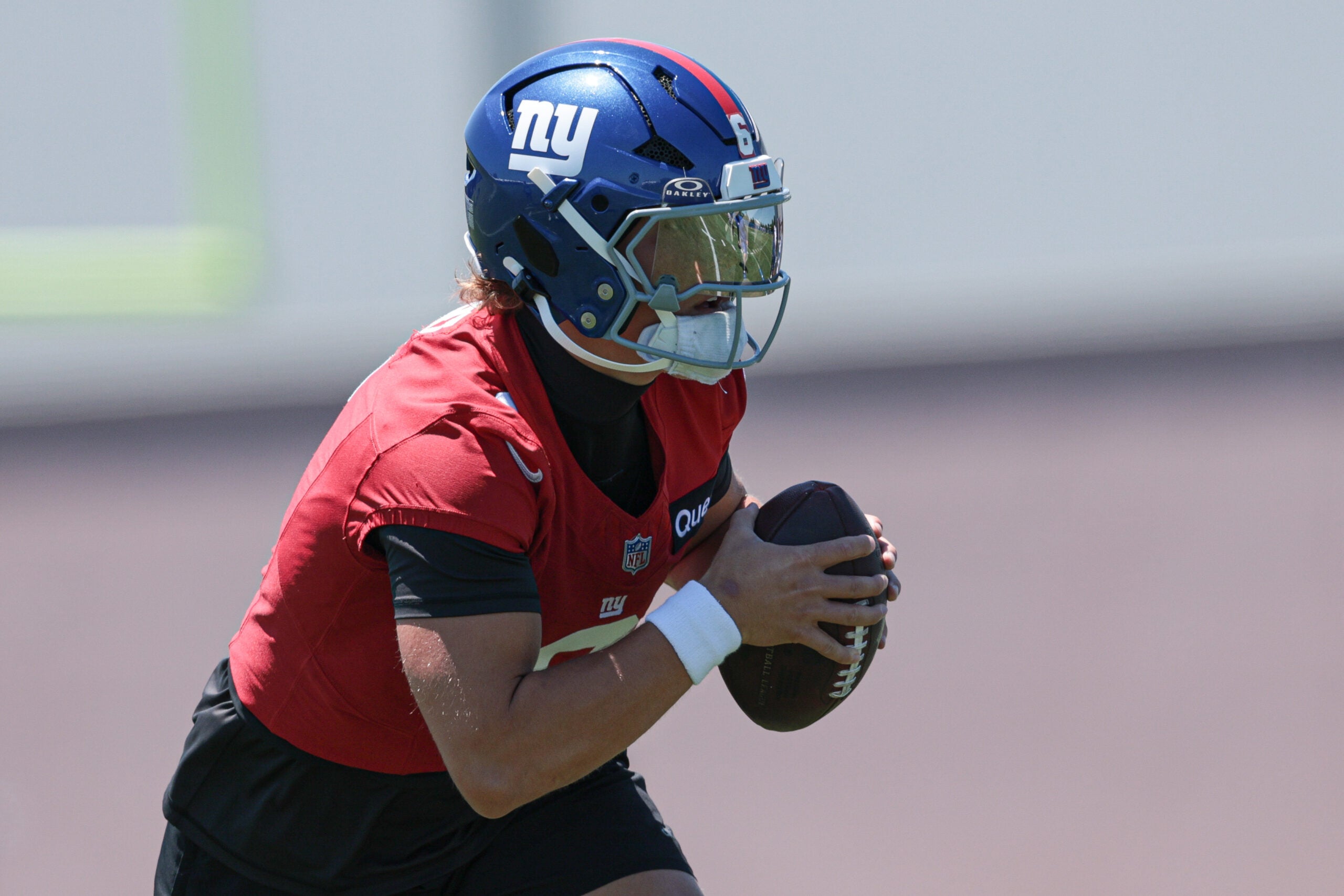
Jaxson Dart finished his rookie season with the New York Giants as the NFL’s best quarterback on out-of-rhythm plays, according to FTN Fantasy charting data. That single statistical distinction reveals why the Giants can build around the 25th overall pick from the 2025 NFL Draft and why his development under a revamped coaching staff could accelerate in Year 2.
Dart posted a 0.38 EPA per play on out-of-rhythm throws (defined as plays with a time to throw of 4.0 seconds or longer, excluding garbage time) during the 2025 regular season among quarterbacks with at least 15 such attempts. He ranked ahead of Justin Herbert, Lamar Jackson, Trevor Lawrence, and Patrick Mahomes. The worst performers in the metric included Shedeur Sanders, Marcus Mariota, Joe Flacco, J.J. McCarthy, and Jacoby Brissett.
What out-of-rhythm success means for Dart’s future
The ability to create outside of structure, scramble, and throw on the move separates Dart from most rookie quarterbacks. Those traits provide a foundation he can lean on while developing other areas of his game to match NFL-level demands.
Dart’s overall rookie numbers were reasonable: a 91.7 passer rating, 63.7 completion percentage, 15 touchdown passes, and five interceptions. He finished 13th in adjusted EPA per play, 17th in success rate, 23rd in completion percentage over expectation, and 10th in air yards. None of those figures scream elite, but they paint the picture of a competent first-year starter with room to grow.
The trait that matters most is his ability to extend plays and produce when the pocket breaks down. Rookie quarterbacks who possess elite physical tools can ease into the professional game because those traits compensate for the areas still under construction. For Dart, out-of-structure playmaking is that tool. It gives him leeway to develop his processing, timing, and accuracy within the rhythm of the offense without dragging the Giants’ production down in the process.
A coaching infrastructure built for development
The Giants’ offensive coaching staff underwent a significant overhaul, and the new pieces align with what Dart does well. Head coach Jon Harbaugh brings experience at the highest level, while offensive coordinator Matt Nagy brings a Kansas City Chiefs-style scheme. Quarterbacks coach and pass game coordinator Brian Callahan spent time as the Tennessee Titans’ head coach and previously served as Joe Burrow’s offensive coordinator with the Cincinnati Bengals. Senior offensive assistant Greg Roman, one of the most respected coaches in the league when it comes to designing run game concepts, adds another layer of infrastructure.
The coaching staff can build an offense around Dart’s strengths while systematically developing his weaknesses. Roman’s run game expertise complements Dart’s mobility, and Nagy’s scheme provides the kind of structure that rewards quarterbacks who can improvise and take advantage of broken plays.
Dart is not an elite quarterback at this stage of his career, and he doesn’t need to be. But the franchise quarterback potential is there, and the statistical evidence from his rookie season supports the idea that the Giants have a viable starter who can take a meaningful step forward in Year 2.
