
Jaxson Dart’s preseason debut sparks debate over Giants quarterback’s 2nd-year development
New York Giants quarterback Jaxson Dart’s preseason debut created some heavy debates. What can we make of that performance?

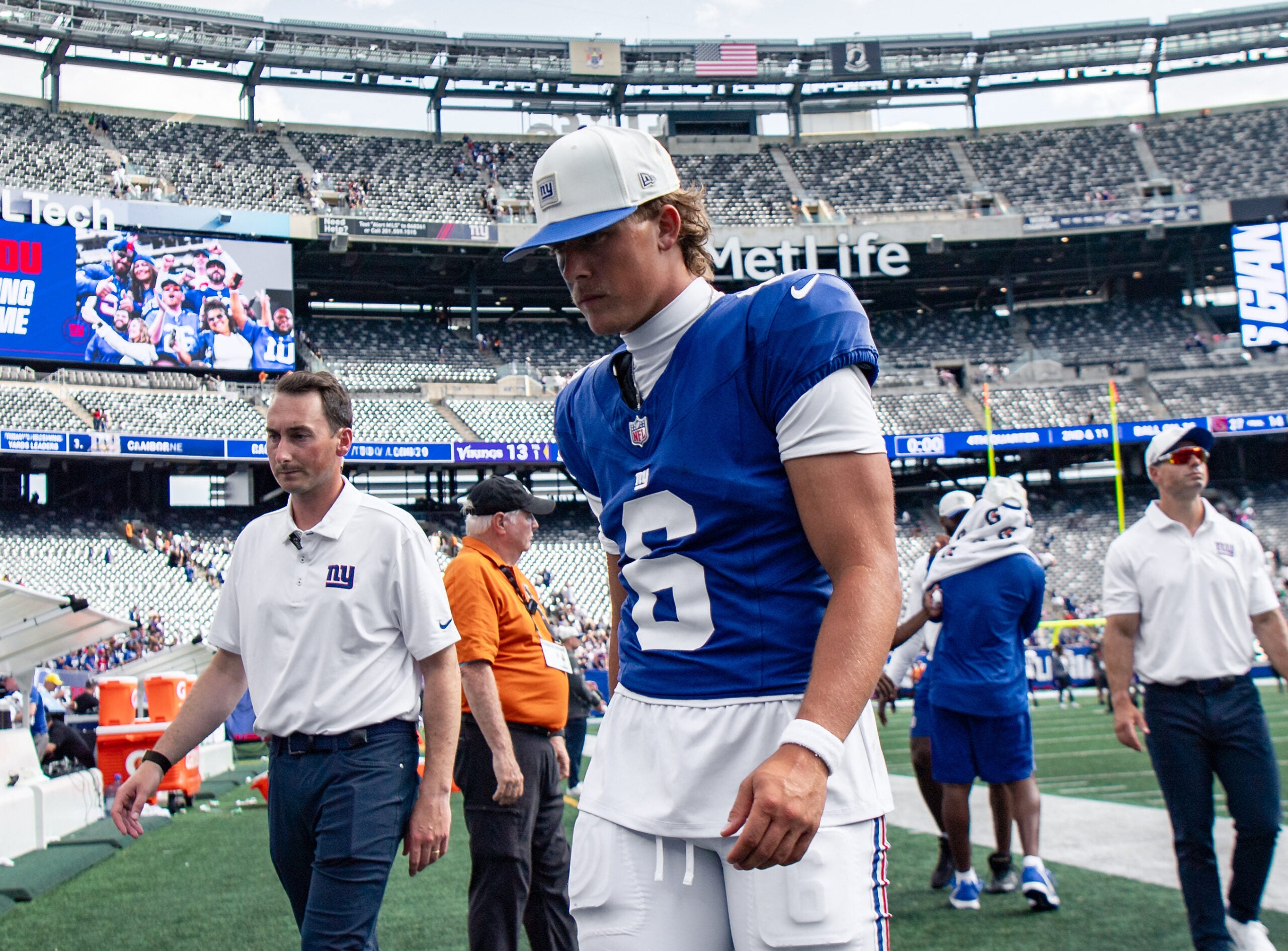
Jaxson Dart’s abbreviated preseason debut with the New York Giants did little to settle the growing questions about his development as a 2nd-year quarterback.
With just four pass attempts in the opener against the Minnesota Vikings, the former Ole Miss signal caller delivered a mixed bag that left evaluators split on whether there’s genuine progress or more of the same peaks and valleys from his rookie season.
The biggest talking point coming into the game centered on Dart learning an entirely new system under head coach John Harbaugh.
Last season under Brian Daboll and then interim coach Mike Kafka, the Giants essentially babied Dart by running a heavy dose of the RPO concepts he thrived on at Ole Miss. Nothing was overtly complex. He performed well in those situations, but it didn’t push him to grow.
That dynamic has changed.
Dart spent the majority of this game under center, something he rarely did at Ole Miss or during his rookie year. The Giants ran the football, and the passing opportunities were extremely limited. His stat line was unimpressive on the surface: 3-of-4 passing with one highlight-reel touchdown throw to rookie wide receiver Malachi Fields.
The throw that stood out
The touchdown to Fields was the type of play that makes you believe in Dart’s upside.
Rolling against his body, Dart extended the play and ripped the ball to Fields without hesitation, allowing the receiver to use his traits as a contested-catch winner in the red zone. That kind of improvisational ability is what the Giants want to facilitate and build upon.
If they can replicate those moments consistently, it forces defenses onto their heels because they have to account for Dart scrambling and extending plays.
But here’s the concern: there’s a baseline of sustainable quarterback play that needs to exist before the highlight-reel moments translate into wins.
The pocket movement, the processing speed, the awareness of where he is on the football field still appear to be works in progress. The sack he took illustrated a recurring issue from his time at Ole Miss.
When his first read wasn’t open, instead of navigating to a second option, Dart panicked and tried to run out of the pocket. The pocket collapsed, and he went down.
The Tyrone Tracy situation adds another layer. Tracy missed a block that resulted in Dart getting annihilated, and the hit sent Dart to the medical tent — again. That’s not on Dart. Tracy needs to be paying attention, and the blame falls squarely on him.
Still, there’s a small element of pocket awareness that could have helped Dart sense the unblocked pressure and evade it. He’s quick enough to do so, but it didn’t happen.
What the Giants are building around Dart
The larger context matters here. The Giants are merging three different offensive philosophies from Matt Nagy, Greg Roman, and Joe Callahan into one system. That level of complexity means Dart isn’t just learning the offense; the coaching staff is also figuring out what the offense is going to be around Dart.
The major beat reporters covering the Giants have consistently described Dart as slowly learning how to play within this new system.
There’s a strong case that the Giants are intentionally limiting Dart’s exposure in the preseason. They don’t want other NFL teams evaluating his performance while the offensive identity is still taking shape.
The run-heavy approach in the opener wasn’t an accident. It’s likely what this team will lean on for the entire 2026 season.
The realistic expectations for Dart in 2026
The path forward for the Giants doesn’t require Dart to throw for 3,500 yards and 30 touchdown passes. It requires them to run the football effectively, figure out who replaces Tracy’s carries as a reliable complement in the backfield, and let Dart play well enough within a run-oriented, tight end-heavy system.
The two throws to tight end Isaiah Likely were encouraging in that regard. Dart read the field, saw Likely open, and got the ball out quick, exactly the type of processing you want from a 2nd-year quarterback.
If the run game works, Dart plays better. And if the defense holds up its end, this Giants team could do some damage despite the quarterback questions.
The preseason debut didn’t confirm a disaster, but it also didn’t quiet the concerns about whether Dart can be a sustainable, face-of-the-franchise quarterback. That answer will take far longer than four pass attempts to reveal.
