
Are the Buccaneers making a mistake with their rushing attack before the season even begins?
New Buccaneers offensive coordinator Zac Robinson has relied heavily on zone concepts when it comes to his rushing attack over the last couple of years and it appears as if he’s bringing that to Tampa Bay. Is it the best idea?


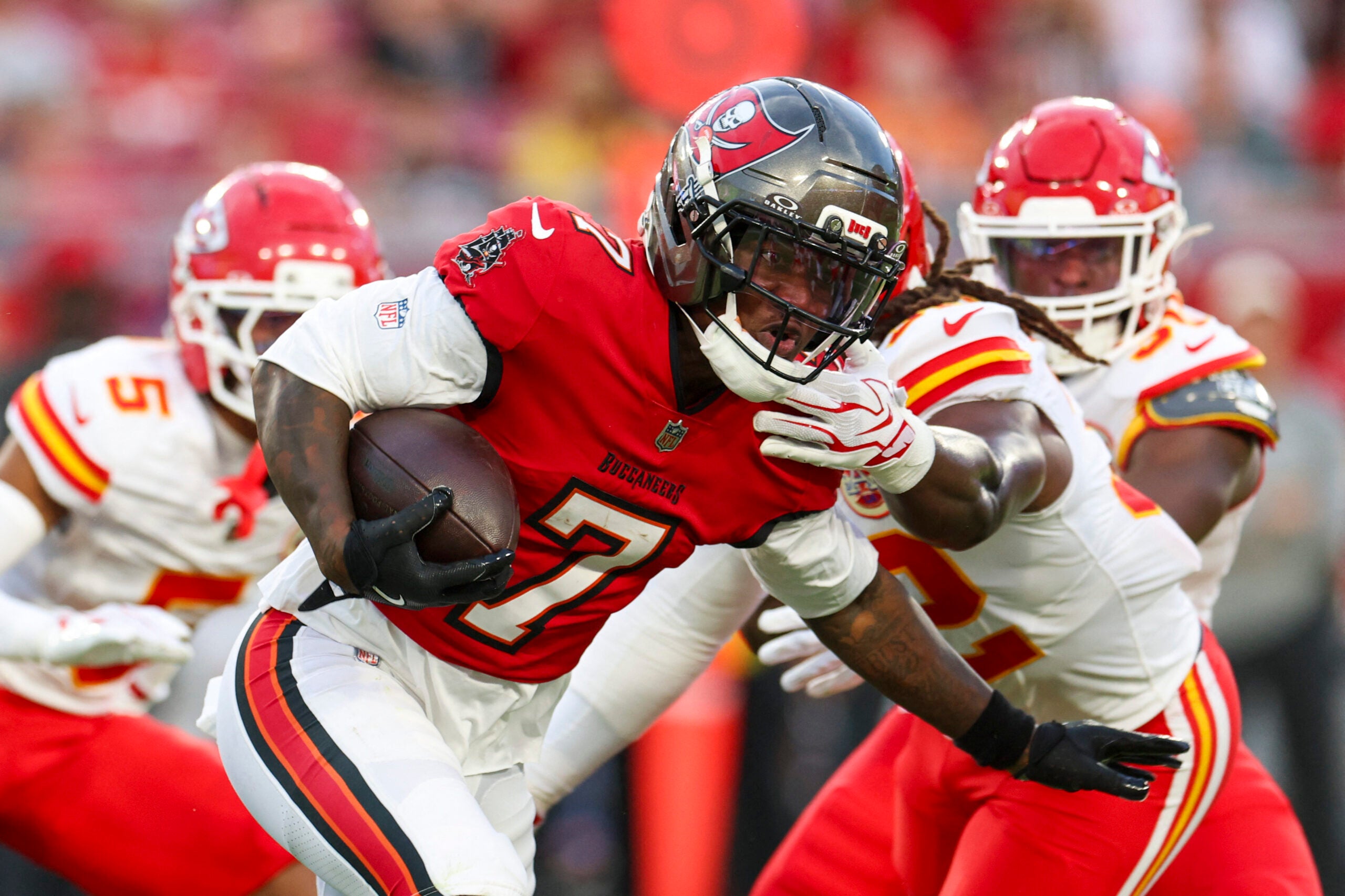
The Tampa Bay Buccaneers return the exact same offensive line and nearly the same running back corps from 2024, yet new offensive coordinator Zac Robinson appears to be installing a zone-heavy rushing attack.
That’s the question worth exploring as Tampa Bay prepares for its Week 1 matchup against the Cincinnati Bengals. Robinson, brought in from Atlanta, ran zone concepts 76% of the time during his two seasons with the Falcons.
The Buccaneers’ 2024 tape, however, tells a very different story about what works best with this group of players.
Robinson’s preference for concepts, mostly of the wide/outside variety, should sound familiar to Buccaneers fans. Liam Coen and Dave Canales both attempted similar schemes in 2023-2024. Canales leaned more toward mid-zone, while Coen preferred a balanced approach between zone and gap.
Through the first 10 games of the 2024 season, according to Pro Football Focus, the Buccaneers ran zone 52% of the time. The results were fine. Per Sports Info Solutions, Tampa Bay averaged 105.8 rushing yards per game (11th in the NFL), 4.9 yards per carry (tied for fifth), a -0.02 EPA per attempt (13th), and a positive play rate of 47% (eighth). Those numbers exclude quarterback runs entirely, so no sneaks, scrambles, or designed runs for Baker Mayfield. We’re strictly talking running back production.
Overall it was OK, but inconsistent. The opener against the Commanders went well, but the next two weeks the Buccaneers struggled to generate anything on the ground. That inconsistency prompted Coen to rethink his approach.
The shift to gap concepts changed everything
After the bye week in Week 11, Coen flipped the script. The Buccaneers ran gap concepts 59% of the time, an 11% swing from zone to power, and the results were obvious.
Over those final seven games, Tampa Bay led the entire NFL with 1,095 rushing yards, which translated to an NFL-best 156.4 yards per game. The Buccaneers also led the league with 5.4 yards per carry, per Sports Info Solutions. Their EPA per attempt jumped from -0.02 all the way to 0.07, good for third in the NFL. Their positive play rate climbed from 47% to 52%, which finished second. The lowest single-game total during that stretch was 134 yards, and three games eclipsed 200 rushing yards.
The shift worked because it was better suited for Bucky Irving. He’s a decisive, downhill runner who thrives when the hole is created for him rather than having to read, process, and choose between banging, bending, or bouncing in zone concepts. The offensive line thrived in gap schemes, too, despite already being one of the better units in the NFL.
And that’s the key, here. Sure, the Buccaneers rushing attack ranked in the upper-half of the league during the first 10 weeks of the 2024 season, but it was elite after the bye week.
If you can get elite production in the NFL, you need to do whatever makes sense to keep that going, which includes the process. Why go back on that?
The same cast of characters is back, so why change?
That’s the crux of the question. The Buccaneers return the basically the exact same crew from 2024 into 2026. The only swap is Kenneth Gainwell replacing Rachaad White. The offensive line has played together for three straight seasons now, even though injuries prevented the full five-man unit from taking a single snap together in 2025. They’ve been on the same practice field and in the same system long enough to have continuity.
If it ain’t broke, don’t try to fix it.
As mentioned earlier, Robinson ran zone 76% of the time in Atlanta. That tells me he’s going to want to do the same thing here. And the preseason data, while limited, supports that concern. Robinson did call more power than zone in the 2026 preseason, but 21 of his 26 gap runs went to Josh Williams (12) and Barika Kpeenus (9), two big, physical backs who live between the tackles. Irving had two zone runs to one gap run. The other backs received zone looks as well. The scheme appears tailored by personnel grouping, with zone remaining the primary approach for the starters.
Robinson has a blueprint if things go sideways
The optimistic case is that Robinson can pivot the way Coen did in 2024 if the zone concepts aren’t producing at a high enough level. His offense shares a lot of the same infrastructure and philosophies as Coen’s, and the 2024 blueprint exists as a roadmap.
Tampa Bay needs this running game to be productive in 2026, especially if wide receivers Jalen McMillan and Emeka Egbuka miss time early. Things are trending in the right direction for both, but their Week 1 status remains unclear.
The running game could be the safety net this offense leans on, but only if it’s executed properly. Whether Robinson’s zone-heavy approach can produce elite results with a roster that already proved it thrives in power is the one question only the regular season can answer.
