
Tennessee Titans tight end duo of Gunnar Helm and Daniel Bellinger built to unlock Brian Daboll’s heavy personnel vision in modern NFL meta
The NFL is steering toward heavy personnel in 2026. the Titans are now equipped to really lean into that. Here’s how:


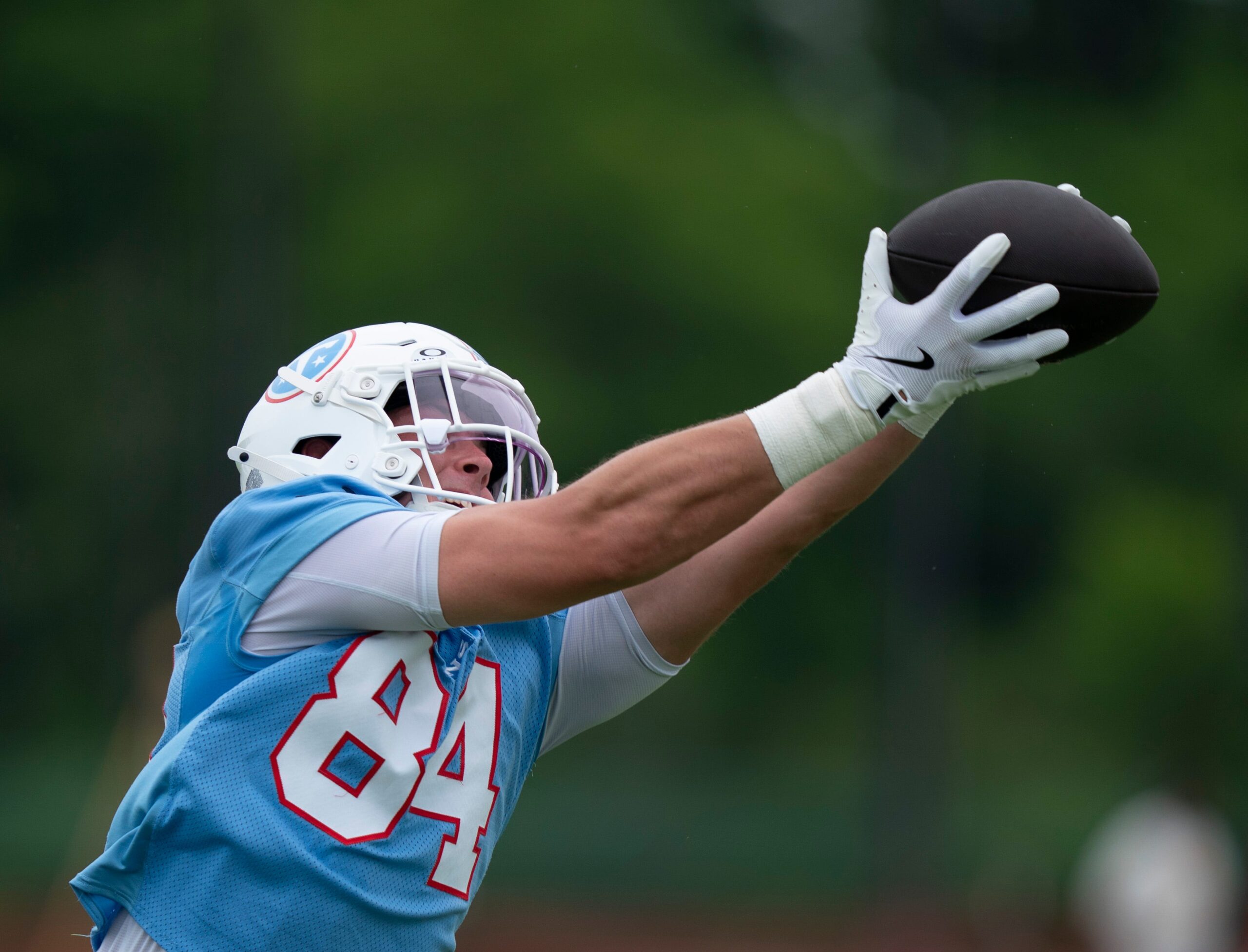
The Tennessee Titans tight end room looks different in 2026, and the composition of this year’s group tells you everything about where the offense wants to go. Second-year tight end Gunnar Helm and free agent addition Daniel Bellinger give the Titans something they simply did not have last season: a well-rounded duo capable of blocking and catching at a level that allows offensive coordinator Brian Daboll to lean into the heavy personnel trend sweeping across the NFL.
A different kind of tight end room
Last year’s tandem of rookie Helm and Chig Okonkwo had clear limitations. Okonkwo was one of the most electric yards-after-the-catch tight ends the Titans have had in some time, but the consistency with which they could get him the ball just was not there for a player Tennessee would want to re-sign. He was also a practical zero in the blocking game, ranking among the worst blocking tight ends in the league. That combination is part of why he ended up signing with the Commanders in free agency.
Helm, meanwhile, showed legitimate promise as a sure-handed pass catcher in limited opportunities, and he developed as a blocker throughout the year too. His rookie tape looked like a player heading into year two with real momentum. The fair question now is whether he can maintain that efficiency with a much larger workload. He is going to get that chance as the Titans’ TE1 in the passing game.
The Bellinger addition is what changes the math. This is a much more well-rounded duo than what Tennessee trotted out in 2025. Do the high highs of Okonkwo with the ball in his hands offer something more than what Helm and Bellinger bring as pass catchers? Perhaps. But I see it less as a downgrade in pass-catching upside, and more as a different kind of upside. One that unlocks schematic possibilities the old group could not.
Why 12 personnel matters for Tennessee
Here’s the thing about this year’s tight end room: it was built to get with the times. With Bellinger and Helm, the Titans have two viable blockers and two viable receivers on the field at the same time. That puts a defense in conflict because it cannot simply diagnose run or pass based on personnel. This is the offensive meta that the 2025 Rams helped popularize, and Tennessee is clearly trying to join that wave.
The numbers back this up when you look at Daboll’s track record. His 2025 Giants offense — which he obviously installed despite not finishing the year with the team — ran 12 personnel at roughly double the clip Tennessee did last year. If the Titans follow that blueprint and essentially double their heavy personnel looks, Helm and Bellinger are going to spend a lot more time on the field together than fans might expect.
That does not necessarily mean both players are going to dominate the stat sheet each week. Daboll is also known for getting the ball to his top receivers, not building the plane out of pass catching tight ends and running backs. Helm should see an uptick in targets compared to his rookie season, and Bellinger will have his moments in the passing game. But both are likely to post more muted individual numbers relative to their outsized impact on how the offense functions.
The Titans are asking Helm and Bellinger to be the engine behind a schematic shift, not just stat accumulators. Their ability to block and catch at a competent level is what allows Daboll to dial up the multiple tight end looks that put opposing defenses on their heels. That is a genuinely exciting development for an offense trying to get with the times! If Helm takes the year-two leap Tennessee expects, and Bellinger provides the veteran steadiness his track record suggests, this tight end room could quietly be one of the more important position groups on the roster.
