
Notre Dame backup quarterback battle creates intriguing debate behind CJ Carr heading into the 2026 College Football season
Notre Dame’s CJ Carr heads into 2026 as one of the best quarterbacks in CFB. What is the contingency plan if something happens to Carr?

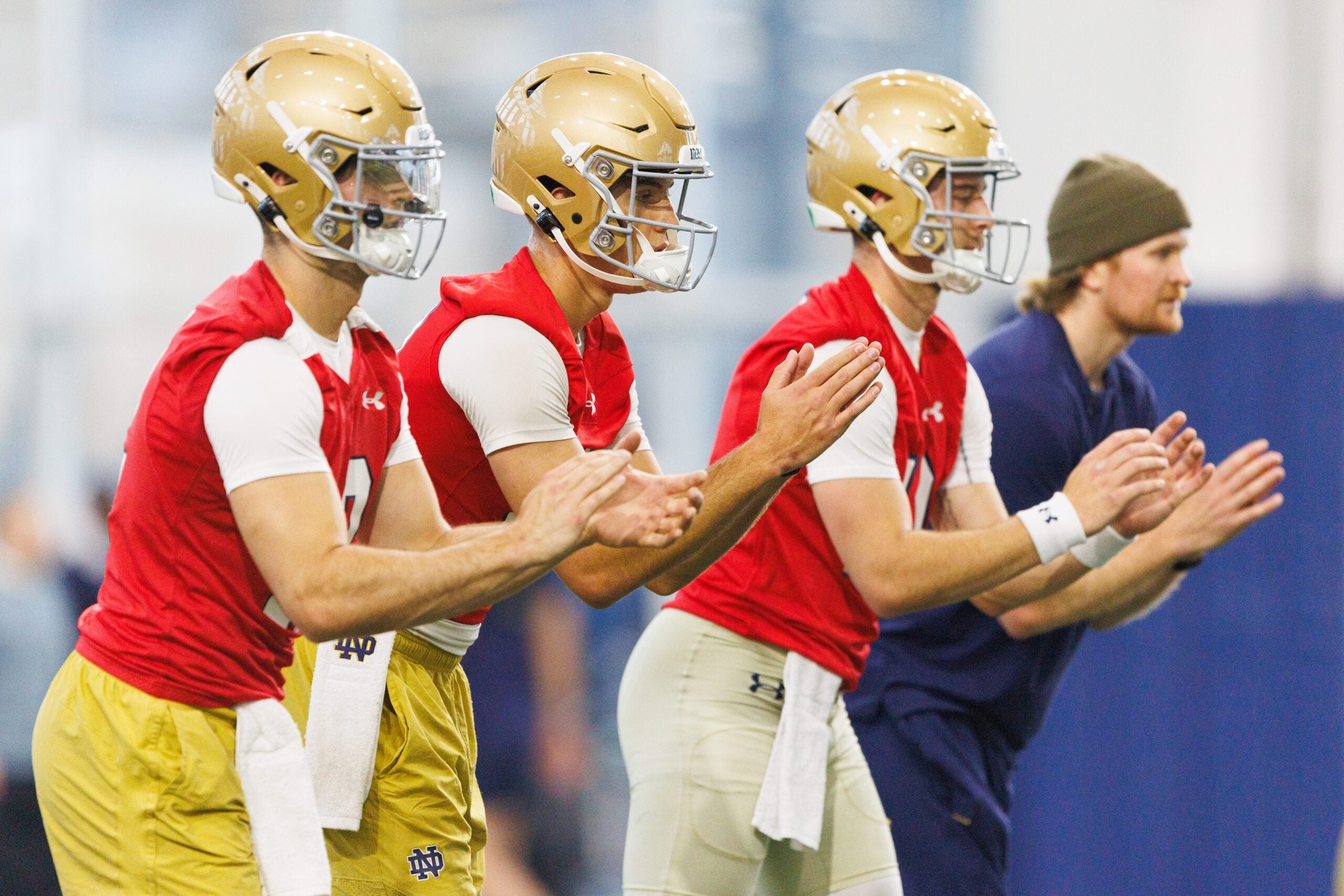
Notre Dame football has no questions at starting quarterback heading into the 2026 college football season.
Redshirt sophomore CJ Carr is coming off a strong redshirt freshman campaign in which he threw for 2,741 yards and 24 touchdowns while completing over 66% of his passes and throwing just six interceptions. Head coach Marcus Freeman and the Fighting Irish expect Carr to be one of the best signal callers in the country this fall.
The conversation that does need to happen, however, centers on the backup quarterback position and who Notre Dame turns to if Carr is unavailable for any stretch of time.
Why the backup conversation matters
Carr was durable during his first season as a starter, playing in all 12 games. That doesn’t eliminate the possibility that something unfortunate could happen. God forbid an injury occurs, but Notre Dame needs a plan in place to make sure the floor doesn’t completely fall out of its season. That’s why the program explored bringing in a transfer quarterback this past offseason. The goal was never to compete with Carr for the starting job but rather to add a reliable veteran who could step in for a game if needed.
That addition never materialized, and Notre Dame now sits with three other quarterbacks on the roster, none of whom have thrown a single pass at the college level. That brings uncertainty, and it creates a genuine debate about the best path forward behind Carr.
The case for Blake Hebert
The easy answer is the most experienced of the group: redshirt freshman Blake Hebert. While Hebert did not appear in a game last season, he has spent a full year in the Mike Denbrock offensive system. That is not nothing. Whether through practice reps, film study, or time in meeting rooms, Hebert holds a clear advantage over the younger quarterbacks in terms of understanding the offense.
You could also make the claim that Hebert might be the rawest and least physically talented of the group, which is not a shot at him. This is a very good roster in terms of physical talent at the position. Regardless, I would predict that Hebert is the guy as the primary backup heading into fall camp. How comfortable everyone is with that remains to be seen and remains very untested.
2 true freshmen to watch
Beyond Hebert, there are two true freshman signal callers to keep a close eye on.
Noah Grubbs was committed to Notre Dame for a long time in the 2026 class and enrolled early. He was in South Bend for the winter and participated in spring practice, giving him several months to learn the playbook and develop alongside Carr and the rest of the quarterback room.
Teddy Jarrard is the more talented of the two freshmen, and the Notre Dame staff is very excited about his potential. Jarrard reclassified from the 2027 class, however, and did not enroll until the summer. That gives Grubbs a meaningful head start in terms of acclimation to the offense.
How the new eligibility rule could change things
There was initially a desire to be patient with both younger quarterbacks. If Carr enters the 2027 NFL Draft and this is his final season in South Bend, the ideal scenario would have Grubbs and Jarrard entering their redshirt freshman seasons with the ability to compete for the starting job against Hebert.
The new 5-for-5 eligibility rule, however, could shift that calculus. If one of Grubbs or Jarrard becomes the primary backup to Carr, he would not burn a year of eligibility. Each player will have five years to play regardless. That could change the formula and challenge the assumption that Hebert is the clear-cut No. 2.
The question becomes this: Are you comfortable with a player like Grubbs or Jarrard stepping in with less mental preparation but more ability to create big plays? Or do you prefer the steadier presence that Hebert provides with his year of experience in the system?
There is no definitive answer to that question today. Fall camp will serve as a significant testing ground for what the backup plan looks like behind Carr, and whoever emerges could become a very important piece of Notre Dame’s championship hopes in 2026.
