
Notre Dame’s subtle offensive wrinkle is coming at the perfect time, and the results aren’t coincidental
Notre Dame football rolled past Stanford with another efficient night on the ground. Why does one subtle offensive wrinkle matter so much with BYU and the playoffs ahead?


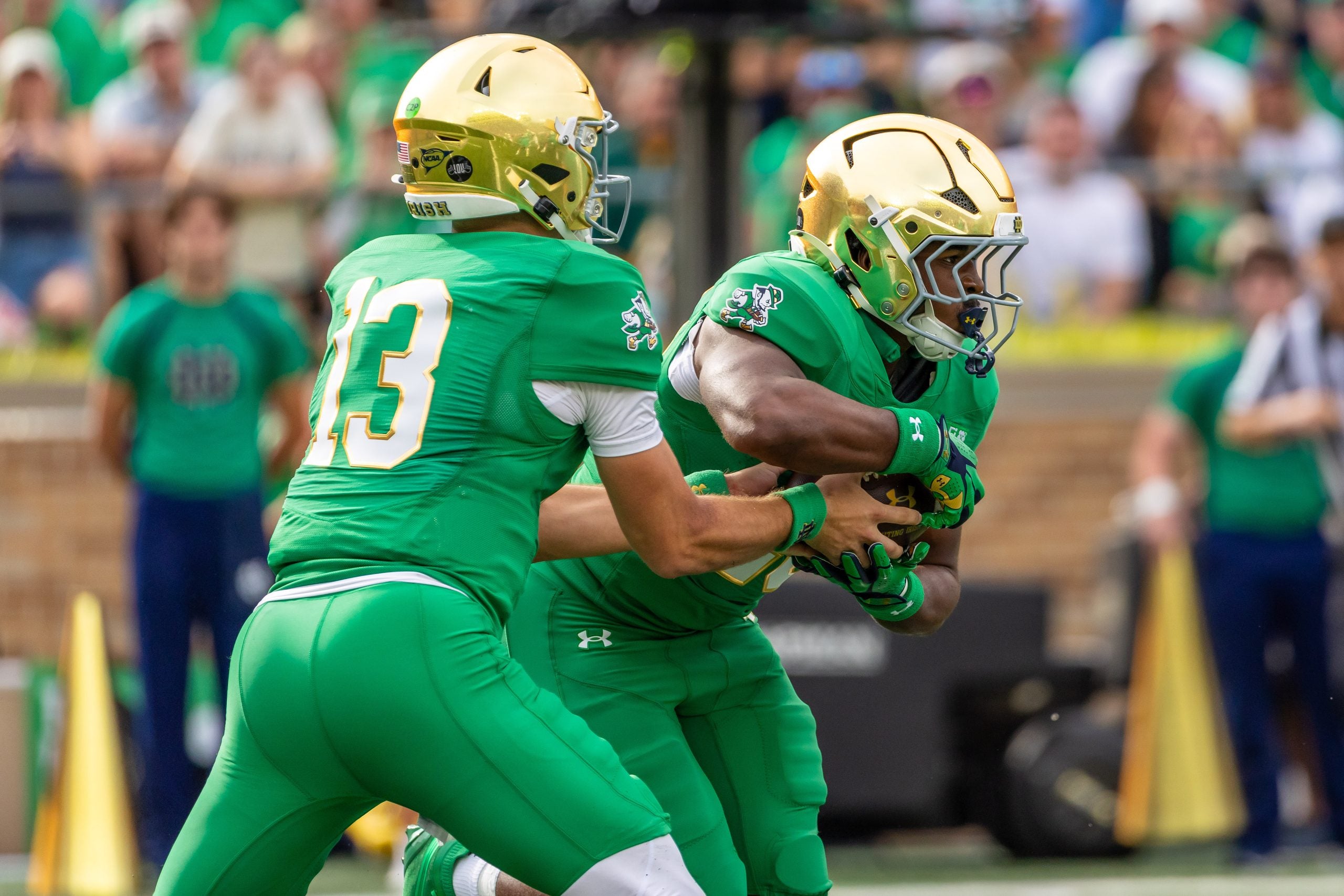
Notre Dame football cruised to a 58-7 victory over Stanford, and the Fighting Irish run game looked like a different unit than it did early in the season.
Quarterback CJ Carr was a big reason why, even if his stat line doesn’t jump off the page. He finished with five carries for 41 yards, and he got those yards in several different ways. Head coach Marcus Freeman and this Fighting Irish staff are beginning to weaponize Carr off run action.
Carr doesn’t need to run for 41 yards every Saturday. I don’t want him to, either. What matters is that Notre Dame offensive coordinator Mike Denbrock is starting to use Carr as a threat in and out of the run game, and the rest of the rushing attack is benefiting from it.
Notre Dame hasn’t leaned on play action under Mike Denbrock
A few games ago, I pointed out that Notre Dame doesn’t use play action much under Denbrock. Last season, the Irish ran play action on roughly 18.3 percent of their snaps, one of the lowest rates in college football in 2025.
When you combine that with a minimal quarterback run threat, it can make your running game pretty static and predictable. There aren’t many options a defense has to deal with.
That approach made more sense with Riley Leonard at quarterback. Leonard was a dynamic runner, so the Irish built a lot of the offense around his legs. Carr is not that type of player, and he never will be.
That’s why I have never pleaded for Notre Dame to run Carr at a heavy volume. It would be a misuse of his talents. Carr is a pocket passer, and the Irish shouldn’t ask him to pretend to be Leonard by calling power reads and zone reads all the time.
My argument has always been about something else. The Notre Dame run game struggled to get going early in the season, and there were plenty of reasons for that.
The offensive line needed time to gel. A few inexperienced running backs were getting their first real live action. On top of that, I thought Denbrock was too stagnant offensively. He doesn’t use much pre-snap motion, and he doesn’t use much play action.
Why the second level matters
Good push up front comes first in any run game. Beyond that, the key to running the football is making the second level of a defense think.
That includes the linebackers and the backside overhang defender on zone runs. That overhang player could be a safety, a nickel, or a linebacker. He’s half in the box and half out wide, and the offense wants to keep him out of the box and guessing.
Defenders panic when they have to process too much, or too quickly. That’s the whole point of eye candy, motion, and RPOs.
Two weeks ago, my problem with this offense was simple. Notre Dame had no action off of its run action.
Whenever Carr put the ball in the belly of the running back, the defense knew exactly who was getting it. With a low play-action rate, a quarterback who is mostly a drop-back passer, and very little RPO in the offense, the back was getting the football every time.
An RPO gives an offense three possible outcomes. The quarterback can hand it off, keep it depending on the design, or throw it. Notre Dame hasn’t done much of that, and Carr hasn’t been a threat to occasionally keep the football.
CJ Carr is giving defenders something to think about
That’s starting to change. Against Stanford, Carr picked up a first down on a scramble, broke off a nice gain on a quarterback draw, and kept the ball on a zone read for another strong run, including a 14-yard gain. The Irish also called a zone read against North Carolina last week.
I don’t think it’s a coincidence that Notre Dame is all of a sudden running the football better while they are starting to weaponize Carr a lot more off of the action. Stanford isn’t a good defense, so that game alone doesn’t prove much. North Carolina is a decent defense, though, and the Irish ran right through the Tar Heels.
It wasn’t just Jonaz Walton in that one. Nolan James Jr. averaged over seven yards per carry as well. Aneyas Williams also had his moments.
Carr has now shown for two straight games that he can pull the football and hurt a defense if it leaves him alone. That forces the backside overhang defender to wait a split second longer, and that gives Notre Dame a numbers advantage.
Think about why Navy and Army run the option. They are usually facing more talented teams, so they want to profit off of defenses making mistakes.
Notre Dame needs the same mindset in big games. Against Miami, the talent gap is much closer. BYU comes next, and while I think the Irish are considerably more talented, the gap isn’t massive. Once Notre Dame reaches the playoffs, it will shrink even more.
The difference between a comfortable defense and one on its heels comes down to forcing it to guess. Notre Dame is starting to make defenses guess wrong, and I want to see a whole lot more of it.
