
Minnesota Vikings got a gamebreaker with Caleb Banks in the NFL Draft, and his development will have everyone excited
The Minnesota Vikings adding Caleb Banks to their defensive line could be the most important draft pick since Justin Jefferson and Adrian Peterson.


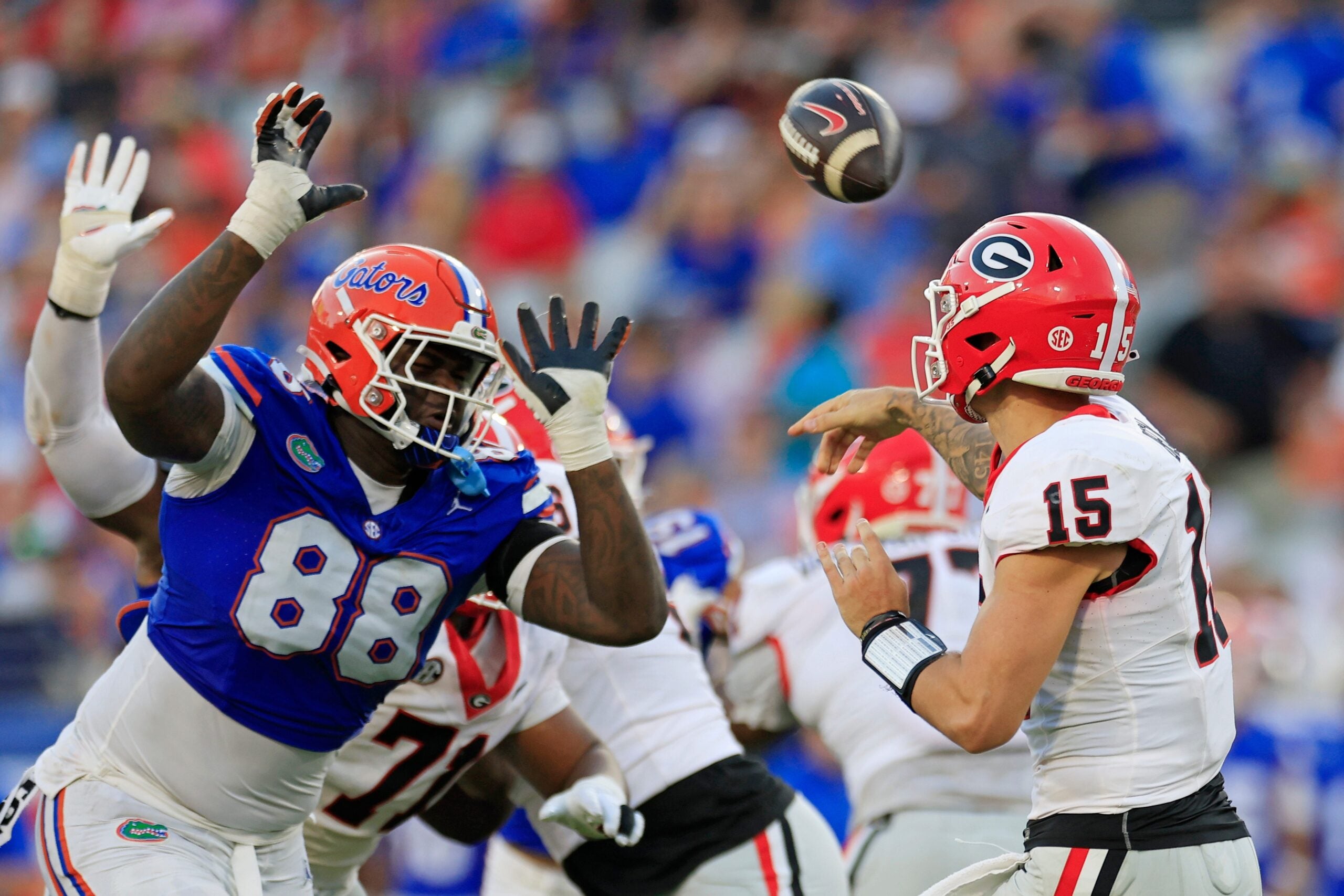
If the Minnesota Vikings were still coached by the late, great Dennis Green, we’d have a long lineage of talented defensive linemen selected in the first round.
Throughout his tenure, they kept taking shots at the position. Chris Hovan, Demetrius Underwood, Duane Clemons, and the infamous Derrick Alexander were all shots in the first round at trying to find another stud to pair with John Randle. While they never manifested into great players, Green’s teams never stopped trying to find that player, especially after making the mistake of taking Warren Sapp in 1995. Now, that mistake weighed so heavily on the heart of Green that he selected Randy Moss at 21st overall in the 1998 NFL Draft.
The selection of Caleb Banks at 18th overall has some interesting parallels to Sapp. Both had an off-field issue that sent them further down the board than they should have. The Vikings could have had a dominant front with Randle and Sapp, and they hope Banks can give them a similar impact they wish had existed 31 years ago.
Caleb Banks’ selection is fascinating on many levels
When the move happened, it was immediately criticized by many in the media. The main reason wasn’t due to his on-field play, but rather the multitude of foot injuries he had suffered. In a 20-minute interview with an orthopedic surgeon during the NFL Draft, he eased all concerns (see below). Essentially, the Jones fracture and broken metatarsal were separate injuries, and neither appears to be at serious risk of re-injury.
That doesn’t absolve the injury issues Banks has had with his foot. It creates a variable that is difficult to parse out. Foot injuries for a player that is 6-6 and 327 pounds could come back much easier than on someone much smaller.
It’s one of the main reasons why he was so low on the consensus board. Banks ranked 37th on Arif Hasan’s consensus board, which arguably has more to do with the foot injury than his play. Let’s break down his interesting all-22 film.
He’s not a nose tackle, but a gap-shooter
When you see Banks, most will view him as a nose tackle. However, that’s not what he was asked to do for the Florida Gators, nor is it what his skill set demands. Across his three seasons with the Gators and two with the Louisville Cardinals, Banks lined up at either 0T or 1T 45 times out of 929 snaps. That’s an important aspect of this discussion.
What the Gators asked Banks to do is shoot gaps and use his insane length to his advantage. The ability to attack gaps with explosiveness created a major impact in multiple facets. Guys of his size don’t move like that.
Having a player with that aspect to his game is huge, but it’s his length that opens things up for said gap shooting.
Caleb Banks’ length is a true weapon
With 35″ arms, Banks’ length is a major issue for offensive linemen. I spoke to him at the Senior Bowl about maximizing the impact of his arm length while preventing it from becoming a deterrent.
“It’s honestly just technique, being able to shock, and it helps me a lot when I got to peak. Sometimes alignment trying to sit there, but they getting stood straight up. So it’s a very, really big advantage. I’m just glad God blessed me with some beautiful long arms.”
Minnesota Vikings DT Caleb Banks
The varied usage of his arm length is all over his tape. His sheer power in his upper body is fascinating to parse out in multiple ways. The first rep is a simple push/pull to attach the guard and throws him aside.
The violence in which Banks uses his hands and arm length is impressive. It’s not just with a two-handed grab, either. Banks knows how to long arm the offensive line.
When you play 3T, 4I, and 5T, that length can help him dominate in more ways than one. He also flashes multiple pass rush moves, which is really good moving forward.
Banks flashes a bevy of pass rush moves
When you watch Banks, it’s all about flashes. There is a lot to work with when he does have a lot of flashes. In 513 pass rush reps in his career, Banks has generated 60 pressures (11.69%). That’s an impressive number for Banks, especially since he was being asked to defend the run first.
Let’s look at the multiple pass rush moves. We’ve already seen the length factor in his pass rush plan, but there is more that he flashes. The first one is a spin move that I mistakenly called a swim move after an insanely busy NFL Draft.
It’s not just that Banks spun to create pressure; he did so with good balance and got into the backfield. One thing that manifested on multiple of these reps was a lack of finishing. It does need to be improved, but he’s got the hard part down of getting into the backfield.
Now, let’s look at an actual swim move where Banks torches the offensive guard. He sets him up with a jab step to the outside before crossing his face and taking the A-gap.
Along with his impressive swim move ability, Banks knows how to get skinny within the gap to create pressure. His sheer upper body strength helps him complete the pressure.
Caleb Banks is not without his flaws
The last pressure you see above is a symptom of his biggest issue: size and leverage. Being 6-6 and 327 pounds creates natural issues. He plays a little high-hipped, and pops straight up out of his stance. It gets him into trouble, especially with double teams. He can get knocked off balance in the process, which will be worse at the NFL level with much better offensive linemen.
Within that rep, there are other issues that arise. He doesn’t have the explosive lower half that you might expect. The majority of his strength comes from his upper half, which in itself is really impressive. However, the knockback Banks receives comes from the lower half issues. If he had the strength to stick his legs in the ground, drop his butt, and drive forward with ferocity, that would solve his leverage issues somewhat.
There is also the element of sensing double teams. Banks struggles in that department and can get knocked off his spot relatively consistently, especially from the side. The awareness of double teams needs to improve, along with his strength profile.
That isn’t the case here. Banks needs to work on that strength profile and get lower. Better players will make him pay for it in the NFL. Now, this is something that is theoretically fixable, but it will take time. As a rookie, there will be some ugly losses, but each one will be a learning experience. If he can fix that, his biggest issue will be fixed.
His future is very bright
The idea of Banks is to deploy him like Richard Seymour was for the New England Patriots in the 2000s: be a dominant 3-4 DE. That will create a lot of opportunities for the linebackers behind him as blitzers, as Banks can shoot gaps and occupy blockers.
There is a lot to love about what Banks brings to the table, but he needs time to reach it. Until then, watching him be explosive will be fun, but it will be a roller coaster.
After watching him, there is a simple question: was he worth the 18th overall pick? I believe so. I feel more strongly about him than when I did his initial evaluation, and that put him 17th on my big board. You can’t teach what Banks gives you, and trying to find a unicorn is never a bad idea.
The hope for Banks is simple: he’s as impactful as Sapp was for the Buccaneers when they won the Super Bowl in 2002. Will he get there? Flores and defensive line coach Ryan Nielsen are the guys you’d trust to make it happen.

