
Notre Dame’s running back debate has a clear answer moving forward following the Michigan State performance
The Fighting Irish don’t have the home run speed they had a season ago, and the running back rotation may be shifting as a result.


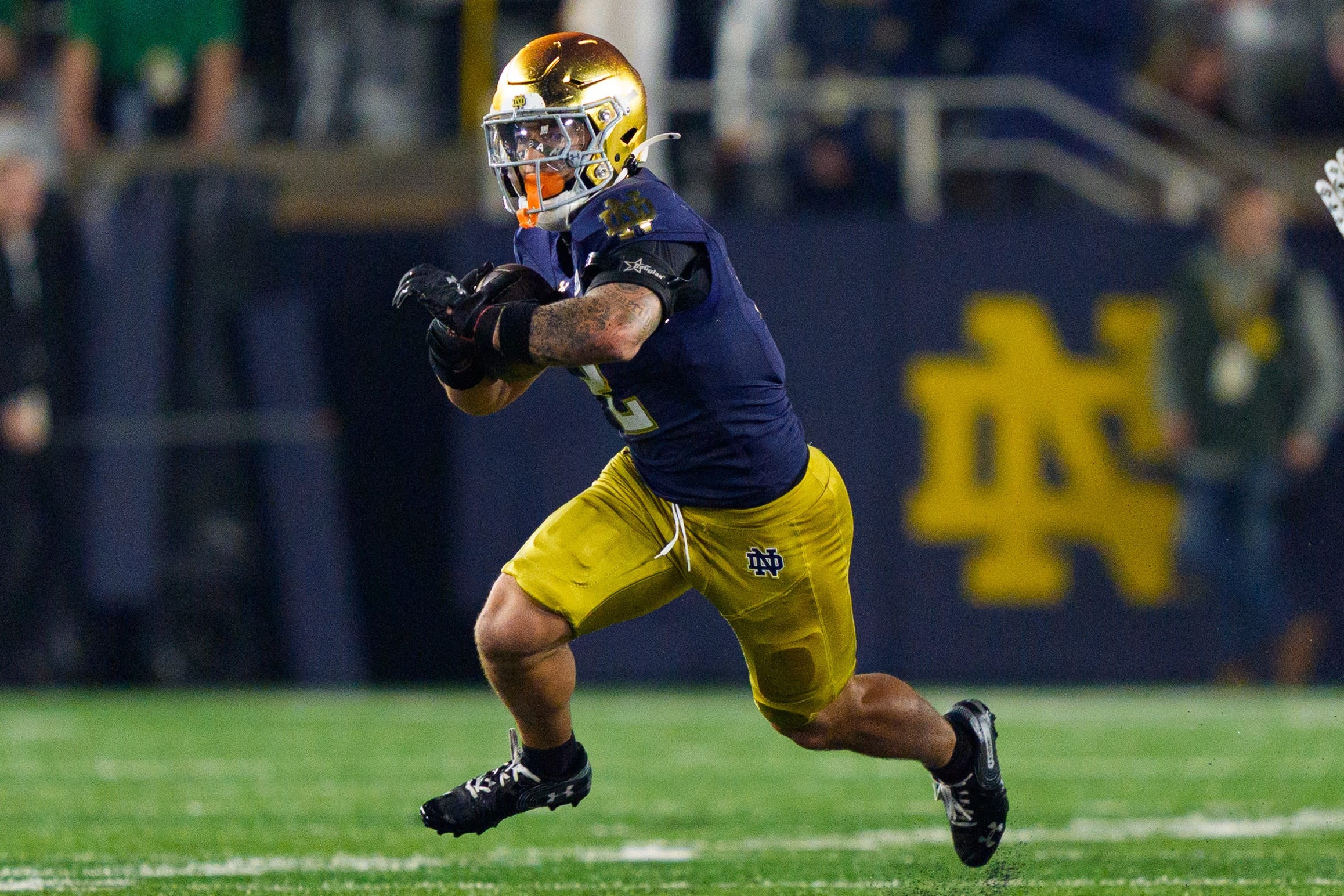
Notre Dame football’s rushing attack looks fundamentally different in 2026, and the Michigan State game may have revealed the path forward. ‘
The Fighting Irish finished with 161 rushing yards and 3 touchdowns on 43 carries against the Spartans, a season high in yardage. The 3.7 yards per carry won’t jump off the page, but running back Nolan James Jr.’s second-half surge offered a glimpse of what this ground game can become.
Notre Dame head coach Marcus Freeman and the offensive staff appear to be recalibrating how they run the football, and the early returns suggest a lead-back change could be on the horizon.
This isn’t last year’s running game
The 2025 Notre Dame backfield featured the kind of home run speed that could bail out a struggling rushing night. With Jeremiyah Love and Jadarian Price, the Fighting Irish had two first-round picks in the backfield, including a top-5 draft selection.
Last year’s group had a get-out-of-jail-free card. A 70-yard carry could tilt the numbers back into Notre Dame’s favor and mask inefficiency on the other 20 rushing attempts. A team that ran for 130 yards on 21 carries looked efficient on paper, even if the production was built on one explosive play rather than sustained success.
That dynamic simply does not exist in 2026.
Notre Dame needs to be a singles-and-doubles hitting run game this season, one built on consistently moving the chains and converting second-effort runs. The short-yardage game, the ability to turn 2-yard gains into 5-yard gains, matters more than ever.
The lack of overall efficiency remains something Notre Dame needs to figure out answers for, but this game may have provided one.
Nolan James Jr. woke things up in the second half
James didn’t have much success before halftime.
At one point late in the first half and into the early second half, he was averaging somewhere around two yards per carry. Then, almost out of thin air, he finished the game with 26 carries for 121 yards and a touchdown. That 4.7 yards per carry still isn’t elite, but compared to what Notre Dame has been doing through three games, it was a really good sign. He was churning out those second-effort runs, turning what looked like stuffed carries into chain-moving gains.
The rest of the backfield didn’t see much action. Aneyas Williams carried the ball 9 times for 25 yards and a touchdown. Jonaz Walton received just 1 carry for negative 1 yards, which was disappointing after he showed some positive things the week before against Rice. Kedren Young didn’t get a carry at all, which was an interesting development worth monitoring.
The Aneyas Williams celebration was a momentum killer
Williams punched the ball into the end zone for a touchdown, then drew an unsportsmanlike conduct penalty for celebrating. It wasn’t a situation that warrants benching or a referendum on his future, but it was a bad decision.
Notre Dame led 17-3 at that point. The game felt like it was about to break open. Instead, the penalty set the Irish back and halted momentum.
Momentum is a very real thing in college football, from a playing perspective and a coaching perspective.
When you haven’t been running the ball well through the first three games of the season and you finally get an opportunity to punch it in, you should treat it like you’ve been there before. There’s nothing wrong with being excited and jacked up, but time and place matter. Freeman clearly felt the same way.
Rolling with Nolan James Jr. as the lead back
Notre Dame was clearly comfortable feeding James the football in the second half, and he rewarded that trust. He should be the starting running back next week. That doesn’t mean Williams gets phased out. Williams can still be a valuable member of the running back room. But James earned the right to be the guy for now.
The Fighting Irish don’t have the luxury of relying on explosive plays to carry the rushing attack this season.
They need a back who can grind out yards, sustain drives, and convert in short-yardage situations. Through one dominant second half against Michigan State, James showed he can be that player. Whether Notre Dame commits to him as the featured back moving forward will be one of the more compelling storylines heading into next week.
