
Notre Dame football may have a running back problem that they will need to find some answers for
Does Notre Dame have a running back problem? They certainly have some things to figure out with their backfield formula.


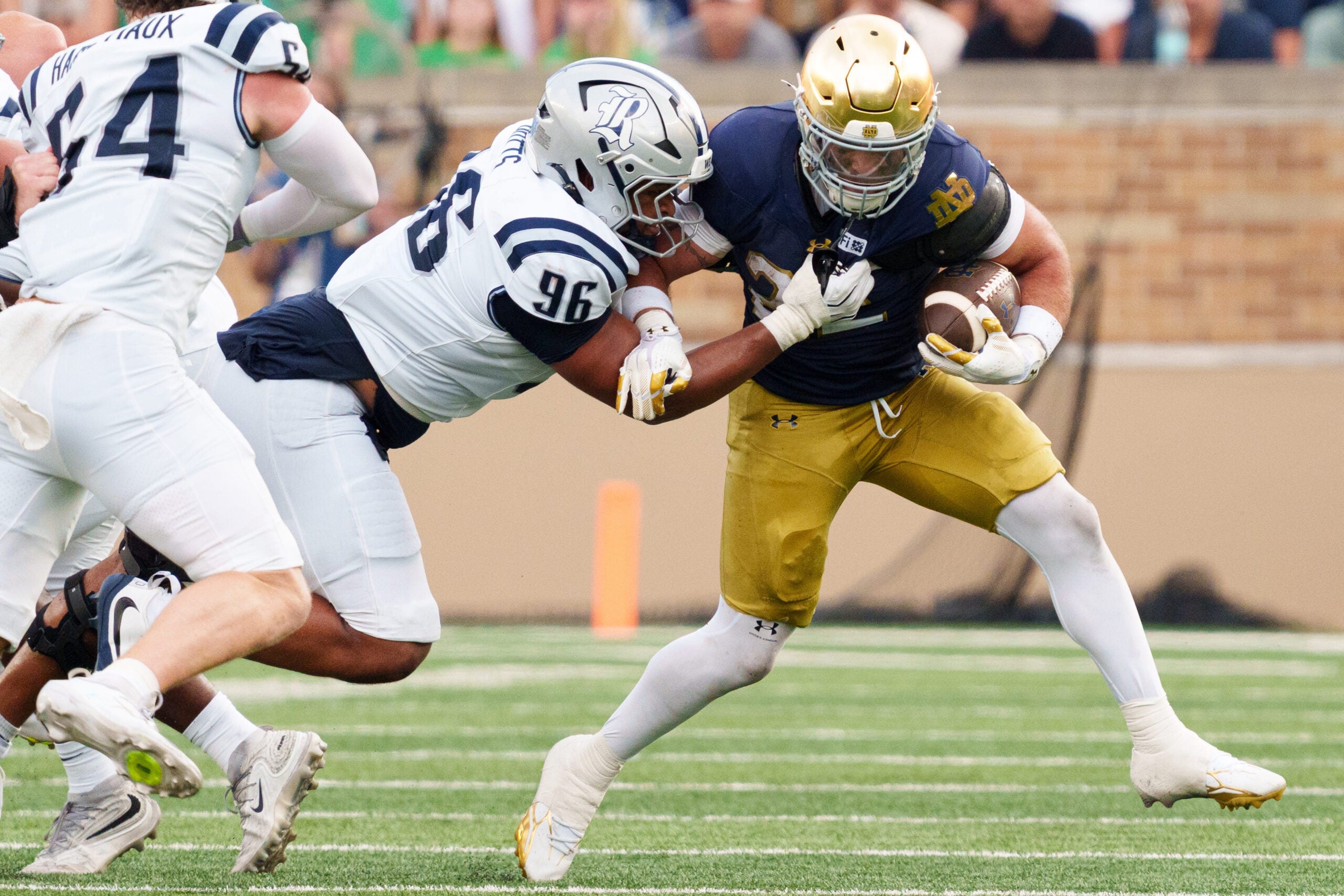
Notre Dame defeated the Rice Owls 52-0 in their home opener on Saturday, pushing the Fighting Irish record to 2-0 on the season.
Head coach Marcus Freeman will be able to build on this performance with a lot of positivity, including an improved passing attack with quarterback CJ Carr at the helm, strong pass protection, and a lights-out defense that recorded several turnovers while preserving the shutout. The one spot that did bring some question marks following the victory, however, was the Notre Dame running game, which continues to lag behind expectations through two weeks.
The rushing struggles are not new. Notre Dame’s ground game was underwhelming in the season opener against the Wisconsin Badgers during their 41-13 victory, though it did show massive improvements in the second half.
During the first half against Wisconsin, the Irish ran for just 29 yards on 16 carries, a 1.8-yard-per-carry average. The second half brought a different story, with the team eclipsing 80 yards at over five yards per pop. Most Notre Dame fans were hoping that improvement would carry over against an inferior opponent, but it did not.
On the day, Notre Dame ran for just 118 yards and two touchdowns on 32 total carries, a 3.7-yard-per-carry average. That means the Fighting Irish have been held below four yards per carry as a team in each of the first two games.
Aneyas Williams and the starting role
Starting running back Aneyas Williams has carried the ball 29 times through two games. After rushing 20 times for 90 yards and two touchdowns against Wisconsin with noticeable improvement in the second half, he had a lackluster performance against Rice, running nine times for just 29 yards with a long of seven. That comes out to a 3.2-yard-per-carry average.
This is not a call to bench Williams. He has shown in the past that he can be a productive weapon for this Notre Dame offense led by offensive coordinator Mike Denbrock.
Freeman always talks about everything being up for constant evaluation, and both the eye test and the box score suggest Williams has been a bit underwhelming during the first two games. He has run the ball more than any other running back on this team, and it is not particularly close.
Other backs making their case
A couple of other running backs did have stronger performances. Nolan James Jr. ran for 29 yards and two touchdowns on six carries after a dynamite performance in the opener, when he caught four receptions for 67 yards and a touchdown through the air. James has looked more explosive and dynamic at the second level and in space than Williams so far.
True freshman Jonaz Walton actually led the team in rushing, doing all of his work in the second half and running for 48 yards on eight carries, which comes out to six yards per run. At 214 pounds with 10.6 100-meter speed coming out of the state of Georgia, his combination of explosiveness and size brings some unique upside to the table.
Kedren Young, the junior returning from a knee injury that cost him the entirety of the 2025 season, ran the ball just four times for eight yards.
Fellow freshman Javian Osborne carried the ball just five times on the night as well. While it is a small sample size, both true freshman running backs, Walton and Osborne, do bring more explosiveness to the table in theory than any of the other backs in the room.
Finding the right formula
Should Walton get more touches? Should James be the lead runner?
With how both have performed, there should probably be a reconfiguration for how these carries are divvied up. Luckily for Notre Dame, the Irish have a stretch of games coming up where they have the opportunity to test things out, determine what the volume should be for each runner, and find the best formula for jump-starting the running game.
There is a lot to be positive about with this Irish team. But when it comes down to the biggest games of the season — Miami, BYU, SMU, and hopefully a deep playoff run — this Notre Dame offense will need to run the football better.
The first two games are going to leave some Notre Dame fans unsettled, and the Irish will need to find answers in the rushing attack over the next few games before the schedule gets unforgiving.
