
Dante Moore, Darian Mensah, and Trinidad Chambliss headline 2027 NFL Draft QB stock watch after week 1
There are several 2027 NFL Draft prospects who had standout performances in Week 1. Who impressed us the most and how high can they go?

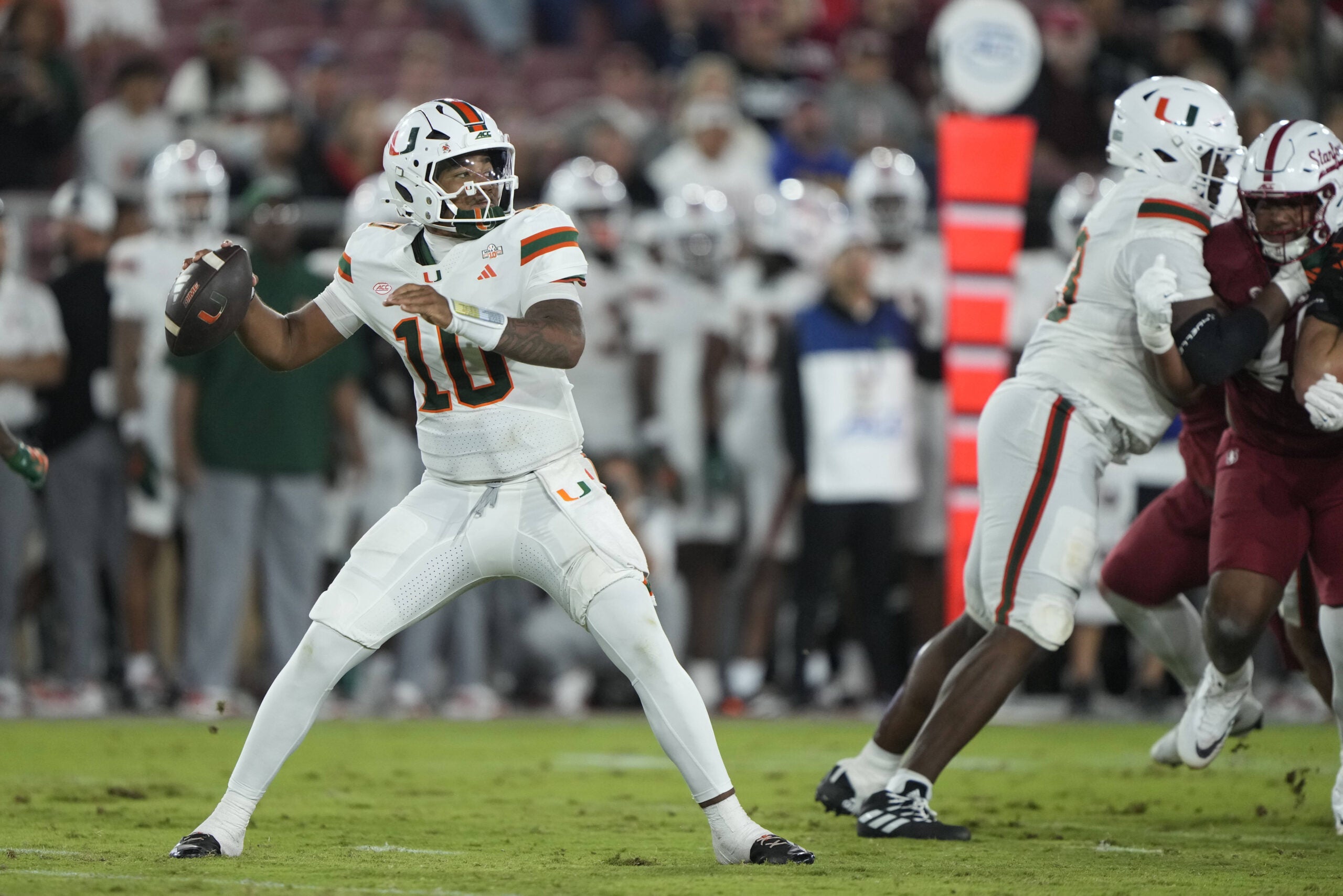
The 2027 NFL Draft quarterback class showed plenty of fireworks in week 1 of the college football season.
Oregon quarterback Dante Moore, Miami quarterback Darian Mensah, and Ole Miss quarterback Trinidad Chambliss each made compelling cases to be among the first signal-callers off the board next April. From Moore’s physical transformation and deep-ball precision to Mensah’s mastery of touch and timing to Chambliss’s fearless improvisational magic, the early returns offered a lot to break down for NFL evaluators.
Darian Mensah looks like a much-improved quarterback for Miami
Miami opened with a dominant performance against Stanford, and Mensah was at the center of it. He completed nearly everything, finishing with just 3 incompletions and 5 touchdown passes. The placement was surgical throughout, with every throw landing where receivers could turn upfield and create yards after the catch.
The physical tools still grade out as adequate rather than elite. His arm strength sits in the B-minus tier, solid but nowhere close to the top of this class. He added some weight this offseason, and the ball velocity appeared slightly improved from his time at Duke. The real separator, though, was diagnostic speed.
Mensah processed the field at an incredibly fast level, got the ball out on time, and showed impressive calm against pressure. He looked like he had been running Shannon Dawson’s offense for three years rather than entering his first season in it.
The comp that fits is Jordan Love coming out of Utah State, a volatile prospect who won with intermediate touch and impressive physical tools. Mensah’s intermediate-to-deep touch is very good, and his style mirrors that mold even if his raw tools fall slightly short of Love’s 6-4, 220-pound frame and arm strength.
The real tests are ahead. Notre Dame, the college football playoff, and the ACC Championship Game will reveal whether this level of play translates against top competition. But the first step was a strong one. Mensah has the weapons around him to keep climbing, and he showed the processing speed and accuracy to earn a long look as a potential NFL starter.
Malachi Toney forces a 2028 NFL Draft conversation after week 1
The conversation coming out of the Miami game extended beyond Mensah and into the 2028 class. True sophomore wide receiver Malachi Toney was phenomenal against Stanford, and the performance was refined enough to plant him firmly in the first-round discussion for the 2028 NFL Draft.
Toney’s ability to accelerate and decelerate without wasted movement is otherworldly. His transitional explosiveness, his fearlessness working over the middle, and his ability to win after the catch make him a legitimate separator at the slot position. He caught 100 passes last year as a true freshman and led Miami to the national championship game. The leap from year one to year two was visible in every route.
He added muscle this offseason, and the added strength showed in his willingness to absorb contact over the middle. He is not the prototypical X receiver in the mold of Jeremiah Smith (Ohio State) or Cam Coleman (Texas), but the slot value at his athletic tier is rare.
Comparisons to Cooper Kupp’s role with the LA Rams and what Seattle built around Jaxon Smith-Njigba illustrate that you can construct an offense through the slot when the talent is this special.
It is a shame that Tony is not eligible for the 2027 draft. But the takeaway from week 1 is clear: he is already one of the best wide receivers in college football, and NFL teams will be circling his name well in advance.
Dante Moore takes an encouraging step for Oregon
Moore entered the season as one of the most polarizing quarterback prospects in the 2027 class, and his week 1 performance against Boise State offered real reasons for optimism.
Oregon got into a dogfight, and the first half was rocky. Moore was out of rhythm early, his accuracy drifted in spurts, and the conservative play-calling kept the offense from stretching the field.
Then he clicked. The second half featured aggressive downfield shots that swung momentum back to Oregon. His deep-ball precision stood out, with throws landing where receivers could catch and run. The ball velocity appeared noticeably improved after he added roughly 17 pounds this offseason, going from 204 to about 221 pounds while working with mechanics coach Paul Skenes.
The CJ Stroud comp remains the one to watch.
Stroud had a similar arc at Ohio State, where a signature performance against Georgia locked in his status as a top-2 pick. Moore needs that kind of moment against USC, Ohio State, or in the Big Ten Championship Game. If he can process at the same speed and maintain his accuracy when the pressure increases from better competition, the buy-in on Moore as a top quarterback prospect becomes much easier.
The offensive line remains a concern, with questions at both tackle spots and a guard who transferred from Yale. When Moore faces better pass rushes, decision-making under duress will determine whether he can separate from the pack.
Trinidad Chambliss brings the volatility and the magic
Chambliss got into a shootout against Lincoln Kienholz and responded exactly as you would hope from a player with his profile. The game got away from him early, and the Ole Miss offensive philosophy seemed to be that Trinidad would figure it out eventually. He did, making several big throws that kept his team in the fight.
The ascension remains one of the best stories in college football. From a no-star recruit at Ferris State to a backup behind Austin Simmons to one of the biggest stars in the sport, every step of Chambliss’s journey has involved defying odds.
At 5-11 and 7/8 by scouts and roughly 205 pounds, he does not fit the traditional size profile. But his arm is stronger than you would anticipate for his frame, and he throws with absolute conviction on every attempt.
That conviction is both his greatest asset and his biggest source of risk. He will rip the ball into tight windows with defenders bearing down, and sometimes that leads to scares where the ball nearly gets picked off.
There is a gambler mentality to his game that works in modern football, where you cannot play quarterback timidly. The Russell Wilson comparison holds up well. The frame, the shiftiness, the elusiveness, and the power in his arm regardless of platform all echo young Wilson during his best years in Seattle.
The question for NFL evaluators is whether Chambliss projects as a long-term starter or follows the Tyrod Taylor path of starting in stretches before cycling into a bridge role. He could also follow the Dak Prescott trajectory, getting drafted as a backup, stealing a job, and proving that the traditional size concerns were overblown.
He feels like a guy you just should not bet against. Every piece of data from the last few years shows him defying one obstacle after another. The range of outcomes will create a wide spread of opinions during the draft process, but he should be firmly in the top-64 conversation.
DJ Lagway and Nico Iamaleava present the toolsy wildcard tier
The class also features a tier of raw, toolsy quarterbacks who could emerge as dramatic risers. DJ Lagway at Baylor and Nico Iamaleava at UCLA are the two most likely candidates to make that leap based on pure physical gifts.
Lagway’s week 1 against Auburn was a fascinating study in extremes. He produced arguably 5 to 7 of the best individual throws of the entire week, with arm talent that is undeniably special.
He layered the football, threw at pace, and showed the kind of velocity that makes evaluators sit up. In the same game, he also produced 4 or 5 of the worst plays of any quarterback in college football. The fumble on a pointless hurdle attempt, the shot-put heave that nearly got intercepted, and multiple turnover-worthy plays all illustrate the volatility.
The problem is that Lagway’s bad plays carry zero upside. They are not aggressive downfield shots into tight windows that, if they connect, create splash plays. They are sloppy, reckless decisions where the only possible outcomes are a dead play or a turnover. Combined with his injury history, the buy-in remains extremely difficult.
Iamaleava, meanwhile, did not generate much excitement in his opener against Cal. The 6-5.5, 220-pound former five-star has the tools on paper, but they did not pop on tape the way evaluators hoped. A couple of nice throws were not enough to separate him from the pack.
Both players draw Anthony Richardson comparisons, and the reality is that one of them will probably end up becoming an NFL starter. The arm talent pops for both. But which one earns the trust of an NFL organization remains very much an open question after just one week of football.
