















































Browns WR Denzel Boston is proving his NFL Draft doubters wrong, and it exposes a flawed way we evaluate receivers
Plenty of evaluators passed on Denzel Boston’s archetype last spring. Nine weeks into his rookie season in Cleveland, it’s worth asking what that skepticism was really built on.

As far as I can remember, just about everybody besides me was down on Denzel Boston before the 2026 NFL draft.
Or maybe that’s just how I’m choosing to remember it.
As a GM, I would have slept like a baby taking him in the first round, let alone with the 39th pick, where the Cleveland Browns grabbed him in the second.
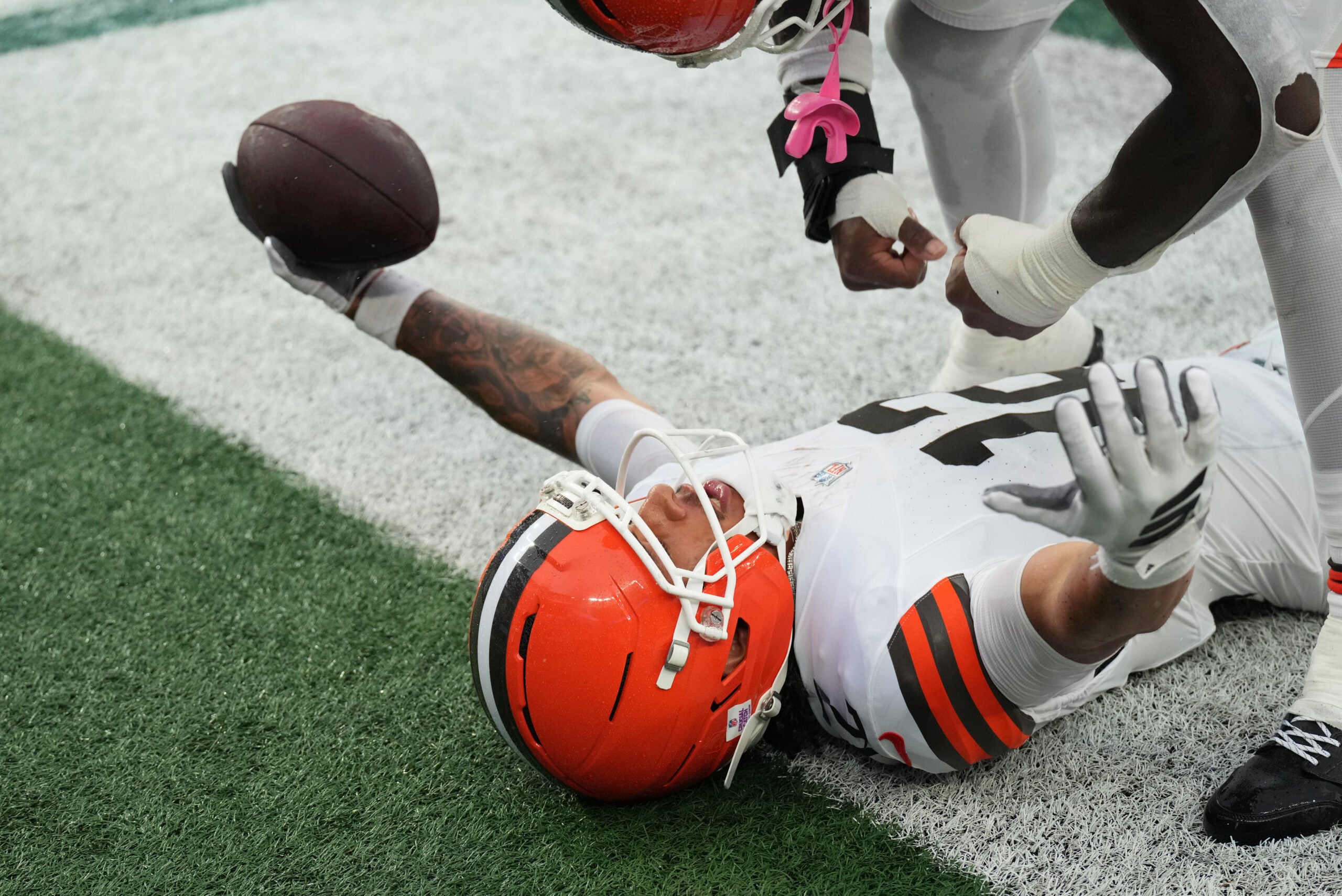
Through eleven weeks, the rookie wide receiver has 523 receiving yards on just 33 receptions, along with three touchdowns. That’s 15.8 yards per catch whilst leading the rookie class so far! Those numbers look even better once you consider the team he plays on and the quarterbacks throwing him the football.
Denzel Boston has been exactly what Cleveland drafted him to be
The Browns have been plucky this season, and their young core of recent draftees is the reason why. Boston and fellow rookie receiver KC Concepcion have given this offense a jolt, and their coach’s attitude has set the tone.
There’s still an ugly, gaping wound at quarterback. Cleveland is getting by at that position for now, and the rest of the roster is buoying it. But Boston has been everything his supporters said he could be. He’s a big-bodied, gliding, contested-catch winner who becomes the biggest target in the world in the parts of the field and on the downs that matter most.
Here’s the thing about Boston: he has looked like this from the jump, not just at the midpoint. He has become a go-to option on an offense with plenty of nice young weapons, and he gets the ball in the big spots. Everything people put in the “what he could be” category last spring has come true.
He’s never going to be a speed and agility guy. You can see that just by looking at his frame. But I’m tired of pretending every draft season that the 40-yard dash guys are the archetype that wins. Go down the list of WR1s around the league, and from what I’ve seen, the average 40 time lands somewhere in the 4.5 range. You absolutely can win as a player built like Boston, and he has proven it every week.
Why the catch-point archetype scares evaluators
My 13 Personnel co-host Ryan Roberts made the case for the other side. He liked plenty of what Boston did on film, but Keon Coleman left a mark on him and many others a couple of years ago. Catch-point dynamos are volatile prospects in his view. For every Tetairoa McMillan, there’s a Kelvin Benjamin, an N’Keal Harry, or a Hakeem Butler. As Ryan put it, “that type of receiver has just burnt me way too often.”
I get it. But I’m starting to think that logic falls apart a bit once you apply it to everything else. What archetype of receiver hasn’t burned us? A percentage of every type of prospect busts. That’s the draft.
My theory is that we twist ourselves into a mental pretzel when a prospect doesn’t give us a hard superlative to latch onto. That can be a 40 time, a height-and-weight combination, or an athletic score. It can also be leadership accolades, a reputation as a processor, or a reputation as a mature, NFL-ready adult. Those markers help us convince ourselves that one prospect is safer than another.
Boston-type receivers don’t hand you that hook. You watch them win in college and like the size and contested-catch ability, but the Benjamin comparisons creep in. With nothing to grab onto on the side of that mountain, it’s easy to look down and fall.
To be clear, I haven’t seen a comprehensive study on this, and I’d want one before saying it with certainty. My hunch is that if you broke down receiver archetypes and their hit rates, they’d land roughly in the same neighborhood. Some are just easier to talk ourselves out of.
Ryan pushed back that separators seem to translate more consistently, and I agree with part of that. True separators are the guys who actually create space on tape, not the ones with the size and speed to do it on paper, and I do think they hit at a higher rate. But how many honest-to-God separators are in any draft class? It’s a small group, and not being in it doesn’t mean a receiver is destined to bust.
The Browns appear to have found something in Boston. The best approach is the simplest one: draft good football players. He’s a good football player.
