











































What the box score didn’t tell you: Three details that explain how the Lions let Thanksgiving slip away
Three details behind the Lions’ Thanksgiving loss: Chicago’s quick scoring drive, where its yards after the catch came from and Detroit’s false starts.


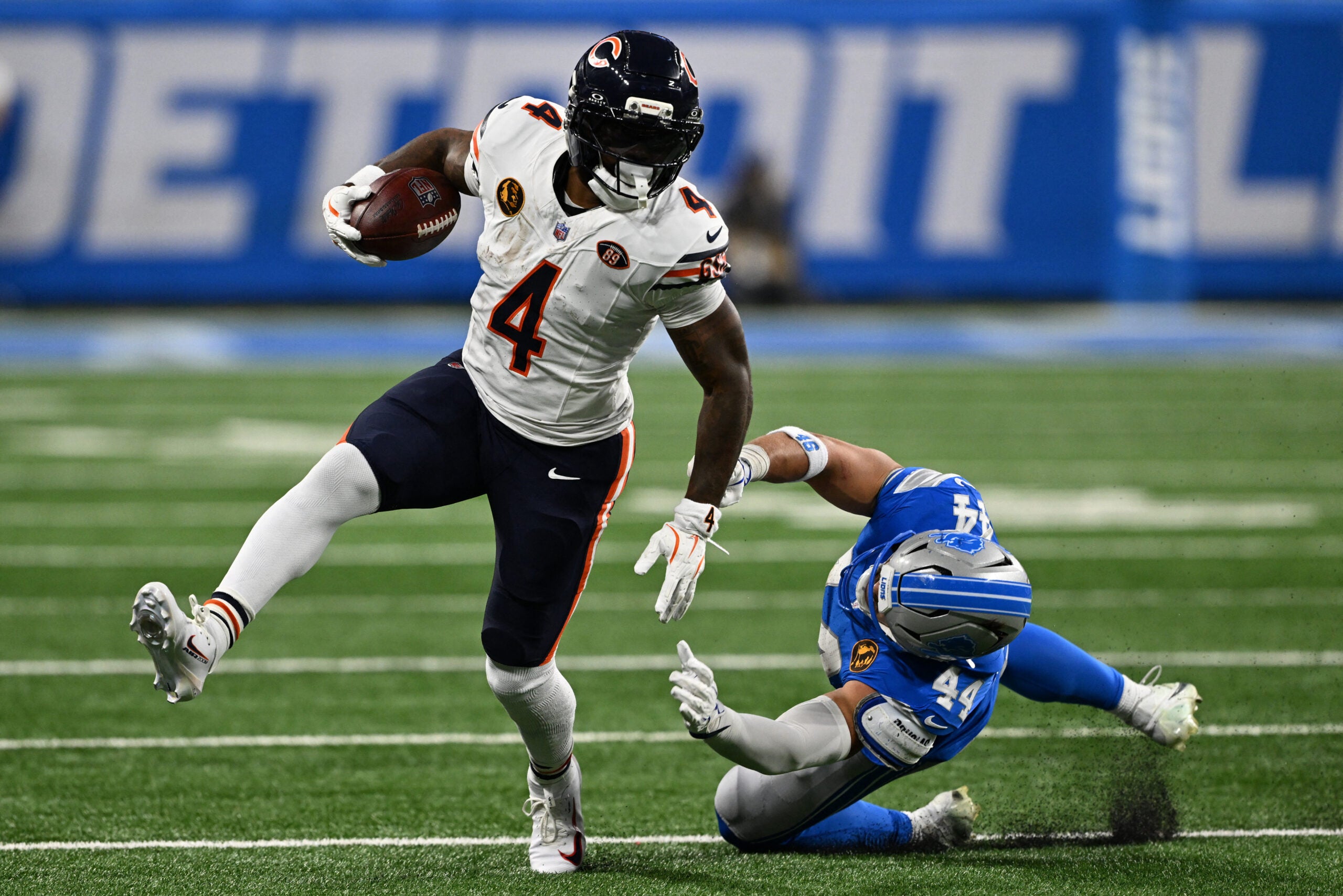
The Detroit Lions put up 549 yards of offense on Thanksgiving. Running back Jahmyr Gibbs ran for 205 yards and three touchdowns. Detroit still lost to the Chicago Bears 39-35.
I could talk about the last touchdown all day. But the Lions were up 11 with a little over eight minutes left. How did it get to the point where wide receiver Rome Odunze could win the game with three seconds left? Here are three things the box score didn’t tell you.
The Bears got back into the game without playing a second down
Gibbs went 70 yards for a touchdown, and the Lions were up 35-24. You’re probably thinking Detroit just needed to make Chicago burn some clock.
The Bears burned one minute.
Quarterback Caleb Williams hit wide receiver Luther Burden for 15 yards on first down. Chicago went no-huddle, and Williams hit Odunze for another 15. Then the Bears went no-huddle again, and Williams found Odunze for a 41-yard touchdown. Williams ran in the two-point conversion, and just like that, it was a three-point game.
That was three passes, two first downs and a touchdown, covering 71 yards. The Lions never even got Chicago to second down.
That’s the drive nobody wants to watch again. This is where Detroit went from having room for a mistake to playing a game where one mistake could cost them. On the very next drive, Jared Goff threw an interception on third-and-1.
Look at where Chicago got its yards after the catch
It’s easy to see 345 passing yards and say the Lions’ secondary had a bad day. The charting points to something more specific.
Pro Football Focus charged linebackers Malcolm Rodriguez and K.J. Britt with 149 yards on 12 targets. Of those 149 yards, 109 came after the catch. That’s 61% of the yards after the catch PFF charted against Detroit on just 28% of the targets.
A little more than a quarter of the targets accounted for more than half the damage after the catch. That doesn’t mean every one of those yards belongs to Rodriguez or Britt. What I want to see on film is where the help was supposed to come from.
Were the Bears getting the ball to guys who already had room to run? Or did the Lions have a chance to get them down and let them get away? Those are two different problems. The answer matters a lot more than just saying the coverage was bad.
Two sets of false starts cost the Lions 10 yards each, and only one drive survived
Rookie tackle Blake Miller allowed zero pressures on 39 pass-protection opportunities, per PFF. The Lions gave up one sack, and PFF didn’t charge it to an individual blocker. There’s a good pass-protection story here. There’s also a story about the line making things harder on itself.
In the second quarter, Juice Scruggs had two straight false starts. Second-and-6 became second-and-16. Sione Vaki gained six yards on the next snap, which would have moved the chains from the original spot. Then Goff missed Vaki on third-and-10, and the Lions punted. Chicago went 80 yards for a touchdown on the next possession.
Right before halftime, Scruggs and Mahogany had back-to-back false starts. Third-and-2 became third-and-12. Gibbs got 11 yards on a catch, and Goff picked up the last yard on a fourth-down sneak. The Lions went on to score, but that could have been bad.
That’s what gets lost in the penalty totals. Same quarter, same 10 yards, two completely different outcomes.
The Lions had enough offense to win this game. They put up 549 yards. Chicago needed only three snaps to make it a one-possession game, and from there, every yard Detroit gave away mattered a little bit more. Let’s see if the film tells the same story.

Detroit Lions News