
The truth about Notre Dame’s running game issues, the biggest problems, and who is the most to blame
The Fighting Irish averaged less than 4 yards per carry for the third straight game, and the All-22 film pointed to a combination of issues.


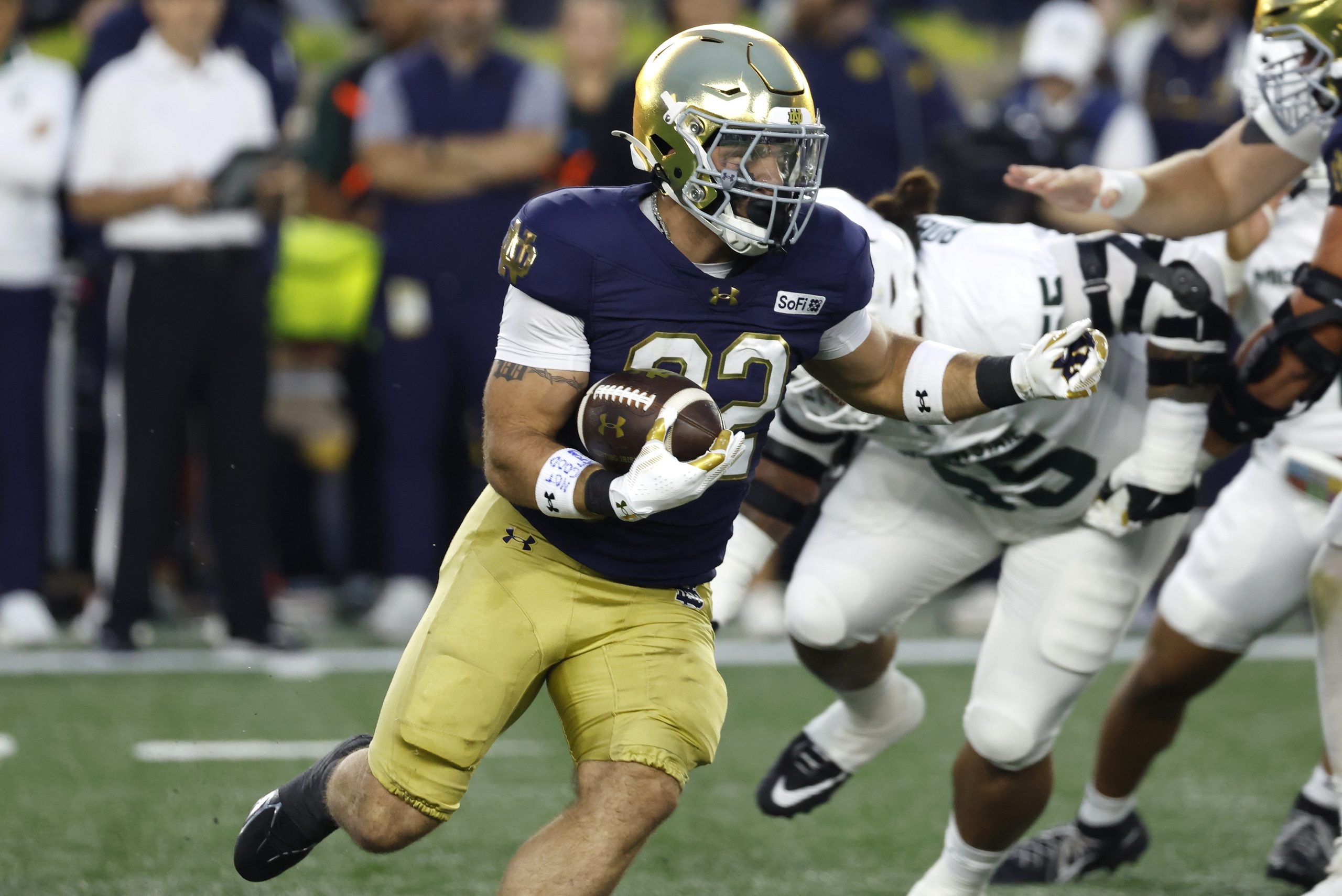
Notre Dame football left Saturday night with a 27-10 victory over the Michigan State Spartans, but head coach Marcus Freeman and the Fighting Irish know the running game remains a significant concern.
For the third consecutive game, Notre Dame averaged less than 4 yards per carry, and the offense continues to lack explosive plays on the ground. The Fighting Irish are one of only two teams (shout out Arkansas) in college football this season without a single rushing play of 20 or more yards.
After watching the All-22 film, a few things became truly apparent, with some being extremely fixable and other parts of the problem a bit more disconcerting.
The tale of two halves
On the day, Notre Dame did finish with a season-high 161 yards rushing on 43 carries and three touchdowns, an average of 3.7 yards per carry. It was truly a tale of two halves, with second-year running back Nolan James Jr. rushing 26 times for 121 yards and a touchdown, the bulk of that success coming in the second half. It’s possible that Notre Dame takes that second-half performance and builds on it, but the storyline feels eerily similar to what the Fighting Irish did against Wisconsin.
Running back quality is not the problem
When you lose Jeremiyah Love and Jadarian Price, you need to become a more efficient running game because you are not going to create the explosive plays at the rate that you did a year ago. Last season, if Notre Dame was having an inefficient night, the Fighting Irish could break off one or two long runs that tilted the success back in their favor. That luxury does not exist this season.
Aneyas Williams, James, Kedren Young, Jonaz Walton, and Javian Osborne are all quality running backs with the ability to create big plays throughout the rest of the season (and the latter two could be stars down the road). None of them, however, are Love or Price, at least not right now.
They don’t have that home-run speed, or at least can’t take advantage of it right now, to consistently create that volume of explosives. The inefficiency comes from several different reasons, but it is not a talent issue in the backfield.
Williams, James, and company are plenty talented enough to be an efficient running game for this offense.
The right side of the offensive line
The main issue Notre Dame is having running the football right now is the right side of the offensive line. During the contest against Michigan State, both right guard Sullivan Absher and right tackle Guerby Lambert had well-below-average days. Each of them struggled at the point of attack and created consistent issues with penetration.
Notre Dame did a lot of pulling in this game, including center Ashton Craig and even some from left tackle Will Black. When those linemen pulled to the right side, there was consistently too much trash to either continue on their track or locate second-level defenders.
Lambert had a real struggle at right tackle, unable to establish leverage in the run game or move the line of scrimmage in the offense’s favor. Everything was playing behind the line of scrimmage, and running backs were contacted too early in reps. Craig had issues at times as well, though not quite as pronounced.
The right side also gave up too much penetration on the backside of runs, which caused problems when Notre Dame’s inside zone running game tried to hit cutback lanes.
The scheme needs more creativity
If you ask me, the biggest issue with this running game right now is the lack of creativity from offensive coordinator Mike Denbrock.
Everything is very static. There is barely any motion pre-snap, not a ton of diversity or movement before the ball is snapped. That motion is critical because it creates confusion on the second level.
Notre Dame is way too concentrated on “getting to the perfect play”, and not enough on giving defenses multiple options and forcing them to choose wrong.
Right now, the linebacker position for the opposition does not have to honor much. The run game action is easy to diagnose. There is no jet motion, no jet sweep off of it, no misdirection. It is a stagnant operation.
There is also barely any utilization of play action.
When there is run action in the backfield, defenders on the second and third levels fire downhill without hesitation. Michigan State’s safeties got involved in the run game because they are not honoring any play-action element. Once they see quarterback CJ Carr put the ball in the belly of a running back, they crash. There is no misdirection from a run-action standpoint leading to play-action pass opportunities.
Carr is one of the better passers in all of college football, but he brings no element of threat off the run action right now. Overhang defenders and third-level defenders do not need to honor the passing game off of run looks.
Until Notre Dame shows it can run RPO or play action effectively, there is no reason for those second- and third-level defenders to stay honest. That allows players to creep into the box, and the Fighting Irish are consistently losing numbers battles because of the lack of diversity.
Carr is obviously not Riley Leonard. He is not a player who will pull the ball and consistently affect the defense with his legs. But having that option occasionally in the arsenal would keep a defense honest. More than anything, there needs to be RPO implementation in this run game structure. Everything is too vanilla and too predictable.
The bottom line
For everyone who wants to say this is one player’s problem or one unit’s problem, that is just not true.
The right side of the offensive line needs to get better. Denbrock needs to call a more diverse, less predictable offense. And Notre Dame needs to figure out a way to let Carr keep defenses honest, whether that is with an occasional read-option pull or an RPO game.
Right now, everything is way too predictable for opposing defenses, especially when you don’t have a get-out-of-jail-free card like Love or Price in the backfield.
