
The 7 national champions since the transfer portal’s creation prove that high school recruiting still reigns supreme
The transfer portal has shifted how college football programs build rosters. What is the best way to build a sustainable product?

The transfer portal has reshaped college football roster building since its October 2018 inception, but a closer look at the last seven national championship teams reveals a consistent truth: high school recruiting remains the foundation of sustainable championship programs.
From the 2019 LSU Tigers to the 2025 Indiana Hoosiers, the blueprint has been remarkably similar, and it carries significant implications for programs like Notre Dame football as they continue to build their rosters for the future. The sample size reveals what really wins games.
The early portal era: LSU and Alabama set the tone
The 2019 LSU Tigers were the first national champions of the transfer portal era, and their roster was built almost entirely through high school recruiting.
Former Ohio State quarterback Joe Burrow was the notable exception, but he was a second-year transfer by the time he led the Tigers to the title. That distinction matters. Over the last several years, second-year transfer quarterbacks have proven to be more sustainable and successful than first-year additions. Jayden Daniels at LSU stands as another key example of that development curve at the position.
Beyond Burrow, that 2019 team was homegrown. Ja’Marr Chase, Justin Jefferson, Clyde Edwards-Helaire, Lloyd Cushenberry, Patrick Queen, and Jacob Phillips were all developed inside the program.
The 2020 Alabama team followed the same mold. Mac Jones threw to DeVonta Smith, Jaylen Waddle, and John Metchie while handing off to Najee Harris. The trenches featured Landon Dickerson, Will Anderson, and Christian Barmore. Patrick Surtain Jr. starred in the secondary.
Nearly every major contributor was a high school recruit.
Georgia’s back-to-back titles reinforce the model
Georgia’s 2021 and 2022 championship rosters were built on the same foundation.
Stetson Bennett, who left Athens for the JUCO route before returning, led both squads. Zamir White, James Cook, Brock Bowers, Jermaine Burton, Ladd McConkey, A.D. Mitchell, Nakobe Dean, Nolan Smith, Jalen Carter, Jordan Davis, and Kelee Ringo were all high school recruits.
Derion Kendrick, a former Clemson cornerback, was one of the few portal additions on either roster.
Georgia’s dominance during that stretch came from recruiting, developing, and retaining talent. The Bulldogs have not made a national title run since, which raises a fair question about whether the program has adapted quickly enough to the evolving landscape.
Michigan, Ohio State, and the supplemental approach
The 2023 Michigan Wolverines offered a balanced distribution. JJ McCarthy, Blake Corum, Donovan Edwards, Roman Wilson, Colston Loveland, Will Johnson, Mason Graham, and Junior Colson were all homegrown. Transfer additions like tight end AJ Barner, pass rusher Josiah Stewart, offensive tackle Miles Hinton, and guard LaDarius Henderson filled specific needs, but the core remained high school talent.
The 2024 Ohio State Buckeyes were slightly mislabeled as a portal-built team.
Quarterback Will Howard transferred from Kansas State, Quinshon Judkins came from Ole Miss, and Josh Simmons was a second-year transfer from San Diego State. Beyond that trio, the roster was homemade. Emeka Egbuka, Jeremiah Smith, Jack Sawyer, Sonny Styles, JT Tuimoloau, and Donovan Jackson were all originally recruited by Ohio State.
Indiana: the outlier that still proves the rule
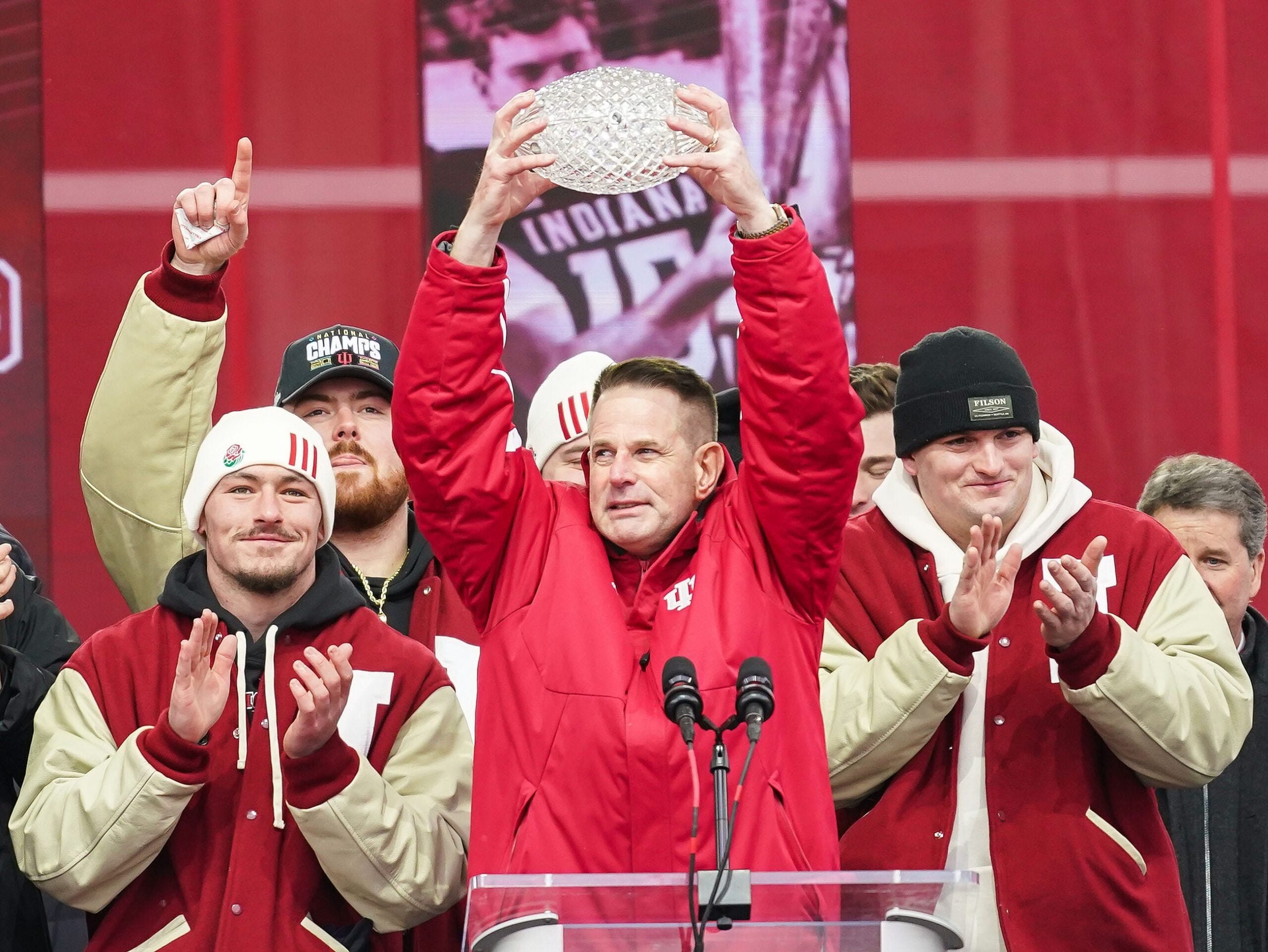
The 2025 Indiana Hoosiers present the most fascinating case study.
Fernando Mendoza became the second straight first-year transfer quarterback to win a national championship after arriving from Cal. The bulk of that roster, however, had been with head coach Curt Cignetti for multiple years, including two at Indiana. Elijah Sarratt, Aiden Fisher, D’Angelo Ponds, and Michael Kamara all followed Cignetti from James Madison. Players like Omar Cooper Jr., Amari Ferrell, and Charlie Becker were already part of the Indiana program.
This was not a team built overnight through one portal cycle. Cignetti came into Bloomington, set the standard, brought players he trusted, and made sure the pieces fit together.
The formula remains the same
The distinction between successful and unsuccessful portal teams comes down to intent. The best programs take transfer players because they want them, not because they need them. Ohio State did not necessarily need Caleb Downs or Quinshon Judkins. They wanted them. That is a significant difference.
Championship teams recruit at a high level, develop their talent, and retain their best players. The transfer portal serves as a supplement, not a substitute. Indiana may have arrived at the destination through a slightly different path, but the recipe holds. High school recruiting comes first, portal additions fill specific gaps, and that formula has produced every national champion over the last seven years.
