
Brian Schottenheimer’s explanation for the Dallas Cowboys’ static offense doesn’t add up, and it points to a bigger problem
The Dallas Cowboys rank near the bottom of the NFL in motion at the snap. Their head coach was finally asked why, and the numbers tell a different story.


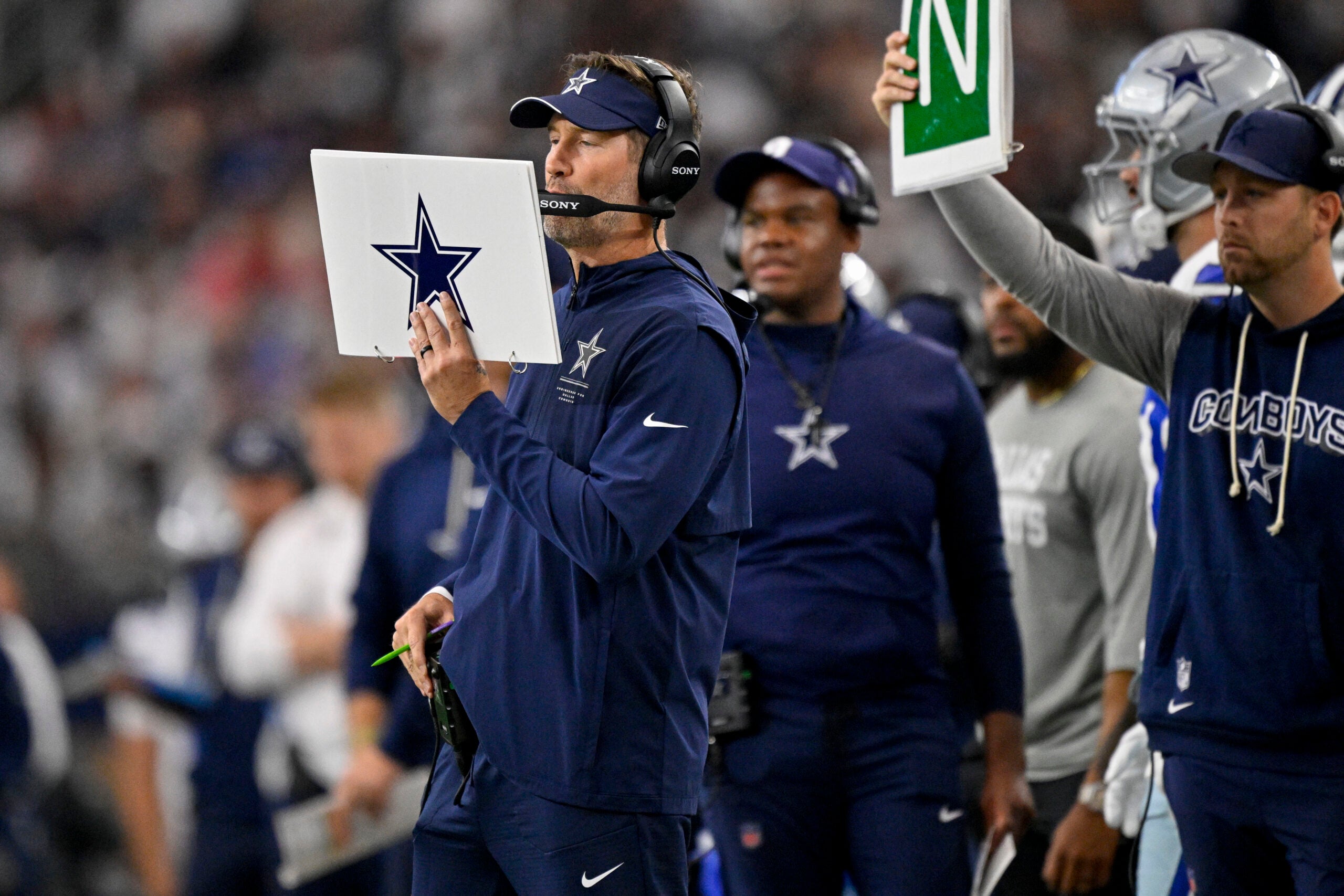
Dallas Cowboys head coach Brian Schottenheimer finally addressed one of the biggest questions fans have been asking about the offense: Why has it become so static? Unfortunately, his answer does very little to appease the masses.
If you ask me, it’s also part of a bigger problem facing the entire organization during a 3-5 start. Let’s dive in.
The Cowboys have a motion problem
Listen, the Cowboys have become a static offense. Motion is at a premium, and if you remove regular pre-snap shifts, there isn’t much Dallas does to take advantage of it. The clearest example is motion at the snap, where the Cowboys rank near the bottom of the league. Many of the NFL’s best offenses use it to gain favorable leverage, confuse defenses, and break their rules.
Just look at what beat them. The Arizona Cardinals’ game-tying touchdown in the fourth quarter came when WR Michael Wilson, Arizona’s No. 1 receiver, motioned from the outside into the No. 3 spot. That freed him up in a matchup against linebacker Shemar James, and the Cardinals win that matchup 10 times out of 10.
So Schottenheimer faced a direct question: Why are the Cowboys using less motion than they did in 2025?
Nobody is asking Schottenheimer to be a coach he isn’t. Last season, Dallas sat near league average in that department while fielding one of the best offenses in the NFL. So why go away from it?
Playing from behind doesn’t explain it
Schottenheimer didn’t add many layers to his answer as he said there was a variety of reasons, and he indicated the Cowboys believe in shifts and motions. But he only really cited one reason for shying away from them: playing from behind.
It isn’t the first time he has pointed to that. And to be fair, there’s some logic there.
In a no-huddle situation, an offense needs to move quickly to mount a comeback and can’t waste time putting players in motion before the snap. I’d argue that only applies when the game is out of hand and the offense is in a two-minute drill mindset. Otherwise, trailing shouldn’t stop you from using motion.
My bigger issue is what the numbers say.
According to Sumer Sports, the Cowboys ranked 18th in motion and 26th in motion at the snap out of 28 teams that played in Week 8. That was against the Cardinals, in a game Dallas never trailed until Arizona kicked the game-winning field goal in overtime.
The full-season numbers are even more telling. When leading, the Cowboys rank 25th in motion and 31st in motion at the snap.
Motion isn’t missing only when Dallas falls behind. The Cowboys are static when they’re ahead, too. There has to be more to it, and Schottenheimer surely knows that. If we know it, he knows it. To act otherwise isn’t exactly encouraging.
Now, you don’t have to be big on motion to have a good offense. But when the run blocking needs help and the Cowboys say they don’t have the answer to getting George Pickens involved, and the blitz is a problem you haven’t figured out, this kind of thing is huge. Pre-snap motion can help in all those areas if applied properly.
Where’s the accountability?
This is where the biggest problem comes into play for me. Schottenheimer seemed far more willing to own his mistakes earlier this season than he does now heading into Week 9.
Think back to the brutal Week 3 loss to the Baltimore Ravens in Rio. After the Cowboys settled for a field goal on that final drive following a first-and-goal and a third-down throwaway, Schottenheimer took a lot of the blame. He even took a bullet for Dak Prescott, saying the message he gave his quarterback over the radio wasn’t what it needed to be.
Compare that to now. Citing the deficits isn’t a direct shot at a terrible Dallas defense, but it at least shields the offense.
Then there are the game management questions. After Sunday’s loss, Schottenheimer was asked about the Cowboys being conservative in the fourth quarter without George Pickens or CeeDee Lamb on the field. Prescott said after the game he wished the offense had been more aggressive in that moment. Schottenheimer said he didn’t view it the same way.
He rightfully cited Pickens’ injury. But why wasn’t Lamb on the field when the Cowboys went to a jumbo package with multiple tight ends and a single receiver?
Schottenheimer does say he deserves part of the blame. Yet there always seems to be something else attached. When Jerry Jones said multiple players let him down against Arizona, Schottenheimer took his share but noted there were five or six plays where that happened. Why even add that if you’re the coach?
Meanwhile, Quinnen Williams spoke to the media on Wednesday and repeated the word “execute” over and over. That’s a player taking accountability. And yet, the head coach always has one extra comment to explain his offense’s struggles.
I don’t love that. Not for a 3-5 team.
