
‘That was not the plan’ – Brian Schottenheimer is adamant about why Cowboys lost, but it’s hard to buy into what he’s selling
The Dallas Cowboys head coach has to look in the mirror after this one, as his play-calling was unjustifiably predictable.


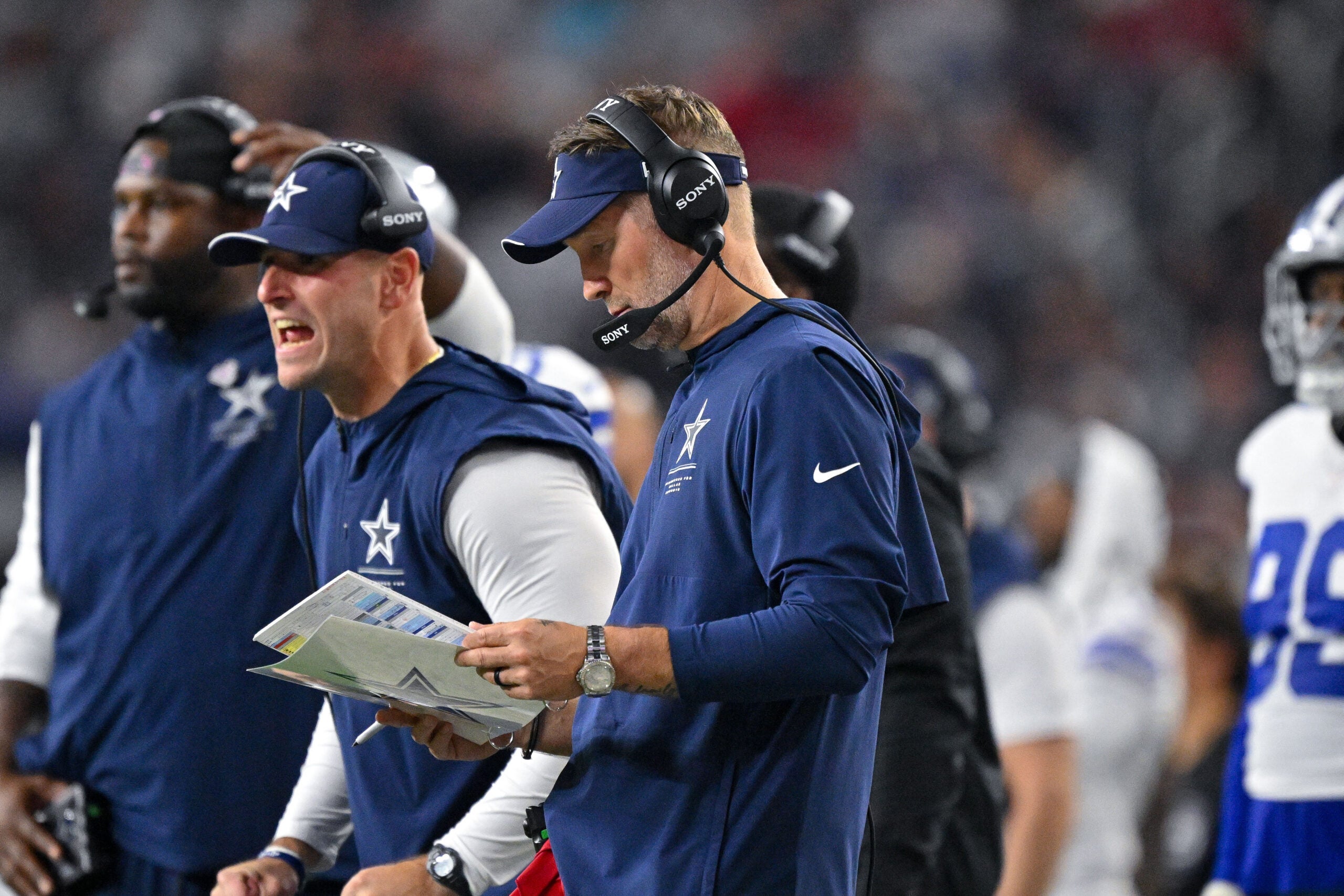
With over nine minutes left to go in the third quarter, Dallas Cowboys running back Javonte Williams scored the first touchdown of the night against the Green Bay Packers to make it 17-7 at Lambeau Field.
In that drive, Williams ran four times for 15 yards, moving the chains once and scoring another time.
The Cowboys ran a pass play in 37 of the following 38 plays.
You read that right. And the most concerning part is Cowboys head coach Brian Schottenheimer’s postgame pitch was that they didn’t have much of a choice. Let’s dive in.
Schottenheimer says Cowboys’ plan wasn’t to throw 54 times
“I didn’t plan on coming into this game and having to throw it 54 times,” Schottenheimer told reporters postgame. “That wasn’t the plan. It’s not a good recipe against this defense that’s been down against the run and pretty good against the pass. So that wasn’t a good recipe for us, but that’s the way the game turned out.”
Did it, though?
When the Cowboys scored Williams’ touchdown, ESPN gave them an 18% chance to win the game. Even after the Packers responded with a field goal, there were still over five minutes left on the third quarter. Of course bouncing back from such a deficit would be hard but this was far from a “forget the run game” scenario.”
The Cowboys got the ball back down 20-7 with a chance to make it a one-possession game. Instead, Dak Prescott threw the ball four times in that drive, ending it with three straight incompletions. The Packers went three-and-out the following drive.
That meant yet another chance to cut it to a one-possession game. The Cowboys dialed up a pass play seven consecutive times, gaining only one first down.
Listen, I’m a sucker for having a pass-happy offense. But abandoning the run the way the Cowboys did is unnaceptable. Schottenheimer claims that’s the way the game turned out, but it’s hard to agree with that as the game was not a blowout at that point.
And yet, Schottenheimer insisted the Cowboys didn’t have much of a choice to do anything else.
“We put ourselves in a position where we got to throw the ball all around, and go two-minute up-tempo to try to get back in the game, and it’s going to be hard to do in the
National Football League,” he added.
It isn’t like the pass game was working, either. The Packers had the Cowboys’ number as they blitzed away knowing very well Dallas had no answers.
Cowboys’ predictability failed to exploit obvious Packers weakness
Then there’s the personnel issue. As the Cowboys insisted on the pass, they stayed on 11 personnel (one running back, one tight end, three wide receivers) in 84.3% of their plays. That meant the Packers could stay on nickel and away from a base defense.
Ask any Packers connosssieur about that and you’ll know how bad of a mistake that was. Green Bay entered the game severly banged up at interior defensive line, with only four active players at the position. Forcing them to stay on base would have been smart coaching.
“The only (Packers) player at (interior defensive line) on the bench was Anthony Campbell, who had only played nine NFL snaps prior to this game,” wrote Justis Mosqueda of Acme Packing Company. “They lucked out that the Cowboys decided to play a lot of light formations on offense, keeping the 3-4 personnel from being ground out in the running game.”
A big part of coaching in the NFL is being aware of your opponents’ weaknesses and targeting them. The Cowboys seemingly had no plans to exploit the Packers’ problems up front.
When Schottenheimer reviews the film and his play-calling, it’s difficult to imagine he’ll be content with it. He cited turnovers as the biggest reason why the Cowboys lost in Green Bay, but the truth is it goes much deeper than that.
It’s time for the Cowboys’ coaching staff to prove they can handle opposing NFL head coaching staffs. Right now, it’s looking like a big-time mismatch no matter who they face.
