
Philadelphia Eagles upgrade offensive weapons, rebuild OL and pass rush during latest 7-round 2027 NFL mock draft
The Philadelphia Eagles have a ton of needs they will need to fill this offseason. They put together an elite haul during the 7-round 2027 NFL mock draft.

The Philadelphia Eagles have some serious decisions ahead of them.
A disappointing 2-7 start to the 2026 season has put Philadelphia in an unfamiliar position, with the team currently sitting at No. 5 in the 2027 NFL Draft order. It’s not where anyone expected the Eagles to be, but it does give general manager Howie Roseman an opportunity to add some significant young talent to the roster.
And knowing Roseman’s history, I wanted to see what kind of return he could get by moving down the board.
Using the A to Z Sports Mock Draft Simulator, I decided to entertain an offer from the Cleveland Browns. Cleveland wanted to move up to No. 5, and Philadelphia was able to get quite a bit in return.
The Eagles traded the No. 5 overall pick to Cleveland for four selections: No. 16 in the first round, No. 50 in the second round, No. 82 in the third round, and No. 116 in the fourth round.
That’s a pretty attractive package, especially for a team that needs to replenish its roster at several positions. The biggest priority in this mock draft was the offensive line. With Lane Johnson retiring, Philadelphia needs to start thinking about the future up front. There are also opportunities to add young talent at tight end, edge rusher, linebacker, and safety.
Here’s how the rest of the draft played out.
Round 1, Pick No. 16: Trey’Dez Green, TE, LSU
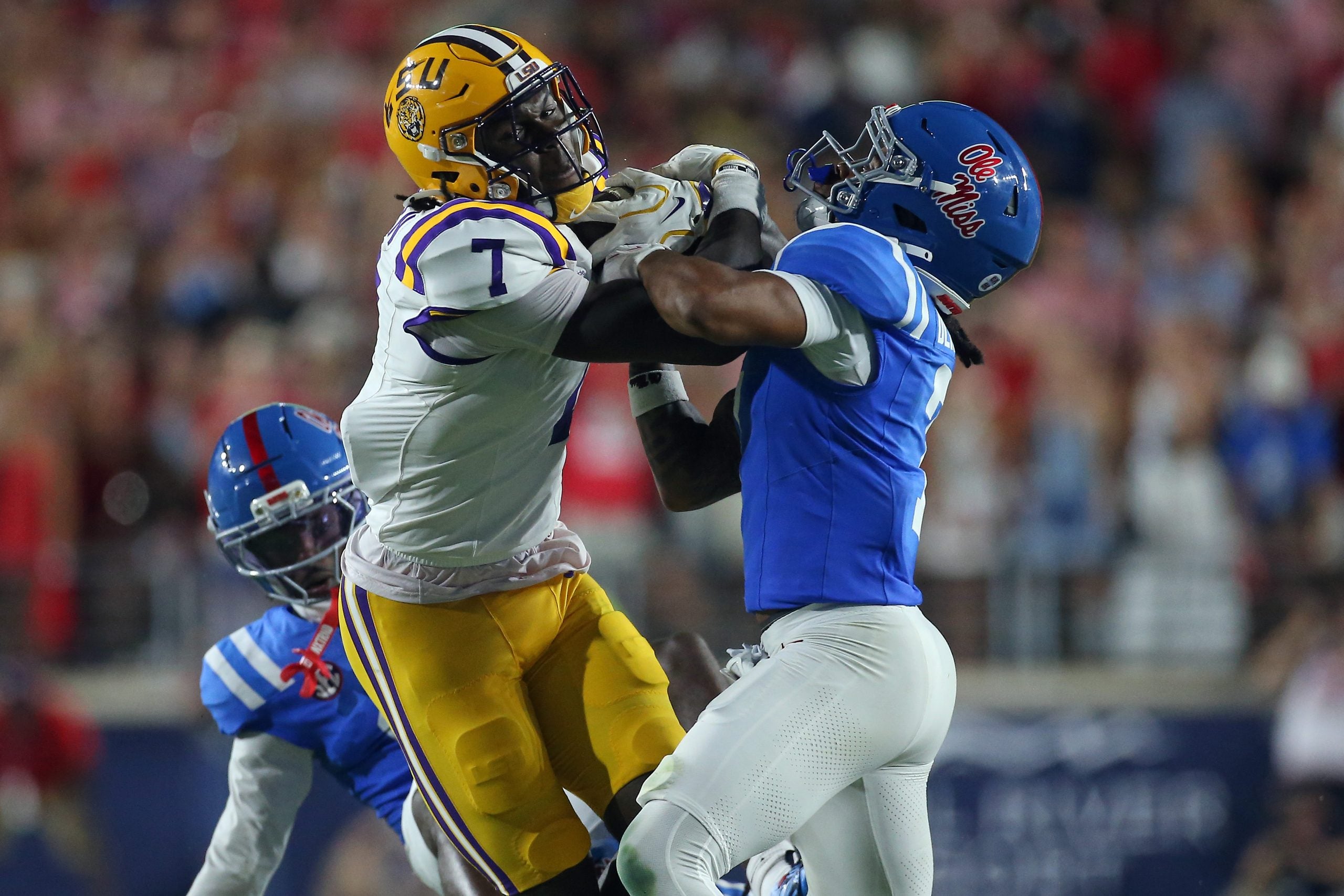
Philadelphia uses its first selection on LSU tight end Trey’Dez Green, a player who brings a pretty unique physical profile to the position.
At 6-foot-7 and 242 pounds, Green is an enormous target who can create problems for opposing defenses, particularly in the red zone. He’s been productive during his time at LSU, recording 75 receptions for 891 yards and 13 touchdowns over three seasons.
Green led the Tigers in touchdown receptions in 2025 with seven. His ability to use his size to win contested catches is probably his biggest selling point, but he’s also shown some ability to create after the catch.
There is still work to be done as a blocker, which is something Philadelphia will certainly want to see improve. The Eagles have traditionally valued tight ends who can contribute in both phases, so that will be an important part of his development.
I understand the argument that tight end isn’t necessarily the biggest need on this roster, especially with previous investments at the position. However, Green gives the offense another potential mismatch and could become a valuable weapon for whoever is playing quarterback.
It’s an interesting way to start the Eagles’ draft, even if there are more pressing needs elsewhere.
Round 2, Pick No. 36: Trevor Lauck, OT, Iowa
This is the selection I like most for Philadelphia.
The retirement of Lane Johnson creates a massive question for the Eagles moving forward. Replacing a player of his caliber isn’t going to be easy, and finding someone who can eventually become a dependable starter at tackle needs to be high on the organization’s priority list.
Iowa’s Trevor Lauck is an intriguing option.
The 6-foot-5, 314-pound offensive tackle has established himself as one of the better linemen in college football. He started every game for Iowa in 2025, helping anchor an offensive line that earned Joe Moore Award recognition. Lauck also earned third-team All-Big Ten honors.
His pass protection is what makes him particularly appealing. He’s shown good technique and consistency on the blind side, and his experience against quality competition should help with the transition to the NFL.
Iowa has developed a strong reputation for producing offensive linemen, and Lauck has the type of background that should make him attractive to NFL teams.
The Eagles have always understood the importance of winning up front. With Johnson’s retirement, this is a position they can’t afford to ignore. Getting a tackle with Lauck’s experience and potential in the second round would be a significant addition.
Round 2, Pick No. 50: Clev Lubin, EDGE, Louisville
Roseman continues adding to the defensive front with Louisville edge rusher Clev Lubin.
Lubin has taken a pretty interesting path to becoming an NFL prospect. His college career included stops at Army, Iowa Western and Coastal Carolina before eventually landing at Louisville.
He’s made the most of those opportunities.
The 6-foot-3, 260-pound defender has demonstrated an ability to consistently pressure opposing quarterbacks. He’s produced double-digit sacks across multiple stops and recorded 8.5 sacks and 13.5 tackles for loss during his first season in the ACC.
What stands out about Lubin is his motor. He plays hard, pursues the football and has shown that he can generate pressure against quality offensive tackles.
The Eagles have made building their defensive line a priority for years. That approach shouldn’t change, particularly with the importance of getting after quarterbacks in the NFC.
Lubin isn’t a finished product. He’ll need to continue developing his pass-rush moves and become more consistent when his initial rush doesn’t work. Still, his production and effort make him an interesting second-round investment.
Philadelphia would be adding another player who could compete for rotational snaps early in his NFL career.
Round 3, Pick No. 82: Earl Little Jr., S, Ohio State
The Eagles address their secondary with Ohio State safety Earl Little Jr.
Little has an interesting college background, having spent time at Alabama and Florida State before continuing his career at Ohio State.
He really started to establish himself at Florida State, leading the Seminoles with 76 tackles and four interceptions in 2025.
At approximately 6-foot and 203 pounds, Little has the physical tools to contribute in different roles. He’s comfortable playing closer to the line of scrimmage and has shown the ability to make plays in coverage.
I like the versatility he could bring to Philadelphia’s secondary.
The Eagles have generally done a good job developing defensive backs, but continuing to add young talent at safety is important as the roster changes. Little could provide some valuable depth while competing for a larger role.
He isn’t necessarily someone I’d expect to walk in and immediately transform the secondary, but adding another experienced defensive back in the third round makes sense.
Round 3, Pick No. 97: Evan Tengesdahl, IOL, Cincinnati
Philadelphia goes right back to the offensive line with its second third-round selection, taking Cincinnati guard Evan Tengesdahl.
This is another pick that fits what the Eagles like to do offensively.
Tengesdahl is listed at 6-foot-3 and 325 pounds and has developed into one of the better interior offensive linemen in college football. He earned AP All-America recognition in 2025 and entered the 2026 season with plenty of preseason attention.
He’s a physical player who does some of his best work in the running game. Tengesdahl has the strength to move defenders at the point of attack and create opportunities for the running backs.
His pass protection is still an area that needs improvement, but he’s already accumulated valuable starting experience.
The Eagles have built their identity around having one of the better offensive lines in football. Losing Johnson makes it even more important to continue investing in that group.
I wouldn’t be surprised if Philadelphia used multiple selections on offensive linemen in this draft. Getting Lauck and Tengesdahl in the same class would give the organization two more young players to develop.
Round 4, Pick No. 107: T.J. Moore, WR, Clemson
The Eagles finally add another wide receiver, selecting Clemson’s T.J. Moore in the fourth round.
Moore was a highly regarded recruit coming out of high school and has developed into a productive player for the Tigers. The 6-foot-3, 200-pound junior has totaled approximately 130 receptions for nearly 1,800 yards during his college career.
His size is probably the most appealing part of his game. Moore has the frame to compete on the outside and has shown the ability to make contested catches.
His production in 2026 hasn’t been quite as impressive, and he’ll need to become more consistent when it comes to creating separation against defensive backs.
Still, there’s enough upside here to make him an interesting fourth-round selection.
The Eagles have invested in their receiving group, but adding another young player gives them some flexibility for the future. Moore could have an opportunity to develop behind the established players on the roster before potentially taking on a larger role.
Round 4, Pick No. 116: Tony Rojas, LB, Penn State
This is another selection I really like.
Penn State linebacker Tony Rojas has the athleticism to become an interesting NFL defender, and Philadelphia could use another young linebacker with his skill set.
Rojas is 6-foot-2 and 236 pounds. He’s coming off a difficult stretch after suffering an ACL injury in 2025, but his return has been an encouraging development for Penn State.
He’s been one of the more productive players on the Nittany Lions’ defense in 2026, contributing as a tackler, pass rusher, and coverage defender. His performance has earned him national recognition, including Butkus Award semifinalist consideration.
What I like most about Rojas is his athleticism. He has the range to make plays outside the numbers and the versatility to contribute in different defensive packages.
Linebacker has been a position where Philadelphia could use more long-term answers. Rojas would give the Eagles a young player with the potential to develop into a three-down contributor.
There are obviously some medical questions following his ACL injury, but the talent is worth taking a chance on in the fourth round.
Round 5, Pick No. 143: LJ Martin, RB, BYU
The Eagles add another running back by selecting BYU’s LJ Martin in the fifth round.
Martin is coming off an outstanding 2025 season in which he rushed for 1,305 yards and 12 touchdowns. That performance earned him Big 12 Offensive Player of the Year honors.
The 6-foot-2, 225-pound senior is a physical runner who does some of his best work between the tackles. He’s capable of breaking tackles, handling a substantial workload, and generating yards after contact.
He’s also been productive in 2026 when healthy, although an ankle injury has limited him.
This isn’t necessarily a major need for Philadelphia with Saquon Barkley still leading the backfield. However, running backs take plenty of punishment throughout an NFL season, and adding another young option isn’t a bad idea.
Martin has a running style that fits what the Eagles want to do offensively. He could provide some insurance behind Barkley and potentially develop into a bigger contributor down the road.
Round 5, Pick No. 154: Sam Leavitt, QB, LSU
Philadelphia closes out its draft by taking LSU quarterback Sam Leavitt.
Leavitt has already experienced quite a bit during his college career, starting at Michigan State before transferring to Arizona State and eventually LSU. His time at Arizona State helped establish him as a legitimate NFL prospect. He demonstrated the ability to make plays with both his arm and legs while helping lead the Sun Devils to a successful 2024 season.
After transferring to LSU, Leavitt has continued to showcase his athleticism and playmaking ability. He’s thrown for more than 2,500 yards and 17 touchdowns in 2026 while also contributing as a runner.
At 6-foot-2, he has an interesting combination of arm talent and mobility. He’s capable of extending plays and creating opportunities when things break down around him.
The biggest concern is his consistency. There have been some turnover issues, and he’ll need to become more disciplined with his decision-making at the next level.
Still, taking a quarterback in the fifth round is a reasonable investment for Philadelphia. The Eagles have experienced some turnover in their quarterback room, and adding another young player gives them someone they can develop behind their established options.
Leavitt has enough physical ability to make this an interesting late-round selection.
Final thoughts
The biggest takeaway from this mock draft is how much the Eagles were able to accomplish by moving down from No. 5.
The trade with Cleveland gave Philadelphia four additional selections in the first four rounds, and I think that’s an important part of the overall strategy. Rather than putting all their eggs in one basket, the Eagles were able to address several areas of the roster.
The offensive line was clearly the priority. Adding Trevor Lauck and Evan Tengesdahl gives Philadelphia two young prospects who could eventually become important pieces up front. With Lane Johnson retiring, that investment makes plenty of sense.
I also like the additions of Clev Lubin and Tony Rojas on defense. Both have the athleticism and production to become useful contributors, while Trey’Dez Green gives the offense another potential matchup problem.
There are certainly some questions. Green might be a luxury selection at No. 16, and several of the later picks will need time to develop. But that’s part of the process when building through the draft.
If I had to pick one move that defines this entire class, it’s the decision to trade No. 5 to Cleveland. Roseman has made a career out of finding ways to accumulate draft capital, and this deal gives the Eagles four opportunities to add impact players in the first four rounds.
This isn’t a draft built around one superstar selection. It’s about giving Philadelphia more options, getting younger in the trenches and finding some potential long-term contributors.
That’s a pretty reasonable approach for an Eagles team that has a lot of work to do heading into 2027.
