
Packers have 5 ways to attack a Vikings’ defense that no NFL offense has solved yet
Green Bay gets a second shot at Brian Flores’ unit on Sunday, and the Week 1 tape and the Bills’ blueprint point toward a specific plan.


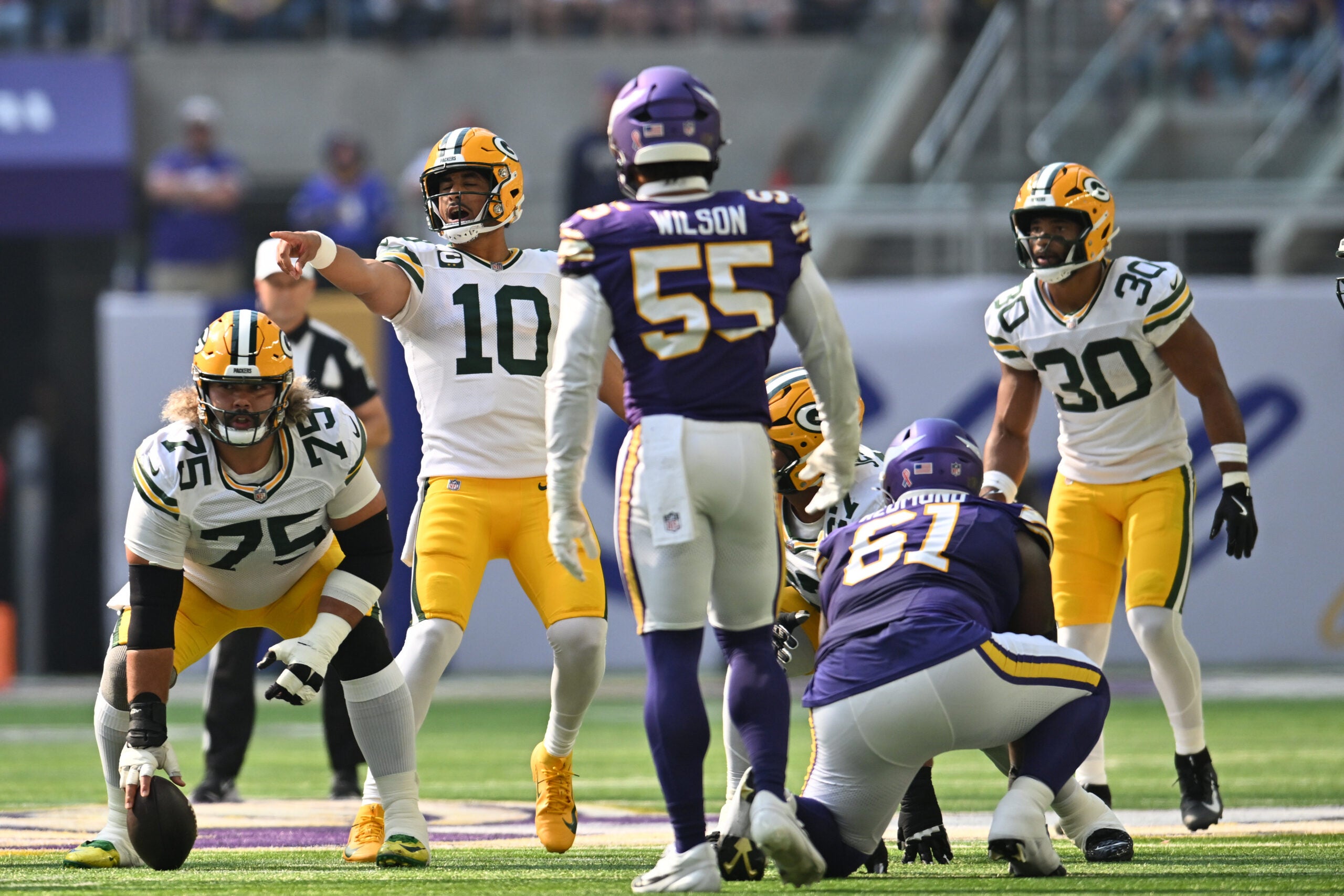
The Green Bay Packers offense faces the NFL’s best defense on Sunday against the Minnesota Vikings. So far, no team has found a reliable way to beat it. After nine weeks, Minnesota ranks first in EPA per play on defense, first in success rate, and first in dropback EPA. It has not allowed a single quarterback to post a 90-plus passer rating, even against Jordan Love, Jared Goff, and Josh Allen.
Love actually played the best of that group. In Week 1, he completed 21 of 42 passes for 387 yards, two touchdown passes, and one interception, good for an 88.1 passer rating. He did it against the league’s highest blitz rate under defensive coordinator Brian Flores, with guards Donovan Jennings and Jacob Monk in the lineup.
The result still went sideways. Green Bay led 22-10 with five minutes left in the third quarter. Then came multiple turnovers, an offensive line collapse, and the Vikings stayed efficient in the red zone to score 29 consecutive points and win 39-22.
So, let’s discuss what the Packers can do differently, based on what worked for them in Week 1 and what other teams have done against Minnesota. That includes the Bills, who won 23-6 on “Monday Night Football” even with Allen making his share of mistakes. Allen completed 21 of 31 passes for 234 yards, one touchdown pass, and one interception (an 87.3 passer rating). Running back James Cook carried the ball 31 times for 107 yards and a touchdown.
Green Bay doesn’t have that luxury. The Packers rank 32nd in rush EPA, so any plan starts with the passing game.
Heavier personnel and split backs
The first adjustment is playing with fewer wide receivers. Multiple running back and tight end sets put more bodies in the backfield to pick up blitzes, which Minnesota relies on heavily. The Packers also lack the receiver depth to live in three-wide sets. Jayden Reed was healthy in Week 1, so the team played a fair amount of 11 personnel. Even with Savion Williams playing pretty well since his return, Green Bay should lean on 12 and 21 personnel, especially if Chris Brooks is back healthy.
Christian Watson and Matthew Golden can win on their own. If the Packers send only those two and tight end Tucker Kraft into routes, that should still be enough to create separation and give Love options. Multiple tight end sets worked in Week 1. It was Jonnu Smith’s best game in Green Bay, with two receptions for 50 yards on three targets. He has only 44 yards combined since then. Backup tight end Mark Redman, a solid blocker, is another viable second tight end.
The second adjustment is shotgun split backs, with two backs (or a back and an H-back) flanking Love. The Bills did this a lot on Monday, and it gave Allen extra time against the blitz. Green Bay had its own version on Watson’s 81-yard touchdown in Week 1. Kraft motioned into an H-back spot on the same side as MarShawn Lloyd, the line slid protection the other way, and Kraft and Lloyd picked up the pressure on the left. Love found Watson over the middle, and Watson did the rest.
Tempo, condensed sets, and a moving pocket
Buffalo also went up-tempo. Minnesota runs a complex system that depends on communication, and that’s why safety Harrison Smith’s return right before the season mattered so much. If Love can get two or three plays called at once and get to the line quickly, the Packers can stress that communication.
Condensed sets come naturally to Green Bay. The Vikings already stack the box, which compresses the formation, but Packers head coach Matt LaFleur designs plays well in those looks, with receivers finding space after the snap. That approach also opens up play action and lets Love move the pocket. In Week 1, he rolled to his right off a play-action fake and hit Golden down the field.
Choose points over aggression
The final point isn’t about play-calling but about LaFleur’s decision-making. Aggressiveness usually pays off, from going for it on fourth-and-short to attempting two-point conversions. Against this specific opponent, though, securing field goals makes more sense. Short yardage is hard to convert against Minnesota, especially without an effective run game.
Week 1 showed the cost. Up 22-10, the Packers kicked a field goal, but a Vikings penalty turned fourth-and-6 into fourth-and-1. Love’s quarterback sneak failed, Green Bay came away with nothing, and Minnesota answered with a score. The Packers spiraled from there.
The Vikings’ offense can’t carry the team, which is why that conservative approach makes sense. Carson Wentz played fine in Week 1 after replacing an injured Kyler Murray, but he was rough against the Bills. This time, defensive coordinator Jonathan Gannon will have time to prepare for both quarterbacks to some extent, even though Kirk Cousins is expected to start. If Green Bay can simply put points on the board, that might be enough. In this particular matchup, a more conservative approach could be the smart one.
