The Top-15 Heisman Trophy Snubs in College Football History: Which players got hosed the worst?
All kinds of controversies are derived from sports and one of the most popular debates is the top Heisman Trophy snubs in college football history. We recently listed and dissected some of the biggest slights over the last few decades.


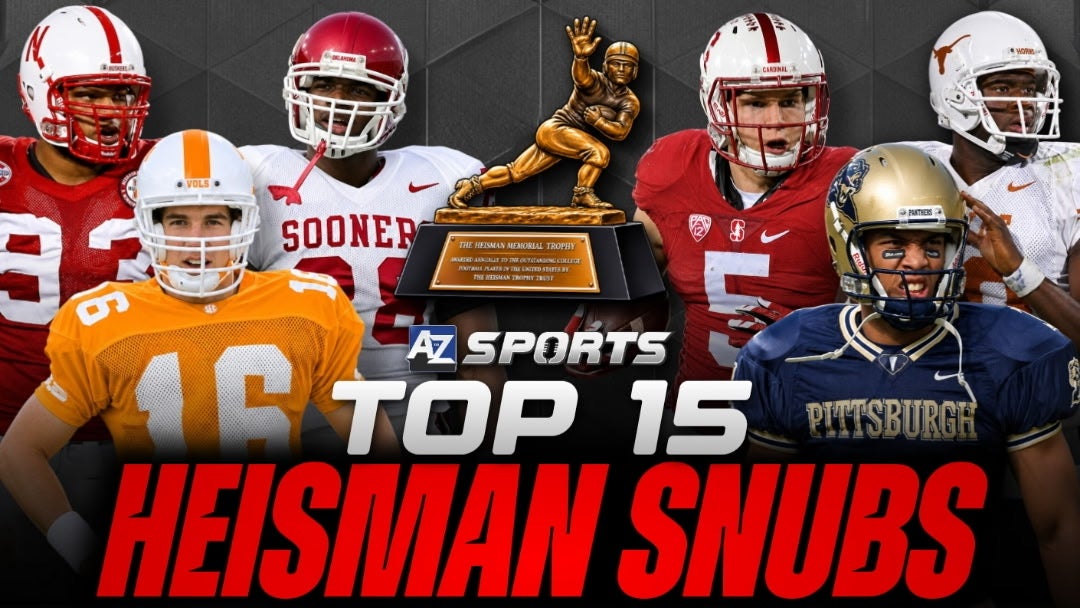
Outside of a national championship, the Heisman Trophy is easily the most coveted item in college football.
Controversy will always come with that kind of desire and prestige, however, and that’s certainly been the case ever since the award was first presented all the way back in 1935.
So, with that being said, we created a list of some of the top Heisman snubs in college football history. Each selection has a break down reminding us all of final outcome how things arrived at the point they did.
Let’s dive in.
15. Peyton Manning isn’t the Vols’ worst Heisman Trophy snub, and the numbers show a Tennessee legend got robbed
The Heisman Trophy has produced its share of head-scratching decisions and notable snubs over the years, and a couple of them involve former Tennessee Vols legends.
When Tennessee fans think about the Heisman Trophy, nearly all of them think first of legendary quarterback Peyton Manning. Manning lost out on the award in 1997 to Michigan cornerback Charles Woodson, and that result remains one of the most controversial in the history of the award.
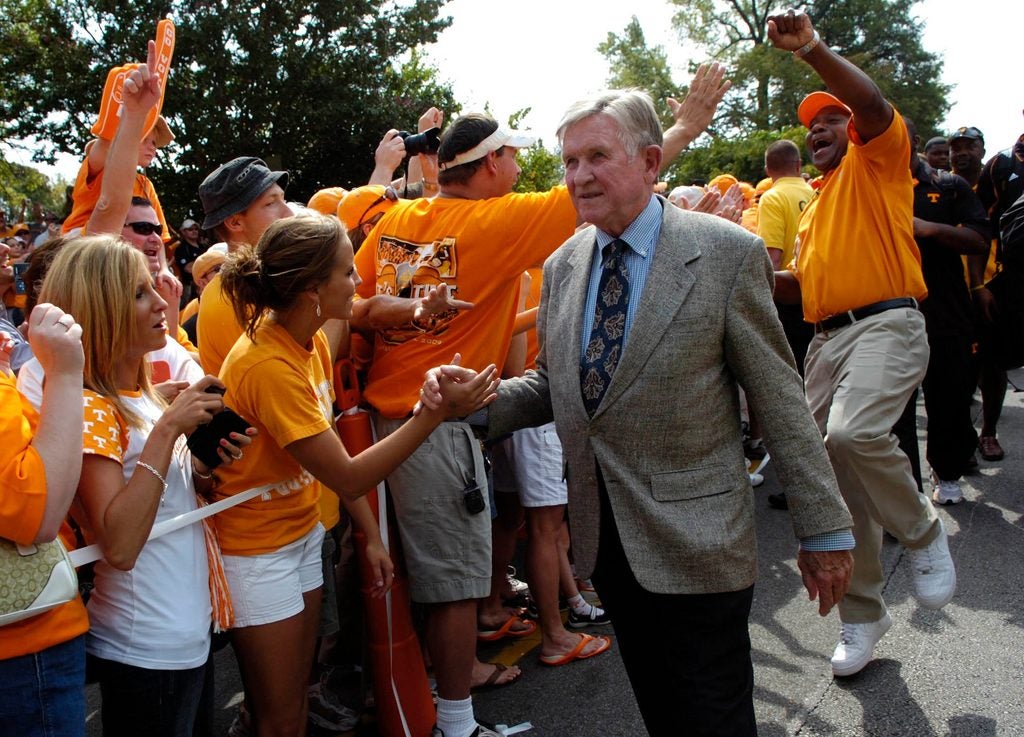
Even so, Manning arguably isn’t the greatest Heisman snub in Tennessee football history. That distinction belongs to former Tennessee standout and legendary head coach Johnny Majors.
Johnny Majors carried the Tennessee Vols to the brink of a national title
Majors served as the Vols’ quarterback in 1956, running Tennessee’s single-wing offense. He led Tennessee to a 10-0 regular season that kept the Vols near the top of the polls and in contention for the national championship.
His production matched the team’s success. Majors completed 61% of his passes for 552 yards, five touchdowns, and three interceptions. He added 549 rushing yards and seven touchdowns on a team-high 108 carries.
That overall resume should have been more than enough to win the award. Instead, the trophy went home with Notre Dame quarterback Paul Hornung.
Paul Hornung’s Heisman Trophy season doesn’t hold up
Hornung’s Fighting Irish stumbled to a 2-8 record in 1956. He completed only 53% of his throws, with three touchdown passes against a staggering 13 interceptions.
Majors wasn’t the only player with a stronger case. Oklahoma running back Tommy McDonald, who won the 1956 Maxwell Award, totaled 1,135 scrimmage yards and 16 touchdowns. He still finished third in the voting behind Hornung and Majors.
The final tally read like this:
- Paul Hornung, Notre Dame: 1,066 points
- Johnny Majors, Tennessee: 994 points
- Tommy McDonald, Oklahoma: 973 points
Majors had the better overall year, pacing a Tennessee team that sat in the driver’s seat for a shot at the national championship. Compared to what Hornung produced, it isn’t much of a debate.
Why the 1956 Heisman vote stings more than 1997
Manning’s loss still frustrates the Tennessee fan base nearly three decades later, and that’s understandable. Woodson, however, at least had a case. He delivered a true Heisman moment with a crucial and jaw-dropping interception against Michigan State and helped lead the Wolverines to a share of the national title.
Hornung had nothing close to that in 1956. He had no defining moment and no comparable level of play, and he was a quarterback on a team that won only twice all season.
To me, that’s the difference. Voters can debate the merits of a cornerback against a quarterback in 1997. In 1956, voters handed the award to a player whose numbers and results trailed Majors in nearly every meaningful way.
For all of those reasons, Johnny Majors’ snub is the worst in Tennessee history, and it ranks among the worst in the history of college football. – Craig Smith
14. Tennessee head coach Josh Heupel came up just short of a Heisman Trophy at Oklahoma
Josh Heupel put together one of the best all-around seasons – in terms of team success – in college football history in 2000, leading the Oklahoma Sooners from No. 19 in the preseason to a national championship.
Heupel, though, still came up short in the Heisman Trophy race.
The future Tennessee head coach finished second in the voting behind Florida State Seminoles quarterback Chris Weinke.
Heupel, a redshirt senior at Oklahoma in 2000, threw for 3,392 yards and 20 touchdowns. He also completed 65% of his passes and helped the Sooners finish undefeated.
Josh Heupel led one of the most remarkable turnarounds in college football history
What made Heupel’s season so impressive was how quickly Oklahoma turned things around under coach Bob Stoops.
The Sooners went 7-5 in 1999, which was Heupel’s and Stoops’ first season with the program. They weren’t viewed as a national championship contender entering the 2000 season.
Heupel’s leadership was key to the turnaround, and his performances against Texas, Kansas State, and Nebraska in consecutive weeks helped Oklahoma climb to the top of the rankings.
The reality is Weinke technically had the better statistical season. He threw for 4,167 yards and 33 touchdowns, leading the nation in passing yards. Florida State went 11-1 during the regular season and reached the national championship game for the second consecutive year.
Weinke, however, was 28 years old.
He had already spent six years playing minor league baseball, which gave him a bit of an advantage over the younger Heupel. His age was a talking point throughout the Heisman race, with some voters questioning whether a player that much older than his competition should win the award.
How close the 2000 Heisman Trophy vote really was
The final numbers were close.
Weinke received 369 first-place votes to Heupel’s 286. Purdue quarterback Drew Brees finished a distant third.
The biggest reason Heupel didn’t win the award was his production down the stretch. He didn’t throw for 300 yards in any of Oklahoma’s final four games, which is when voters are paying particularly close attention (though he was dealing with an injury to his throwing arm).
Heupel also threw three interceptions in the Big 12 Championship Game against Kansas State. Weinke, meanwhile, kept putting up impressive numbers, including 353 yards and three touchdowns in the regular season finale against Florida.
But Heupel had some legitimate reasons to win the award. He was the AP Player of the Year, the Walter Camp Player of the Year, and the Big 12 offensive player of the year.
Of course, I don’t think Heupel would change anything about the way things turned out.
Oklahoma beat Florida State 13-2 in the Orange Bowl to win the national championship.
Heupel didn’t win the Heisman. But he got what every player wants most: a national championship. – Zach Ragan
13. Raghib Ramadian “Rocket” Ismail takes College Football by storm but it’s not enough to win the Heisman
If there is one Heisman race that Notre Dame fans can point to when discussing the award’s biggest misses, it is Rocket Ismail’s 1990 season.
Ismail was one of the most electrifying players in college football. He wasn’t simply a wide receiver or a return specialist. He was a game-changing weapon who could completely alter a game without necessarily needing the ball in his hands on every offensive possession.
His 1990 numbers demonstrate just how versatile he was
Ismail rushed for 537 yards and three touchdowns on 67 carries. He caught 32 passes for 699 yards and two touchdowns, averaging an incredible 21.8 yards per reception. He also returned 14 kickoffs for 336 yards and a touchdown while adding 151 yards on 13 punt returns.
That gave him 1,723 all-purpose yards and six total touchdowns.
He was named a unanimous All-American and won the Walter Camp Player of the Year Award. Notre Dame finished the regular season 9-2 before defeating Colorado in the Orange Bowl.
Despite those accomplishments, Ismail finished second in the Heisman voting behind BYU quarterback Ty Detmer.
Detmer had an outstanding season of his own. He threw for 5,188 yards and 41 touchdowns, leading a prolific BYU passing attack. He was one of the most productive quarterbacks in the country and had a legitimate case for the award.
But the argument for Ismail was about more than traditional offensive statistics
He was a threat as a runner, receiver and returner. Defenses had to account for him every time he stepped onto the field, and his ability to create explosive plays in multiple phases made him one of the most dangerous players in the country.
The voting reflected a fairly decisive victory for Detmer. He received 1,482 points, including 361 first-place votes. Ismail finished with 1,177 points and 237 first-place votes.
Ismail also had a remarkable 1989 season, helping Notre Dame win the national championship. He finished 10th in that year’s Heisman voting, making his second-place finish in 1990 even more notable.
There is a reasonable argument that Ismail should have become the first Notre Dame player since Tim Brown in 1987 to win the Heisman. His versatility and game-breaking ability made him a unique candidate, even if Detmer’s statistical production was difficult to match. – Ryan Roberts
12. Willis McGahee’s big 2002 season with Miami still makes a strong case as one of the Hurricanes’ biggest Heisman snubs
The Miami Hurricanes of the early 2000s rank among the hottest teams college football has seen in any era. Miami didn’t lose a game from early in the 2000 season through the 2002 regular season, a run that added up to a 34-game winning streak.
That 2002 Hurricanes team looked poised to keep the program’s championship run going. A big part of that was redshirt sophomore running back Willis McGahee, whose season still stands out as the best in Miami history.
Willis McGahee carried a loaded Miami offense to a 12-0 regular season
The Canes had no shortage of talent on offense. Ken Dorsey was back under center. Wide receiver Andre Johnson, a future Pro Football Hall of Famer, lined up out wide. Future Pro Bowl tight end Kellen Winslow Jr. worked at the end of the line.
Still, McGahee’s workhorse performances powered the offense on the way to a 12-0 regular season.
McGahee rolled up 1,753 rushing yards and 28 rushing touchdowns. Yes, 28. That put him fifth in the country in rushing yards and first in rushing scores. He also added 27 catches for 355 yards out of the backfield on his way to first-team All-American honors. His 1753 rushing yards is still the program single-season record.
To me, Miami very likely doesn’t reach the Fiesta Bowl undefeated without that production. That includes what was arguably his Heisman moment against Florida State.
In the fourth quarter, with the Hurricanes trailing the Noles 27-21, McGahee took a screen pass and broke free down the sideline for a 68-yard gain. Jason Geathers scored on the next play, and Miami hung on for a 28-27 win. It turned out to be the Canes’ closest call all season on the way to a Big East title and a berth in the Fiesta Bowl against Ohio State.
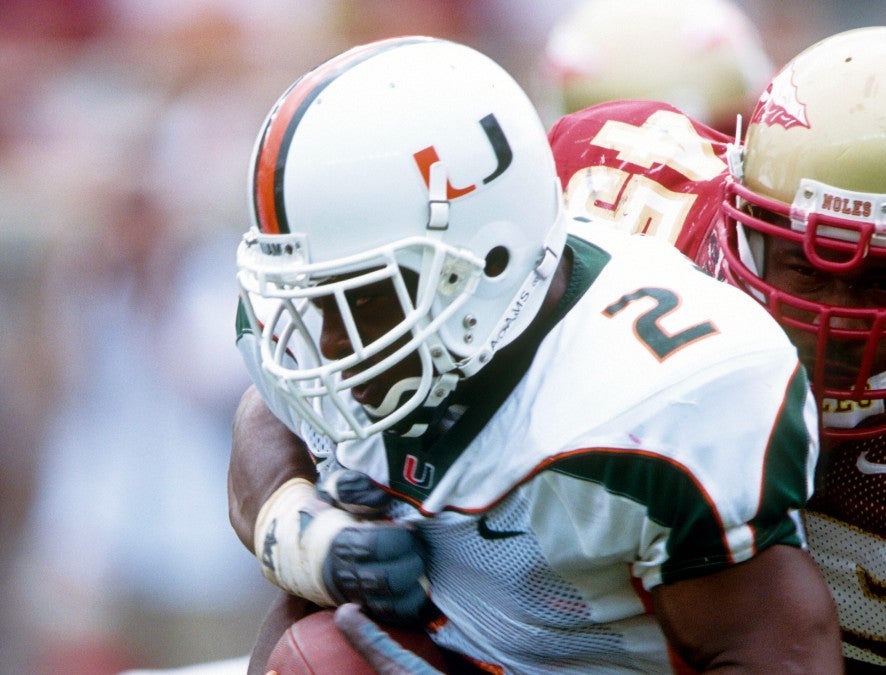
McGahee finished a distant fourth in the 2002 Heisman Trophy voting
Despite the production and his importance to the Hurricanes’ offense, McGahee finished a distant fourth in the Heisman voting. USC quarterback Carson Palmer won the award, with Iowa’s Brad Banks and Penn State’s Larry Johnson finishing second and third, respectively. Dorsey, his own quarterback, came in fifth with 643 total votes, right behind McGahee.
All three players who finished ahead of McGahee had good seasons. It’s also understandable that Palmer won. The award typically goes to quarterbacks above every other position, and Palmer finished with 3,942 passing yards, 33 touchdown passes, and 10 interceptions. Those numbers are respectable, especially for that era.
That being said, McGahee’s numbers were more than solid, and he was a major reason the Hurricanes found themselves playing for another national championship. Leading the nation in rushing touchdowns while serving as the engine of an unbeaten team is a strong résumé for any player, at any position.
Maybe it doesn’t scream outright massive snub. Palmer had a legitimate case, and the voting history favors the quarterback position whether it should or not. But when it comes to deserving Miami contenders who walked away without the trophy, McGahee sits right at the top of the list. – Craig Smith
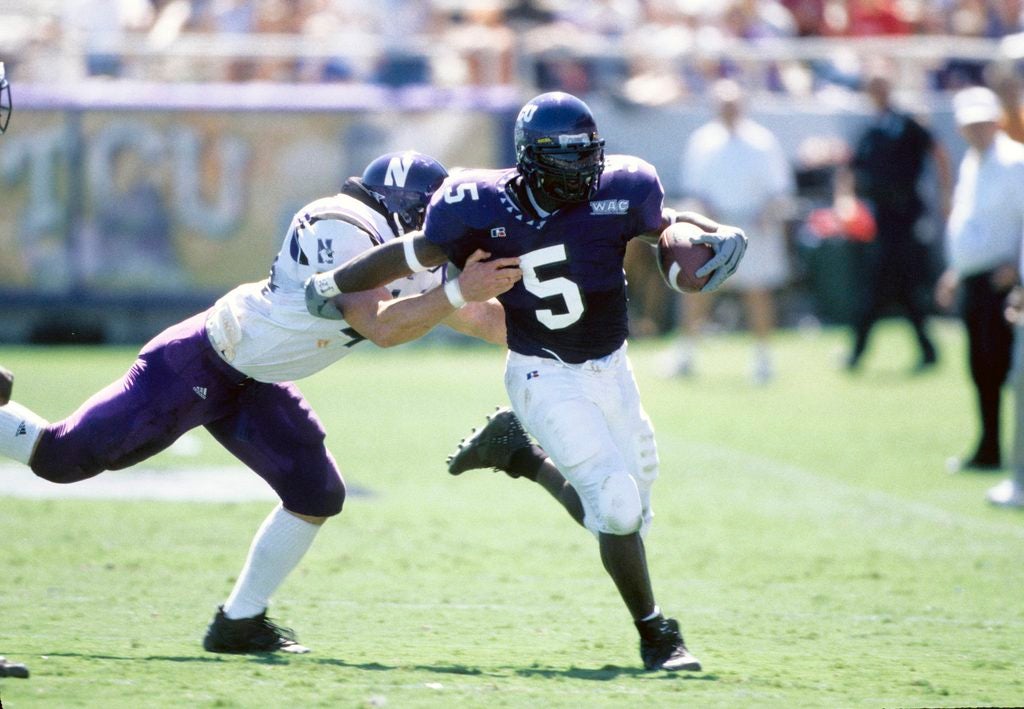
11. LaDainian Tomlinson is robbed of a historic career finish at TCU
LaDainian Tomlinson’s 2000 season might be the most statistically impressive of the three examples.
The TCU running back was practically unstoppable, putting together one of the greatest individual rushing seasons in college football history. He entered his senior season coming off a 1,850-yard campaign in 1999 and somehow found another gear.
Tomlinson rushed for 2,158 yards and 22 touchdowns in just 11 games. He averaged 196.2 rushing yards per game, leading the nation for the second consecutive season.
He also finished with 2,198 all-purpose yards.
Think about that production for a moment. Tomlinson averaged nearly 200 rushing yards every time he stepped onto the field. He was the focal point of the TCU offense, and opposing defenses knew exactly who they needed to stop.
LaDainian Tomlinson’s 2000 stats
LT led the country in rushing yards, rushing touchdowns, and total touches from scrimmage in 2000, but it wasn’t enough to win the Heisman. Below is a breakdown of his stats from that season.
- Rushing attempts: 369
- Rushing yards: 2,158
- Yards per carry: 5.8
- Rushing touchdowns: 22
- Total touches from scrimmage: 379
Tomlinson’s elite production didn’t matter, though
Tomlinson was named the WAC Offensive Player of the Year for the second consecutive season and helped TCU become one of the most dangerous teams outside the traditional college football power structure.
Yet when the Heisman voting concluded, he finished fourth.
Florida State quarterback Chris Weinke won the award after throwing for 4,167 yards and 33 touchdowns with 11 interceptions. Oklahoma quarterback Josh Heupel finished second, while Purdue quarterback Drew Brees came in third.
Weinke certainly had an impressive season. Florida State finished 11-1, won the ACC championship and played for the national championship. His numbers were excellent, and the Seminoles were one of the most recognizable programs in the country.
But Tomlinson’s case was difficult to dismiss
He led the entire country in rushing, topped 2,100 yards and scored 22 touchdowns. He wasn’t putting up those numbers against a schedule of lower-level competition, either. TCU was competing in the Western Athletic Conference and eventually shared the conference championship with UTEP.
The biggest argument against Tomlinson’s candidacy was likely the national profile of TCU compared to Florida State, Oklahoma and Purdue.
The Horned Frogs didn’t have the same television exposure or national championship expectations as those programs. That shouldn’t have mattered when evaluating individual performance, but it is fair to wonder whether it influenced the voting.
Tomlinson received just 47 first-place votes. Weinke received 369.
There is also an important distinction here: Tomlinson didn’t finish a particularly close fourth. He was well behind the top three. That makes his exclusion from the top of the ballot even more frustrating when considering what he accomplished.
His 2,158 rushing yards remain one of the defining individual seasons of the era. He went on to become one of the greatest running backs in NFL history, eventually earning induction into the Pro Football Hall of Fame.
Looking back, it’s difficult to argue that a player who averaged nearly 200 rushing yards per game wasn’t worthy of a much stronger Heisman finish. – Ryan Roberts
10. Deion Sanders’ dominant final season at Florida State deserved far more Heisman Trophy love than voters gave him
The 2024 Heisman Trophy went to Colorado Buffaloes two-way standout Travis Hunter. Some might debate it, but it was a worthy selection and a rare chance for a player who excelled on defense to take home college football’s most prestigious individual award.
Hunter became just the second player, after Michigan’s Charles Woodson in 1997, to claim the Heisman while playing a significant role on the defensive side of the ball.
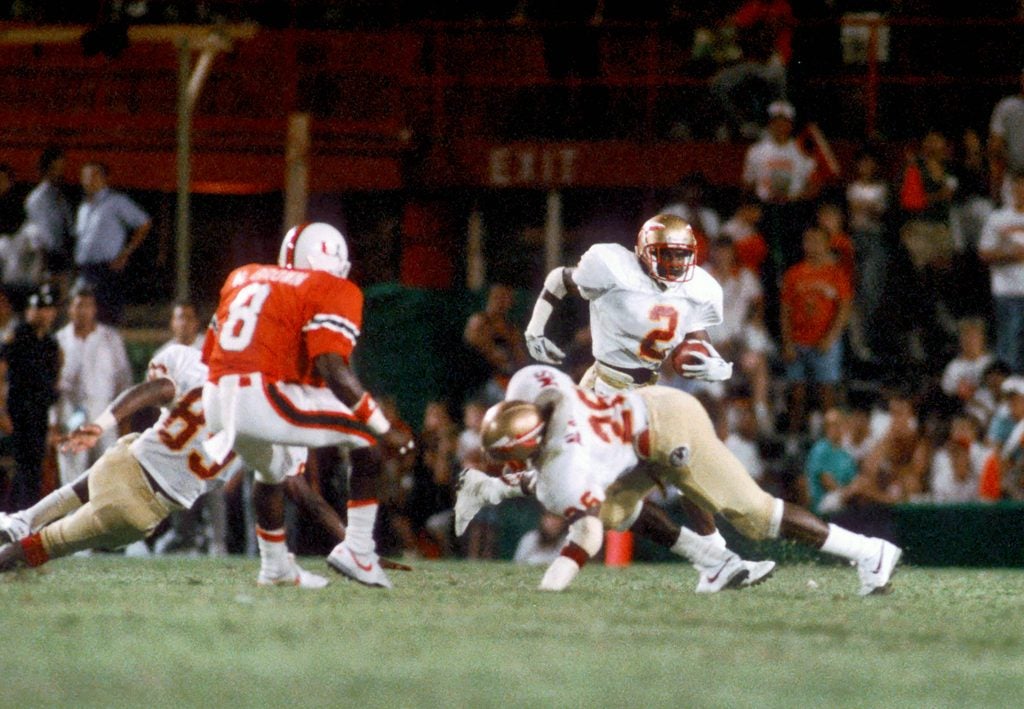
However, Hunter’s own head coach at Colorado, Deion Sanders, once had a Heisman case of his own. During his time with the Florida State Seminoles, Sanders was one of the best defensive players in all of college football, if not the best.
Deion Sanders was a human highlight reel at Florida State in 1988
In his senior season in Tallahassee, “Prime Time” delivered his best year for the Seminoles.
Sanders appeared in all 11 games and totaled a career-best five interceptions for 116 return yards and two pick-sixes. On top of that, he led all of college football in punt return yardage with 503 yards on 33 returns.
He was a human highlight reel at positions where highlights typically didn’t happen too often. That’s part of what made his argument as the best player in college football stand out even further.
Heisman voters left Sanders far outside the conversation
When the voting was done, Sanders’ name was nowhere near the top of the list. He didn’t even receive an invitation to the Heisman Trophy ceremony.
Sanders finished eighth with just 22 points. He collected three second-place votes, 16 third-place votes, and no first-place votes.
By contrast, the winner was Oklahoma State running back Barry Sanders, who piled up 1,878 points. That put him far ahead of second-place USC quarterback Rodney Peete. UCLA quarterback Troy Aikman and Miami quarterback Steve Walsh rounded out the top four, and both finished well ahead of Deion as well.
To be fair, it’s tough to argue with Barry’s candidacy. The former Oklahoma State Cowboys great posted a generational stat line of 2,628 rushing yards and 37 touchdowns. That’s just not something you see, either now or in the 1980s.
Barry was a deserving winner. Deion, however, deserved a place much higher than eighth and firmly in the conversation for the award itself.
No offense to Peete, Aikman, Walsh, or the others who finished in front of Deion, a group that includes Michigan State offensive lineman Tony Mandarich. But it’s hard to imagine a more impactful player on one side of the football than what Sanders gave Florida State in 1988.
Deion Sanders’ Heisman place in the Heisman voting looks even worse in hindsight
The college football world would wait another nine years before a defensive player finally broke through. Woodson did it in 1997, and Hunter followed him all these years later under Deion’s watch in Boulder, Colorado.
That’s what makes the 1988 vote stick out. Sanders did everything a defensive back and return man could possibly do to force his way into the race. Interceptions, touchdowns, and a national lead in punt return yardage should have been enough to at least get him to New York for the ceremony.
Of course, the voters of that era leaned heavily toward quarterbacks and running backs, which made up the top five. A cornerback with five interceptions was always going to have a hard time cracking that group, no matter how electric he was with the ball in his hands.
Overtaking his namesake would have been a tall task for Deion in any case. Barry’s season belongs in the conversation for the greatest in college football history, and there’s no shame in finishing behind it.
Still, there’s no doubt Deion deserved to be far higher on the list. He should have been legitimately involved in the conversation for college football’s greatest award that year, not stuck in eighth place without a seat at the ceremony.
Now, the player who finally brought the Heisman back to the defensive side of the ball did it while playing for him. Deion may never get his own trophy, but Hunter’s win carries a little extra weight because of who was coaching him. – Craig Smith
9. Ohio State legend Orlando Pace had a 1996 Heisman Trophy case that shows an offensive lineman may never win the award
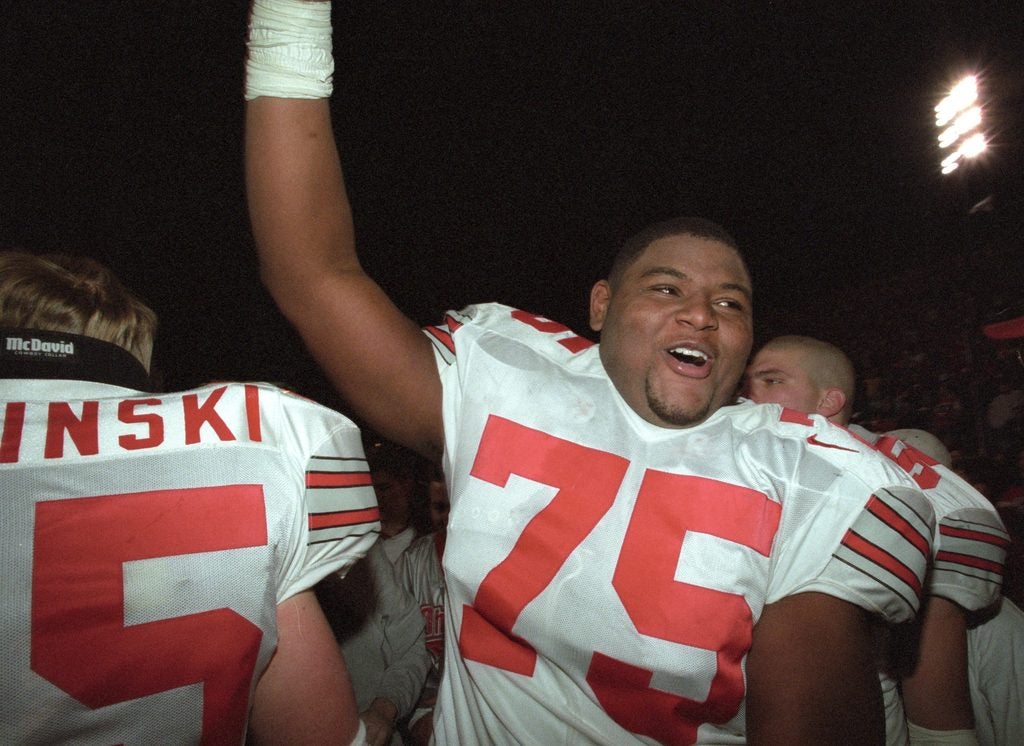
The Heisman Trophy rarely gives anyone outside of a quarterback or running back a real chance to win it. Former Ohio State offensive lineman Orlando Pace came about as close as anyone at his position ever has. He was in the running for the 1996 Heisman Trophy, and you could make the case he was the best player in college football that season despite not taking home the award.
Pace had a dominant career with the Ohio State Buckeyes from 1994 through 1996. At 6-foot-6, 330 pounds, he had a rare combination of strength, athleticism, and technique, along with the ability to move downfield as a run blocker. He was a starter immediately in Columbus and started every game during his three seasons with the program.
He was also the key blocker for former Ohio State running back Eddie George during George’s Heisman Trophy season in 1995. George ran for 1,927 yards and 24 touchdowns that year, and Pace was a major reason why.
Orlando Pace stacked up rare individual awards at Ohio State
Offensive linemen aren’t always highly decorated with individual accolades, but that’s exactly what Pace was. He became the first sophomore ever to win the Lombardi Award in 1995, which recognizes the nation’s top lineman or linebacker. The following season, he became the first player in history to win that award twice.
Pace also won the Outland Trophy in 1996. He was a unanimous All-American for a second straight year and was named the Big Ten Offensive Player of the Year.
The production backed up the hardware. Pace did not allow a single sack during his final two seasons at Ohio State, and he finished the 1996 season with 80 pancakes.
How the 1996 Heisman Trophy voting played out
The 1996 Heisman Trophy went to Florida quarterback Danny Wuerffel. He was a senior playing under Steve Spurrier, and he threw for 3,625 yards, 39 touchdowns, and 13 interceptions that season. Those are strong numbers and the kind that are deserving of a Heisman, especially when you consider how uncommon a high-volume passing offense was in the 1990s.
Wuerffel won the award with 1,363 points and 300 first-place votes. Iowa State running back Troy Davis finished second with 209 first-place votes, and Arizona State quarterback Jake Plummer finished third with 685 points.
Pace finished fourth with 87 first-place votes. For an offensive lineman, that’s unheard of. The position doesn’t get the same attention as others because linemen usually aren’t around the football making the big splash plays that pull fans out of their seats. Still, Pace was often the best player on the field, and his fourth-place finish was great recognition, even if he deserved to finish higher.
He did finish above Florida State running back Warrick Dunn and Tennessee quarterback Peyton Manning. That alone shows the respect Pace earned for the kind of player he was.
Ohio State finished that 1996 season with a share of the Big Ten championship and a trip to the Rose Bowl. The Buckeyes beat Arizona State and Plummer in that game to cap off the year.
Pace’s career only got better in the NFL
Following his time at Ohio State, Pace was the No. 1 overall pick in the 1997 NFL draft when the Rams selected him. He went on to earn seven Pro Bowl selections and five All-Pro honors. Pace was also a Super Bowl champion and is a member of the Pro Football Hall of Fame.
Looking back on it, it wouldn’t have been wrong to give Pace the trophy that season. He checked every box an offensive lineman possibly could, from historic awards to a spotless pass protection record to a fourth-place Heisman finish that no lineman has topped since.
If Pace couldn’t win the Heisman, it’s hard to see an offensive lineman ever winning it. That’s all you can say. – Brandon Little
8. Randy Moss scored 26 touchdowns at Marshall and still finished 4th in the 1997 Heisman race behind a historic winner
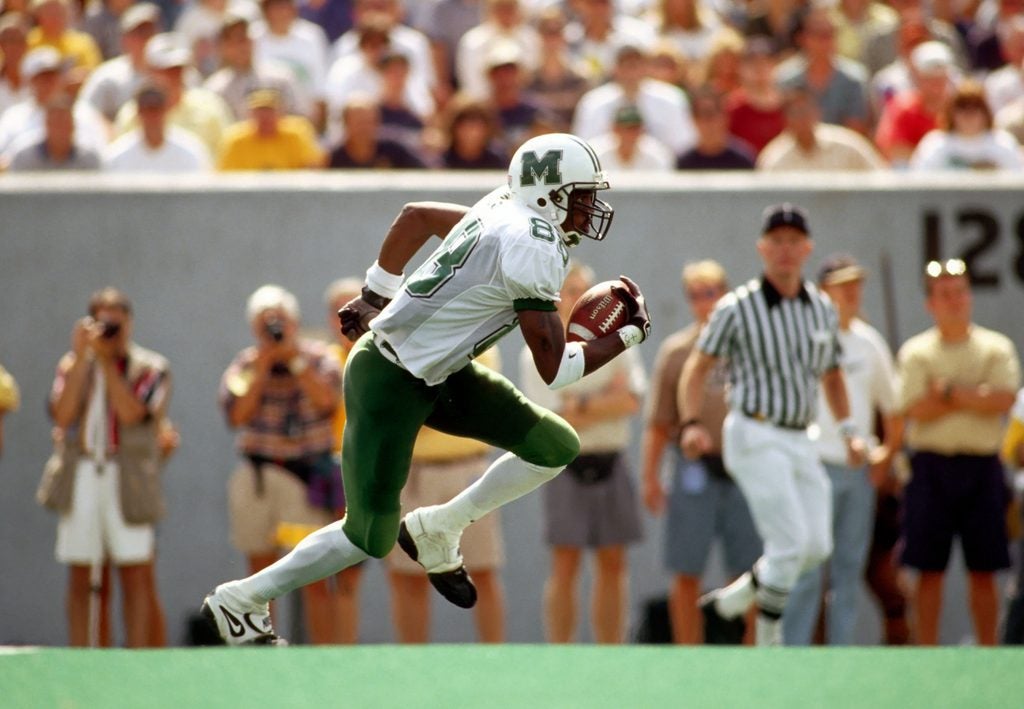
Randy Moss put together one of the greatest seasons a college wide receiver has ever produced in 1997. He caught 96 passes for 1,820 yards and 26 touchdowns for Marshall, set a Division I-A record, and earned unanimous All-American honors.
He finished fourth in the Heisman Trophy race.
Fourth. . . and it wasn’t particularly close.
Moss’s fourth-place finish is a case study in how hard it was for a receiver outside the sport’s spotlight to break through. His competition included a Michigan defensive star, two elite quarterbacks from traditional powers, and decades of Heisman voting habits.
Randy Moss’s 1997 season at Marshall was absurd
This was Marshall’s FIRST season at the Division I-A level. The Thundering Herd had just moved up into the Mid-American Conference, and Moss treated the jump like a formality.
The numbers:
- 96 receptions
- 1,820 receiving yards
- 26 touchdown catches
- 19 yards per catch
- A receiving touchdown in all 13 games
Those 26 scores set the Division I-A single-season record for touchdown receptions. Marshall went 10-3 and won the MAC championship, and Moss was the reason opposing defensive coordinators lost sleep every week.
A touchdown in every game is the stat that sticks out to me. Talented receivers have big games all the time. Moss didn’t take a week off.
Charles Woodson made Heisman history, and the vote wasn’t close
Michigan cornerback and return specialist Charles Woodson took home the trophy. He recorded seven interceptions, locked down receivers in coverage, returned punts, and chipped in on offense. Michigan entered bowl season unbeaten and sat atop the AP poll, which gave Woodson the biggest stage in the country.
Woodson became the first primarily defensive player to win the Heisman. That’s a legitimate piece of history, and it’s hard to argue against his case.
The final tally:
- Woodson: 1,815 points, 433 first-place votes
- Tennessee quarterback Peyton Manning: 1,543 points, 281 first-place votes
- Washington State quarterback Ryan Leaf: 861 points, 70 first-place votes
- Moss: 253 points, 17 first-place votes
Moss finished 1,562 points behind Woodson. He wasn’t the runner-up being robbed at the wire. He was a distant fourth.
Why Moss didn’t break through
The most straightforward explanation is profile. Marshall was in year one of Division I-A, playing a MAC schedule, while Michigan, Tennessee, and Washington State played on bigger stages with far more national eyeballs. Voters simply saw less of Marshall.
The Heisman’s history matters too. The award has long favored quarterbacks and running backs, which put any receiver at a disadvantage before the season even started. Moss wasn’t just fighting Woodson, Manning, and Leaf. He was fighting the ballot’s track record.
Then there’s the road Moss took to Huntington, West Virginia.
He originally signed with Notre Dame, but a high school fight and the criminal case that followed derailed that plan. He enrolled at Florida State instead and redshirted, then a probation violation ended his time with the Seminoles. Only after that did he transfer to Marshall and become the most feared receiver in college football.
That history was publicized, and it may have complicated his image with some voters. But nobody can measure that impact without testimony from the voters themselves. In my opinion, the conference-profile argument is the one the evidence actually supports. The off-field question is fair to raise. It just isn’t proof of why anyone filled out a ballot the way they did.
The NFL proved the talent, not the ballot
The Minnesota Vikings selected Moss with the 21st pick in the 1998 NFL draft. He finished his career with 15,292 receiving yards and 156 receiving touchdowns and entered the Pro Football Hall of Fame in 2018.
Nobody needs convincing about how good Randy Moss was.
Still, a Hall of Fame career doesn’t retroactively rewrite a college award vote. The 1997 Heisman voters were judging one season, and Woodson’s season was historic in its own right.
What Moss’s fourth-place finish really shows is how narrow the path was for a receiver at a newly promoted MAC program. He had the most dominant season on the field and very little help from the stage he played on. Turns out 26 touchdowns weren’t enough to be seen from Ann Arbor. – Austin Stanley
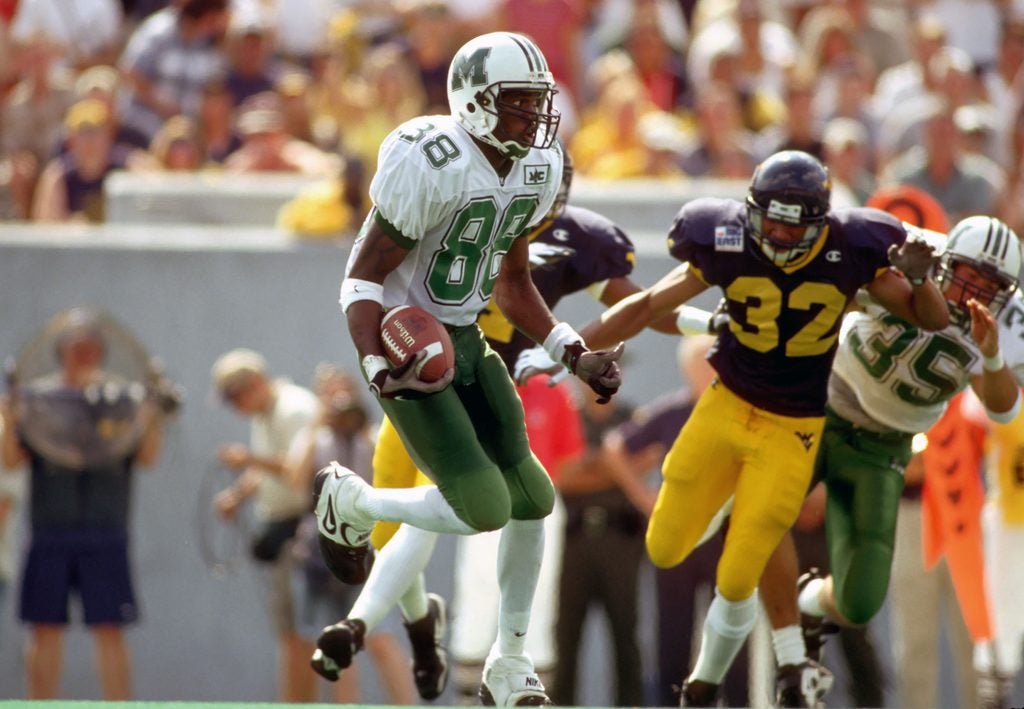
7. The catalyst behind “The Greatest Show on Turf” is one of the biggest Heisman snubs of all-time
Marshall Faulk was already establishing himself as one of the most dangerous players in college football before his sophomore season at San Diego State. His 1991 campaign was outstanding, with 1,429 rushing yards, 21 rushing touchdowns and another 201 receiving yards. He finished ninth in Heisman voting.
He somehow managed to take things to another level in 1992.
Faulk rushed for 1,630 yards on 265 carries, averaging 6.2 yards per attempt. He scored 15 rushing touchdowns and added 18 receptions for 128 yards. His 1,758 yards from scrimmage made him one of the most productive offensive players in the country.
He was named the Western Athletic Conference Offensive Player of the Year and finished second in the Heisman voting.
The problem? Miami quarterback Gino Torretta took home the trophy.
Torretta had a productive season, throwing for 3,060 yards, 19 touchdowns and seven interceptions. Miami finished 11-1 and remained one of the country’s premier programs. There was certainly a legitimate argument for Torretta, particularly given Miami’s national profile.
But Faulk’s production was difficult to overlook
He finished with 550 more rushing yards than Torretta had passing touchdowns-adjusted? More importantly, Faulk’s 1,630 rushing yards alone were an extraordinary accomplishment, particularly considering the offensive responsibility he carried.
The voting wasn’t particularly close, either. Torretta received 1,400 points compared to Faulk’s 1,080.
There is another interesting part of this story: Faulk wasn’t the only running back who had a legitimate argument. Georgia’s Garrison Hearst finished third with 1,547 rushing yards and 19 touchdowns.
Still, Faulk’s combination of rushing production, efficiency and impact made him a worthy Heisman winner. The fact that he finished behind Torretta remains one of the more debated decisions in the award’s history. – Ryan Roberts
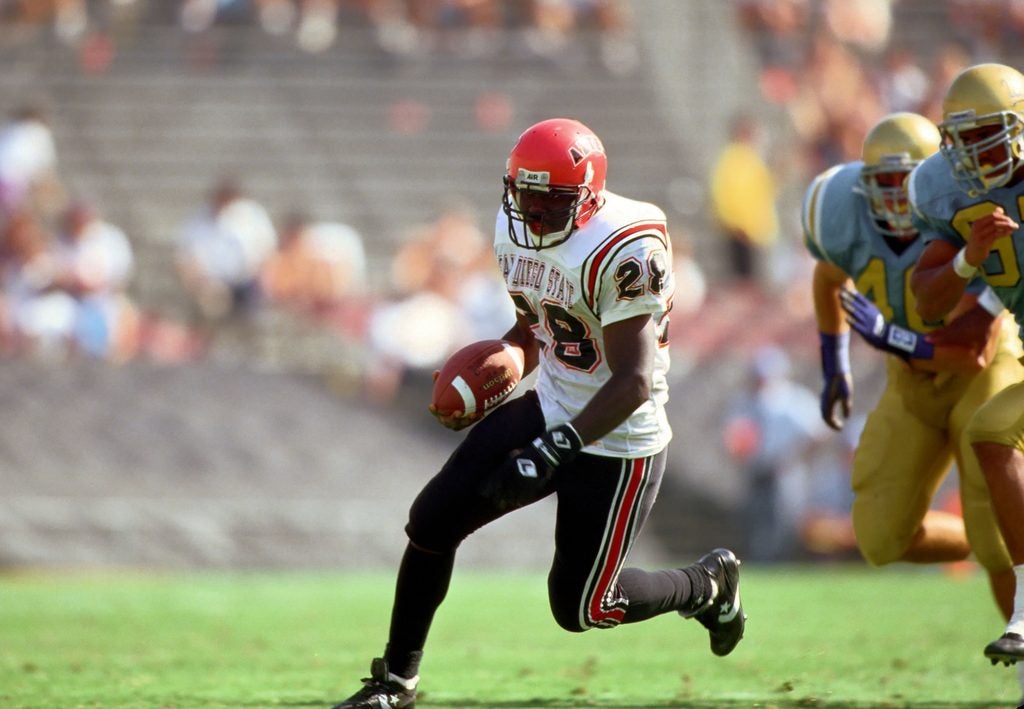
6. Christian McCaffrey’s record-breaking season somehow didn’t result in an Heisman at Stanford
Christian McCaffrey was a do-it-all running back at Stanford in 2015, and his sophomore season still ranks among the best college football has ever seen. McCaffrey came up short in the Heisman Trophy race to Alabama’s Derrick Henry anyway. Nearly a decade later, the 2015 Heisman vote remains one of the more debated finishes in the award’s history.
McCaffrey piled up 3,864 all-purpose yards, an NCAA single-season record. He ran for 2,019 yards, added 645 receiving yards, and chipped in 130 punt return yards and 1,070 kick return yards. That production came from every phase of the game, and that’s what made his candidacy so different from anyone else’s that year.
Christian McCaffrey’s 2015 season in numbers
It’s still pretty wild to think McCaffrey didn’t win the Heisman after setting records across the board. Here’s a good look at his exact production in that final year at Stanford.
- Rushing attempts: 337
- Rushing yards: 2,019
- Rushing touchdowns: 8
- Receptions: 45
- Receiving yards: 645
- Receiving touchdowns: 5
- Punt return average: 8.9
- Punt return TDs: 1
- Kick return average: 28.9
- Kick return TDs: 1
- Total touchdowns: 15
Christian McCaffrey beat teams in multiple ways
McCaffrey’s Heisman case was never just about running the ball. He hurt opposing defenses as a runner, as a receiver, and in the return game. Henry couldn’t say the same.
Henry was a bell cow for Alabama and ran for 1,986 yards and 23 touchdowns. Those are huge numbers, but Henry didn’t impact games in as many ways as McCaffrey did. They were two very different running backs, and voters had to decide which kind of season carried more weight.
The voters chose Henry, who finished first with 1,832 points, while McCaffrey finished second with 1,539 points. Former Clemson quarterback Deshaun Watson finished third. It was the closest Heisman race since the 2011 season.
McCaffrey’s best performance came against USC. He put up 461 all-purpose yards in that game, with 207 on the ground, another 105 through the air, and 149 on kickoff and punt returns. That one night captured his entire season. He was a player who could beat teams in a multitude of ways, and USC had no answer for any of them.
Why Derrick Henry won the Heisman over McCaffrey
The reasons McCaffrey got snubbed are pretty simple, and they come down to two things.
The first is the program behind each player. Henry played for Nick Saban at Alabama, a national powerhouse, and the Crimson Tide had more team success than Stanford did. Heisman voters have long leaned toward players on winning teams in the national spotlight, and Alabama was squarely in that spotlight.
The second is strength of schedule. Henry faced tougher competition week in and week out, while McCaffrey was playing a Pac-12 slate at Stanford. That gap in opponents gave Henry an edge in how voters viewed his production.
Henry also delivered more memorable moments on the national stage. Even so, the overall body of work belonged to McCaffrey. His record-setting all-purpose total is the kind of number that doesn’t come around often, and it’s a big reason his second-place finish still gets brought up today.
Both running backs became NFL stars
Neither player let the Heisman result define his career. McCaffrey and Henry both went on to become early-round NFL draft picks, and both have built resumes that should land them in the Pro Football Hall of Fame one day.
They’re still starting running backs, too. McCaffrey is the lead back for the San Francisco 49ers, while Henry carries the load for the Baltimore Ravens. Very few players from any Heisman class have stuck around at a high level for this long, let alone the top two finishers.
That longevity only adds to how memorable the 2015 race was. Henry has the trophy, while McCaffrey has a record that still stands as one of the most complete seasons in college football history. Whether the voters got it right remains a question fans will keep debating for years to come. – Brandon Little
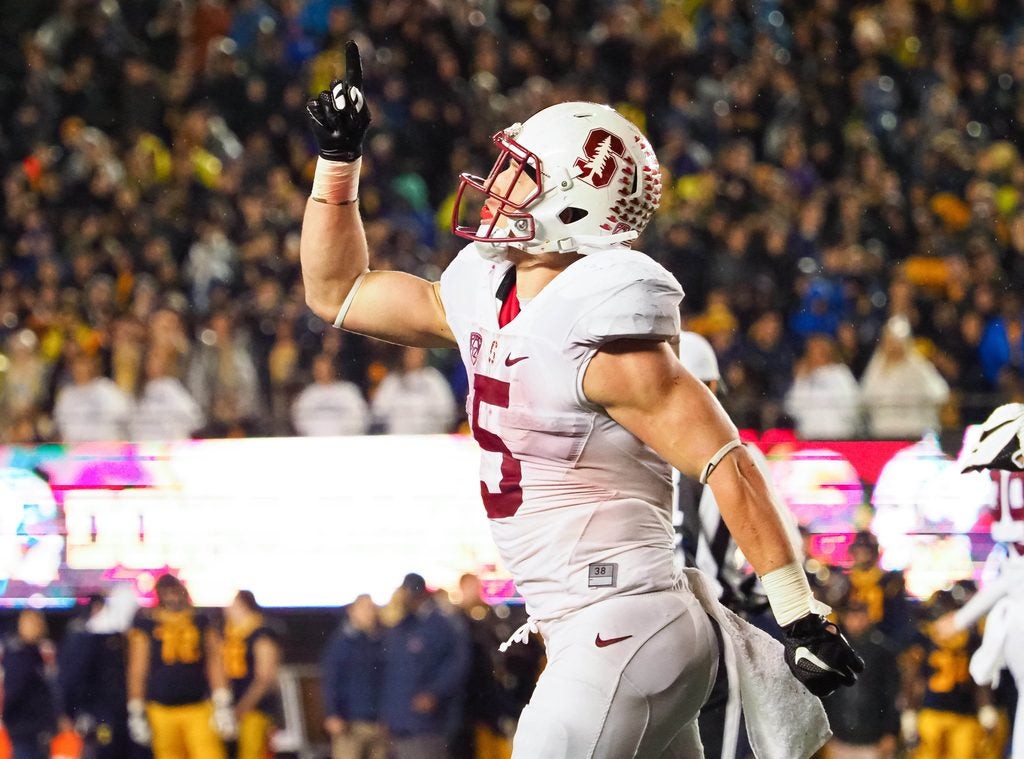
5. Adrian Peterson may have lost the 2004 Heisman Trophy to USC’s Matt Leinart because of one of his own Oklahoma teammates
Adrian Peterson immediately established himself as one of the best players in the history of college football as a true freshman with the Oklahoma Sooners in 2004, but it still wasn’t enough to win the Heisman Trophy.
Peterson finished second in the 2004 Heisman Trophy voting, the highest finish by a true freshman in the award’s history at the time. Despite an extraordinary season, he couldn’t beat out USC Trojans quarterback Matt Leinart, who took home the trophy.
Adrian Peterson’s record-setting freshman season at Oklahoma
Peterson ran for 1,925 yards and 15 touchdowns that season. He averaged nearly six yards per carry and led the nation with 339 rushing attempts, which is insane for a kid who was playing high school football the year before.
He didn’t pile up those numbers against weak competition either. He faced five ranked opponents and posted nine consecutive 100-yard rushing performances, setting an NCAA freshman record.
His best game came against Oklahoma State, when he ran for 249 yards in a 38-35 win.
Peterson helped Oklahoma finish the regular season undefeated, win the Big 12 Championship, and earn a spot in the BCS National Championship Game (the Sooners lost that game to USC).
Leinart had a terrific season of his own. He threw for 3,322 yards and 33 touchdown passes with just six interceptions. He completed 65% of his passes and led the Trojans to an undefeated regular season and, eventually, a national championship.
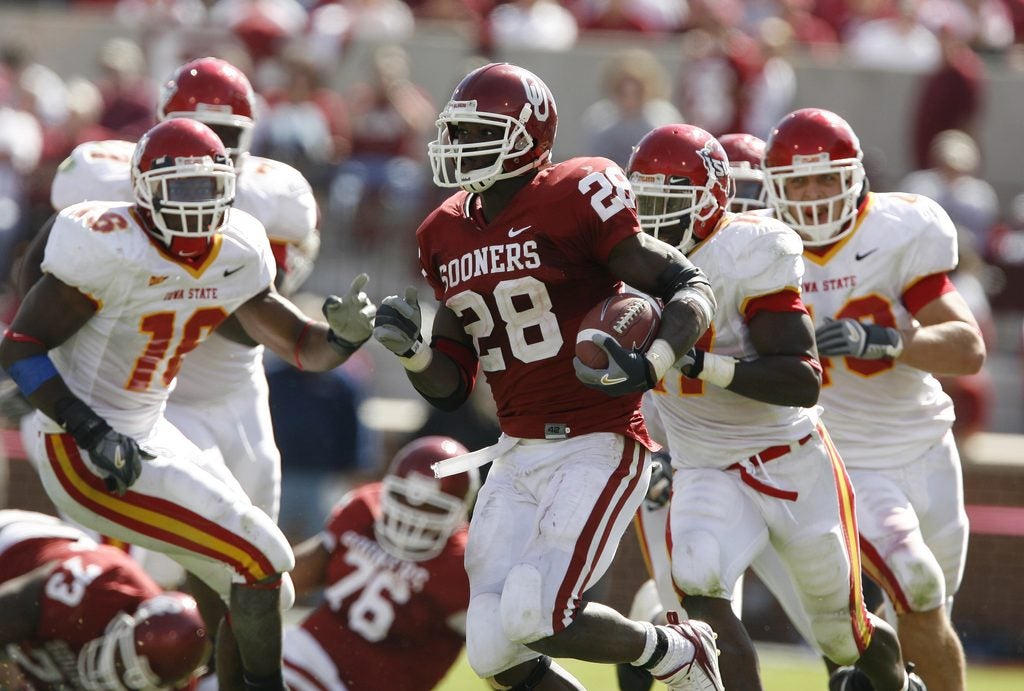
Jason White split the Heisman vote with Peterson
Part of the reason Peterson didn’t win the award is because he wasn’t the only Oklahoma player in the race.
Sooners quarterback Jason White, who won the 2003 Heisman Trophy, finished third in the voting.
Leinart received 267 first-place votes. Peterson finished second with 154 first-place votes, while White actually received more first-place votes than Peterson with 171 (White still finished just behind Peterson in the final tally).
If those two Oklahoma stars hadn’t split the vote, maybe Peterson is able to edge out Leinart.
Instead, Peterson became the first true freshman to finish second in the Heisman voting.
Leinart was certainly deserving of the award. But Peterson doing what he did as a freshman made it feel like he had a real chance to make history.
Either way, Peterson’s career turned out just fine. He went on to become the 7th overall pick in the 2007 NFL Draft and won the NFL MVP award in 2012.
Leinart, meanwhile, didn’t find much success at the next level. – Zach Ragan
4. Larry Fitzgerald lost the 2003 Heisman to Jason White by 76 points, and the Big 12 title game makes that harder to defend
Pittsburgh wide receiver Larry Fitzgerald put together one of the greatest seasons in college football history in 2003, and he still finished second in the Heisman Trophy race. Oklahoma quarterback Jason White won the 2003 Heisman by 76 points.
Seventy-six. That’s it.
Heisman snubs pile up quickly once you start digging through the voting history. Most of them come down to a feeling or a narrative. Fitzgerald’s case is different because it’s grounded in the actual margin, and that margin was razor thin for an award that usually isn’t close.
Larry Fitzgerald’s 2003 season at Pitt was absurd
Fitzgerald caught 92 passes for 1,672 yards and 22 touchdowns. He averaged 18.2 yards per catch and 128.6 receiving yards per game, which is the kind of production you’d expect from a video game created player, not a sophomore.
The hardware followed. He won the Biletnikoff Award and the Walter Camp Player of the Year Award, and he earned unanimous All-American honors.
He also set an NCAA record by catching a touchdown pass in 18 consecutive games across his college career. Eighteen straight games. Defenses knew exactly who was getting the ball in the end zone, and they still couldn’t stop it.
Jason White’s Heisman case, and the Kansas State problem
Enter Jason White.
White threw for 3,744 yards, 40 touchdowns, and eight interceptions before the bowl game. (Fitzgerald’s line above is his final-season total, so keep that in mind when comparing the two.) Those are big numbers, and the story behind them was even bigger. White had returned from serious ACL injuries in both 2001 and 2002, and Oklahoma’s undefeated regular season and No. 1 ranking gave that comeback a national stage.
Then Dec. 6 happened.
Kansas State stunned previously undefeated Oklahoma 35-7 in the Big 12 Championship Game. White threw two interceptions. The presumed Heisman favorite had his worst moment at the worst possible time, right before ballots mattered most.
He won the Heisman a week later anyway.
That’s the heart of Fitzgerald’s argument. The front-runner stumbled HARD in his final performance before the vote, and he still held on in a close race. If there was ever a year for the runner-up to steal it, this was it.
The vote was closer than its reputation
Here’s how the top of the ballot shook out:
- Jason White, Oklahoma: 1,628 points, 369 first-place votes
- Larry Fitzgerald, Pittsburgh: 1,552 points, 286 first-place votes
- Eli Manning, Ole Miss: 616 points, 69 first-place votes
- Chris Perry, Michigan: 566 points, 47 first-place votes
The gap between first and second was 76 points. The gap between second and third was 936.
Fitzgerald also won three of the six voting regions: the Northeast, the Midwest, and the Mid-Atlantic. Half of the country’s voting regions saw him as the best player in college football. That doesn’t happen to a guy who was never really in the race.
So why didn’t he win?
White’s 40 touchdown passes, his comeback story, and his association with an unbeaten regular-season powerhouse were a compelling package. The Heisman has also historically favored quarterbacks and running backs, and a wide receiver had to be overwhelming to break through that bias.
Then there’s the age question. Fitzgerald was a sophomore at a time when no sophomore had ever won the trophy. Whether that directly swayed specific ballots is impossible to say for certain, but it was the backdrop of the race.
Team success played a role too. Pittsburgh finished 8-5, including its bowl game, while Oklahoma entered the postseason with a much stronger record. Voters love a winner, even one who just lost by four touchdowns in his conference title game.
Larry Fitzgerald’s career answered the question anyway
The Arizona Cardinals made Fitzgerald the 3rd pick in the 2004 NFL Draft, and he spent his entire NFL career in the desert. He finished with 1,432 catches, 17,492 yards, and 121 receiving touchdowns.
He was inducted into the College Football Hall of Fame in 2024.
A historic receiving season, three of six voting regions, and an ugly late loss by the eventual winner still weren’t enough in December 2003. Two decades later, the guy who finished second turned out just fine. . . and he still has the best case of anyone to wonder what might have been. – Austin Stanley
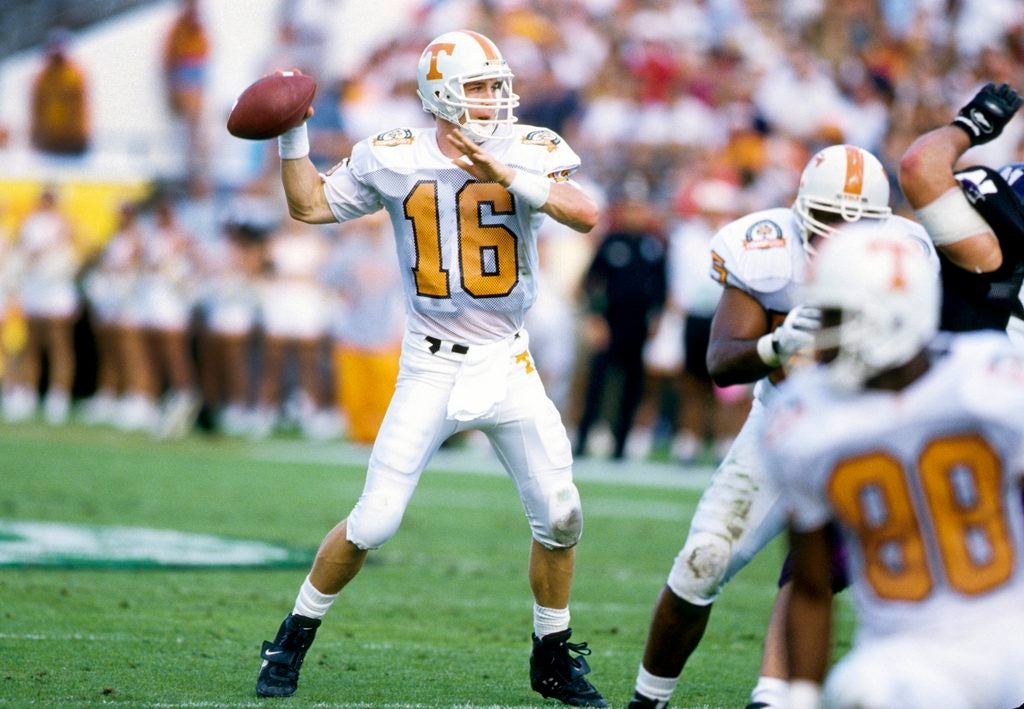
3. Peyton Manning’s 1997 Heisman Trophy loss to Charles Woodson remains the snub Tennessee Vols fans will never get over
Ask any Tennessee Vols fan about the biggest Heisman Trophy snub in college football history and you’ll get the same answer every time: Peyton Manning losing to Michigan’s Charles Woodson in 1997.
Manning had an incredible senior season in Knoxville. He led the Vols to an SEC championship, put up huge passing numbers, and entered Heisman voting as the favorite to win the award.
Instead, he finished second behind Woodson. The Michigan Wolverines star made history as the first primarily defensive player to win the Heisman.
Peyton Manning’s 1997 season at Tennessee
Manning threw for 3,819 yards and 36 touchdown passes in his final season on Rocky Top. He also led Tennessee to an 11-2 record.
His biggest moment came in the SEC Championship Game when he threw for 373 yards and four touchdown passes in a 30-29 win over Auburn.
Manning also passed for 523 yards and five touchdowns in a November win against Kentucky.
Additionally, Manning won the Maxwell Award, the Davey O’Brien Award, and the Johnny Unitas Golden Arm Award. He was also named SEC Player of the Year and collected numerous national player of the year honors.
Charles Woodson’s historic season at Michigan
To be fair to Woodson, he had a season unlike anything college football had seen in a long time.
He recorded seven interceptions and 43 tackles as a cornerback. Michigan also used him on offense where he caught 11 passes for 231 yards and two touchdowns.
In Michigan’s win over Ohio State in the regular season finale, Woodson returned a punt 78 yards for a touchdown and intercepted a pass in the end zone against the Buckeyes.
The Heisman vote wasn’t as close as many expected
Despite Manning entering as the favorite, the final voting wasn’t particularly close. Woodson received 433 first-place votes, while Manning received 281.
It’s no question that Woodson’s versatility made him a compelling candidate. Voters had rarely seen a player impact the game in so many ways, and his highlight plays against Ohio State came at the perfect time (right before voting).
But I think Manning had the stronger overall case. He was the quarterback of an SEC championship team, he posted an elite statistical season, and he swept several of the sport’s other major individual awards. Winning the Maxwell, the Davey O’Brien, and the Johnny Unitas Golden Arm Award, then losing the Heisman by that kind of margin, is hard to explain.
Manning, of course, went on to have a Hall of Fame career in the NFL, but that hasn’t erased what happened in 1997 for the Vols’ fan base.
Tennessee still has never had a Heisman Trophy winner. And for a lot of Vols fans, Manning will always be the one that got away. – Zach Ragan
2. Vince Young lost the 2005 Heisman to Reggie Bush by 933 points, then delivered the rebuttal voters never got to see
Texas quarterback Vince Young lost the 2005 Heisman Trophy to USC running back Reggie Bush, and it wasn’t close. Then Young went out and beat Bush, Matt Leinart, and the USC dynasty for the national championship in the Rose Bowl.
That sequence has fueled one of college football’s longest-running arguments: did the Heisman voters get it wrong?
I think the question is built on a faulty premise. The voters didn’t ignore Young’s best game. They couldn’t have seen it, because it hadn’t happened yet.
What the Heisman voters had in front of them in December
The ballot comes down to what each player did before the bowl games.
Young’s season looked like this before the Rose Bowl:
- 2,769 passing yards
- 850 rushing yards
- Nine rushing touchdowns
- 3,619 total yards of offense
- A 12-0 regular season for Texas
- A 70-3 demolition of Colorado in the Big 12 title game
He also won the Maxwell Award. That’s a Heisman-caliber resume in almost any other year.
Bush had a different kind of year. He rushed for 1,740 yards and 16 touchdowns while averaging 8.7 yards per carry (an absurd number for a full season). His 513 all-purpose yards against Fresno State became the signature moment of the season, and it played on every highlight show in the country.
Bush also had the backdrop. USC brought a 34-game winning streak into the postseason and was chasing a third consecutive national title. A dynasty story, a highlight-reel runner, and a number that looks like a typo (8.7 per carry)… that’s a hard combination to vote against.
The voters didn’t vote against it.
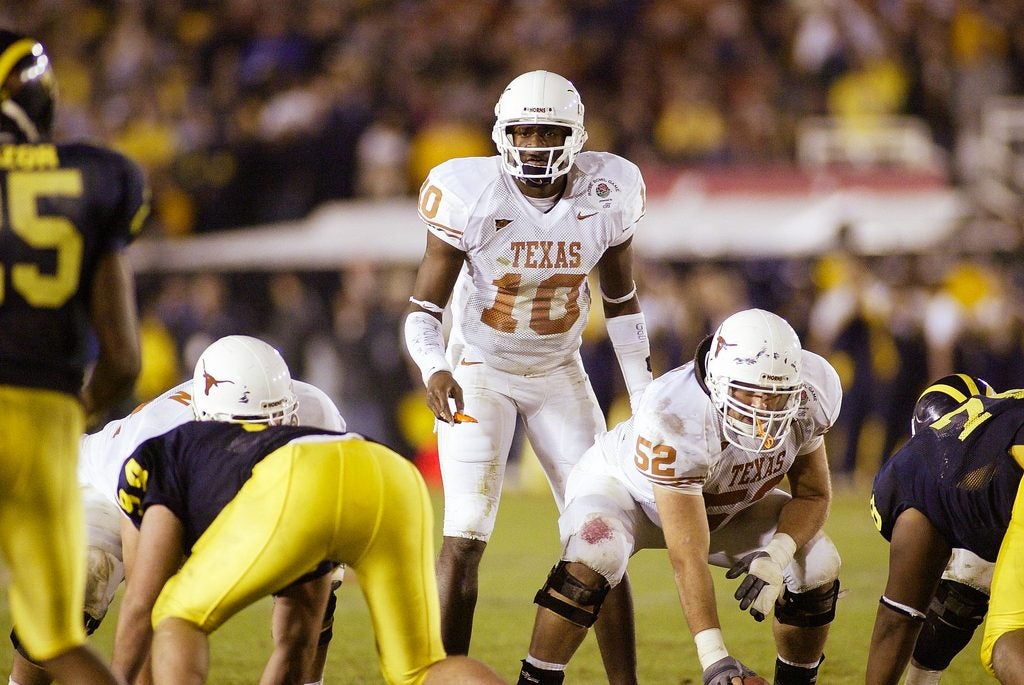
The 2005 Heisman vote was a landslide
Here’s the final tally:
- Reggie Bush: 2,541 points, 784 first-place votes
- Vince Young: 1,608 points, 79 first-place votes
- Matt Leinart: 797 points, 18 first-place votes
Bush won by 933 points. Young finished with roughly a tenth of Bush’s first-place votes. Whatever revisionist history pops up every January, the December electorate made its choice loudly and clearly.
So when someone claims the Heisman voters “robbed” Young, they’re asking those voters to account for a game that was still weeks away.
Vince Young’s Rose Bowl turned the runner-up into the season’s lasting story
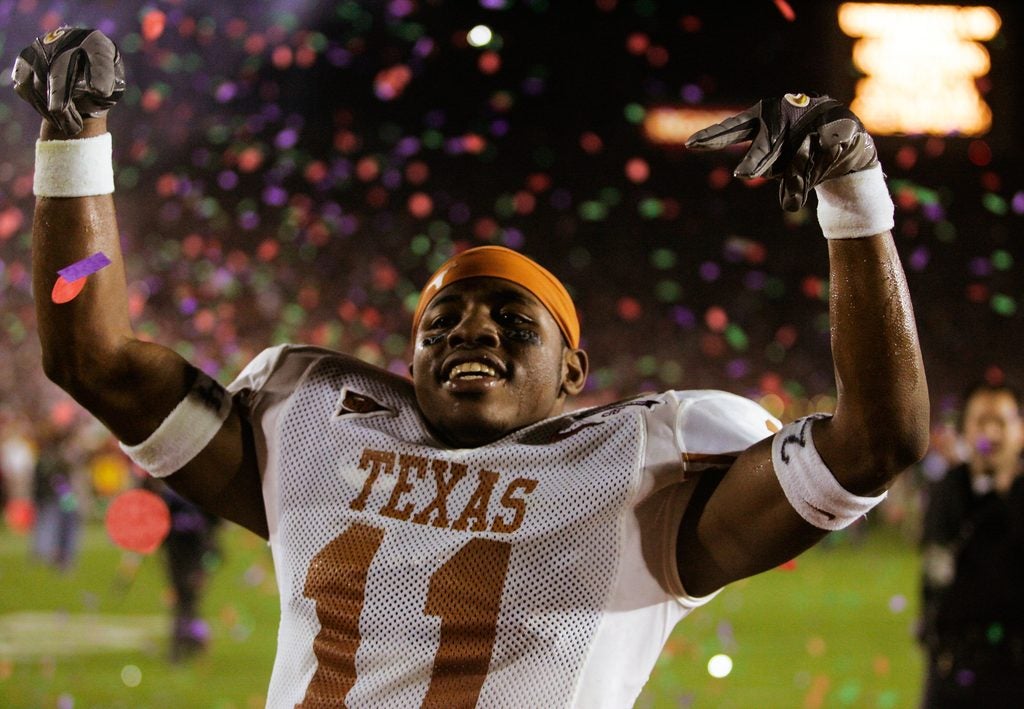
On Jan. 4, 2006, Young produced one of the greatest individual performances in college football history.
He threw for 267 yards, rushed for 200, and scored three rushing touchdowns. With 19 seconds remaining, on fourth-and-5, Young ran 8 yards to give Texas a 41-38 win over USC and end the Trojans’ title run.
That’s 467 total yards on the biggest stage the sport has, against the team everyone assumed would win.
Add the Rose Bowl back in, and Young’s full-season line reads 3,036 passing yards, 26 passing touchdowns, 10 interceptions, 1,050 rushing yards, and 12 rushing touchdowns. He completed 65.2 percent of his passes and finished with 4,086 total yards and 38 total touchdowns.
That’s why the argument never dies. The runner-up authored the season’s defining moment, and he did it against the winner, head to head.
The Bush controversy didn’t change Young’s place in history
The story took another turn years later. Bush surrendered the award in 2010 amid NCAA sanctions related to impermissible benefits. For more than a decade, the 2005 Heisman sat without a recognized winner.
Young was never retroactively named the winner. Then, in April 2024, the Heisman Trophy Trust reinstated Bush’s 2005 award.
So the record books land right back where the voters left them in December 2005.
Both things are true. Reggie Bush was the overwhelming choice based on the evidence available when the ballots were due. Vince Young delivered a rebuttal in January that no ballot could ever reflect.
The Heisman goes to the best player in the regular season. The national championship goes to whoever is still standing in January. In 2005, those were two different guys, and only one of them got to hold the crystal football. – Austin Stanley
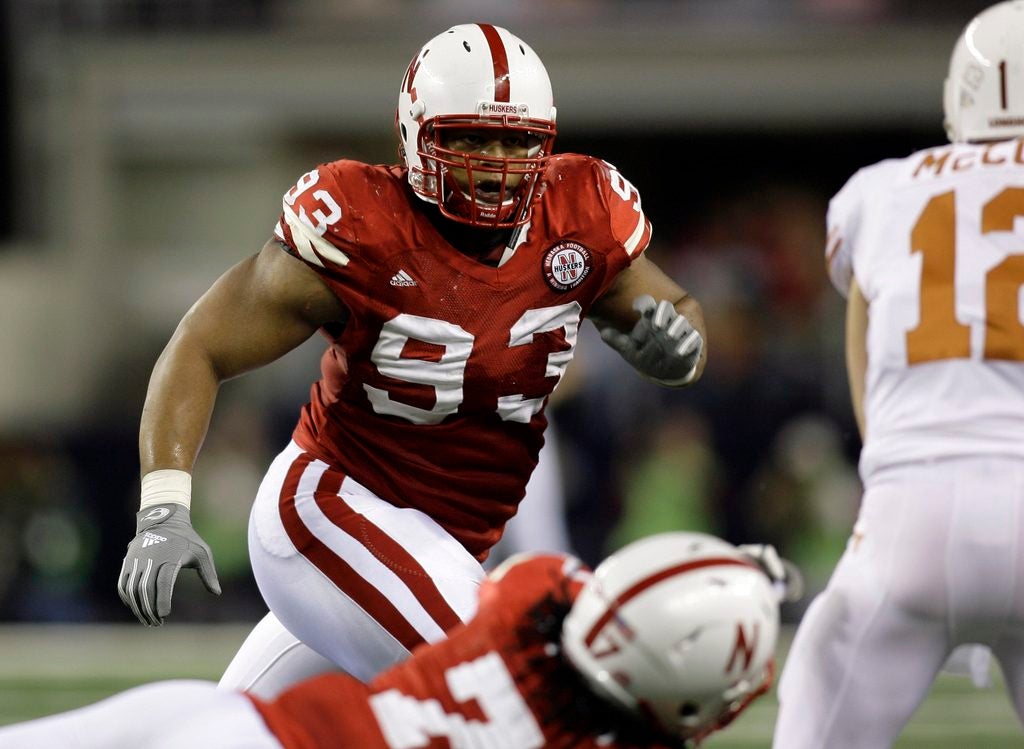
1. Heisman voters flat out disrespected Ndamukong Suh back in 2009
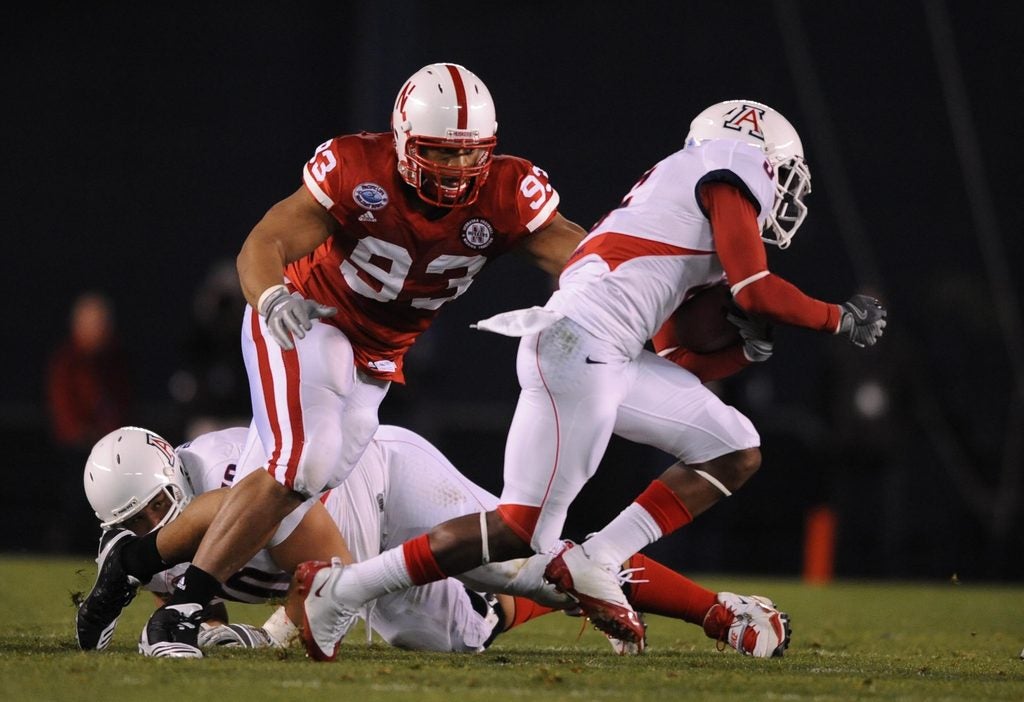
Ndamukong Suh might be the biggest Heisman Trophy snub in college football history when it comes to a defensive player who deserved to win it. Suh was a defensive tackle at Nebraska in 2009, and he put together one of the most dominant seasons college football has ever seen.
The former 300-pound Cornhusker was a nightmare for opposing offensive lines. Suh finished his senior season with 85 tackles, 12 sacks, 20.5 tackles for loss, and an interception. Those would be ridiculous numbers for any defensive lineman. For an interior defensive lineman who often faced double teams and triple teams, they were on another level.
Suh was the centerpiece of a good Nebraska defense, and the awards piled up. He won the Outland Trophy, the Lombardi Award, the Chuck Bednarik Award, and the Bronko Nagurski Trophy. Suh was also a unanimous All-American and became the first defensive player since 1998 to win the AP College Football Player of the Year award.
Suh didn’t even finish in the top 3 of the 2009 Heisman vote
Somehow, despite all of that, Suh didn’t win the Heisman Trophy. The award went to Alabama running back Mark Ingram, and Suh didn’t even crack the top three.
Ingram was a sophomore running back for coach Nick Saban’s Alabama team, which went undefeated and won the national championship. He ran for 1,542 yards and 15 touchdowns while adding 322 receiving yards. There’s no doubt Ingram was one of the most productive running backs in the country, and he played a big role in Alabama’s success that season.
The 2009 Heisman race ended up being one of the closest ever. Ingram finished with 1,304 points and just edged Stanford running back Toby Gerhart, who had 1,276 points. Texas quarterback Colt McCoy finished third with 1,145 points. Suh came in fourth with 815 points.
Positional bias kept Suh from winning the Heisman
The biggest reason Suh didn’t win the Heisman comes down to positional bias. Quarterbacks and running backs have traditionally dominated Heisman voting because their production is much easier to measure across the field of candidates. Simply put, the eyes are on those players the most because the ball is in their hands.
It’s also hard for many voters to measure just how good defensive numbers are when they’re put up in bunches. That played a role in how Suh’s season was viewed, and it undersold just how special he was. Suh was putting up numbers that were unheard of at the time.
His game against Texas in December 2009 should have caught everyone’s eye. Nebraska faced McCoy and the Longhorns, and Suh took over. He finished with 12 tackles, six tackles for loss, and 4.5 sacks against one of the top Heisman candidates in the country. If that isn’t a Heisman-winning kind of game for a defender, it’s hard to say what is.
Nebraska lost that game, but the Cornhuskers still held Texas to just 13 points on the back of Suh’s performance.
Suh’s NFL career backed up his college dominance
Suh went on to become the 2nd overall pick in the 2010 NFL draft. From there, he put together a great NFL career with five Pro Bowl selections, three first-team All-Pro honors, and a Super Bowl championship with the Tampa Bay Buccaneers.
When you compare his career to the other Heisman finalists he was up against that year, Suh had the best football career of them all. The trophy went elsewhere in 2009, but time has made the case for Suh as the most deserving defender to never take home the Heisman. – Brandon Little